
In Re-Aligning Vision: Alternative Currents in South American Drawing, curators Mari Carmen Ramírez and Edith Gibson propose a convincing revision of the varied approaches to drawing taken by artists working in Argentina, Chile, Brazil, Colombia, Venezuela, and New York since 1960 while formulating an alternative to the survey exhibition model. The exhibition offers a new perspective on the proliferation of this medium in the region during the 1960s and 1970s known as the Boom, first introduced to US audiences by the survey Lines of Vision curated by Bárbara Duncan at the Archer M. Huntington Art Gallery in 1976. The curators argue that artists working in South America "turned to draw to communicate new meanings derived from the specificity of their social and cultural circumstances"1 while investigating formal and technical issues which engaged with international modernism.
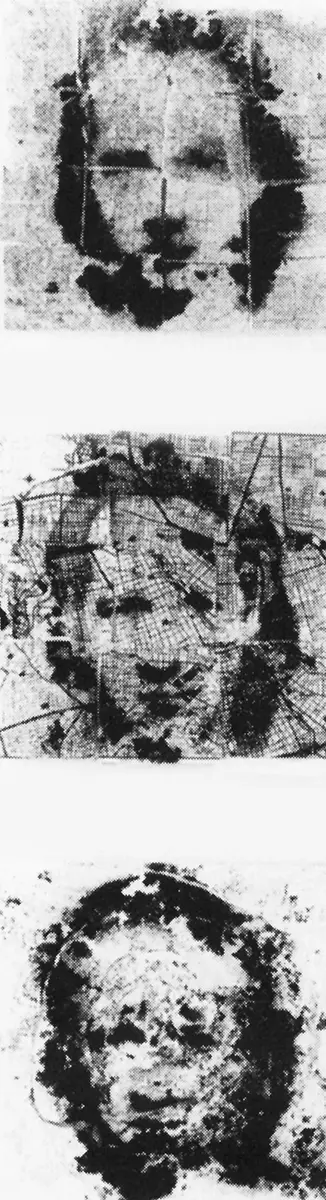
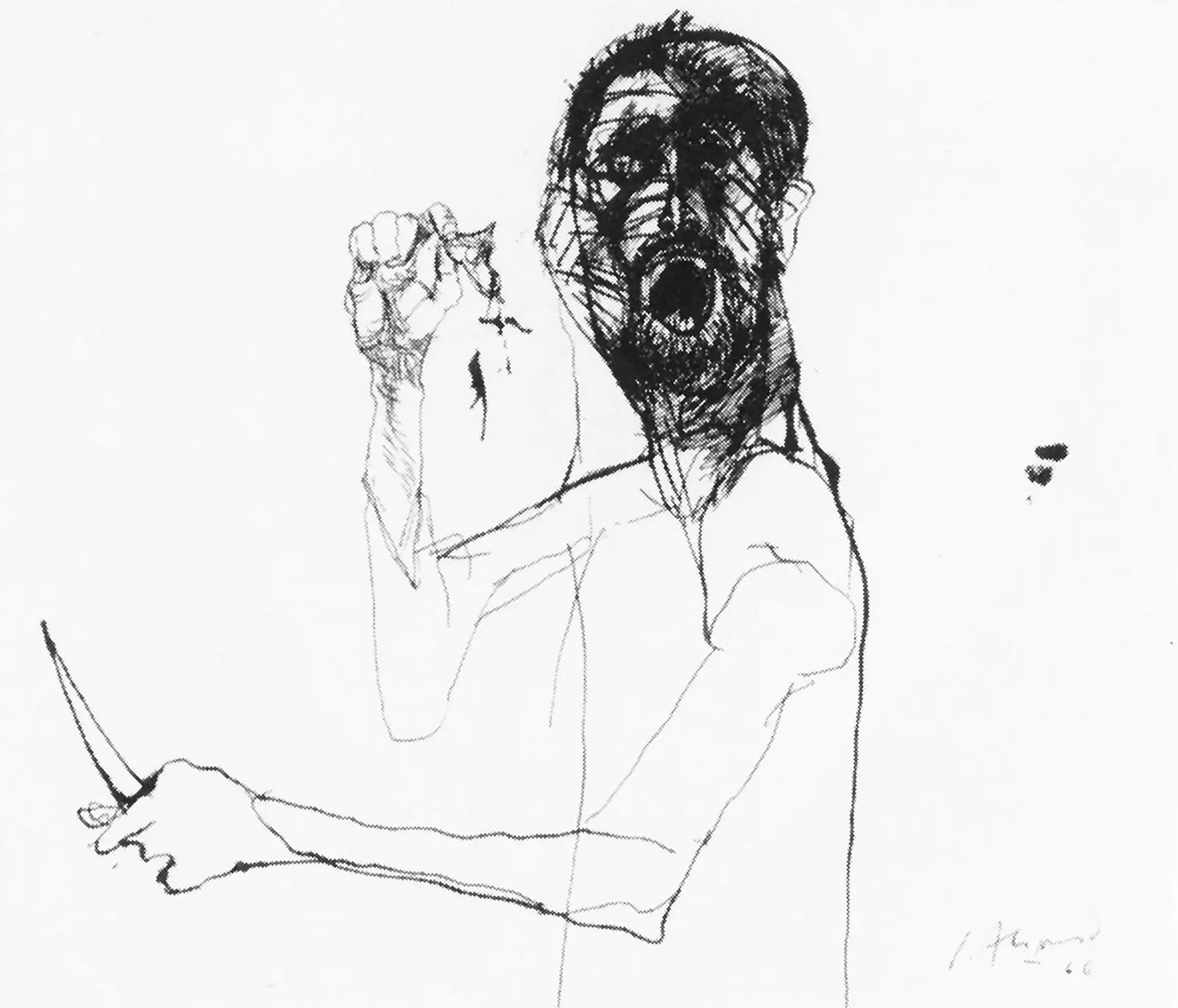
Ramírez and Gibson have organized the exhibition, which includes 141 works by 46 artists (with slight variations by venue) around six terms that emerge from the new interpretations of drawing formulated by artists during this period: convention, mediation, gesture, trace, projection, and withdrawal. These terms refer to the diverse ways artists investigated formal, technical, conceptual, and functional qualities associated with withdrawing. Convention alludes to artists’ referencing of Western traditions of draftsmanship while suggesting that visual representations, like language, are not natural but rather are governed by a series of constructed rules. Carlos Alonso’s Butcher II (1972), in which severed human limbs dangle from meat hooks, calls to mind both the work of Rembrandt and acts of torture carried out under Argentina’s military dictatorships.2 Liliana Porter’s The Correction V (1991), an assemblage on canvas depicting the outlines of a vase and its geometric components, includes a piece of red chalk resting on a shelf, thus blurring the boundaries between drawing and sculpture, and calling attention to drawing as a system of signification. Mediation comprises diverse approaches to drawing which investigates mass media imagery and related questions of authenticity versus mechanical reproduction. Narcissus (1994; 1997-1998), a series of self-portraits by Óscar Muñoz, bridges categories of drawing, photography, sculpture, and installation, using non-traditional materials and processes incorporating chance. In the earlier of the two series, traces of a face are superimposed over a series of images, suggesting the functions of drawing in constructing and reinforcing systems of knowledge and power: aerial reconnaissance photos, topographical maps, street plans, and historical texts. At the same time, Muñoz's use of mechanical processes to render his own visage calls into question notions of authorship and authenticity (ie. the "signature style") associated with drawing.3
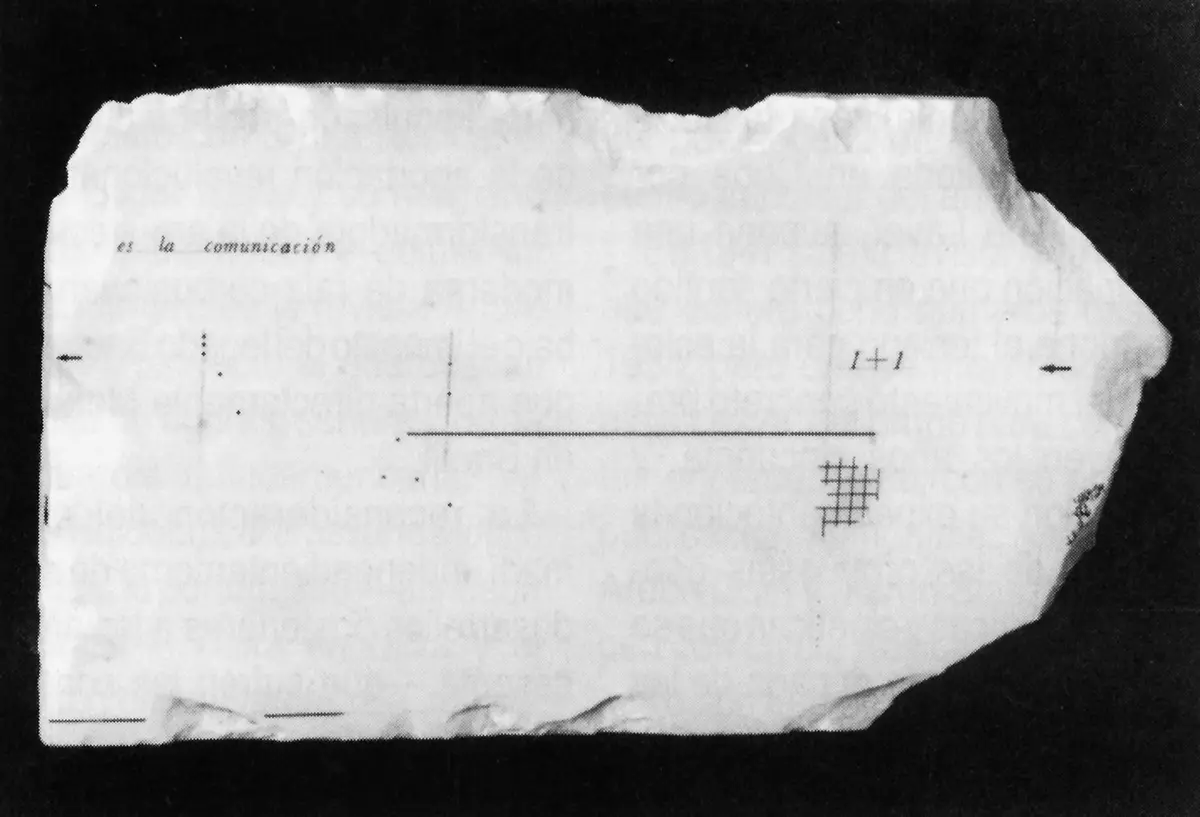
Trace refers to indexical qualities of images, to the act of drawing itself, and to "affinities between writing and drawing"4 These affinities are the subject of an untitled work on marble by Marie Orensanz (n.d.) in which fragments of various signifying systems coexist: language, geometry, topography, and mathematics, alongside lines whose function is to order meaning: a line, a graph, and an arrow. The term gesture is used to allude both to non-verbal communication and to the commonly-held view that line is a direct and unique register of an artist's internal state. Carmela Gross simultaneously interrogates definitions of authenticity and traditional draftsmanship in the two series, Linhas and Rabiscos (1978). A series of lines on sheets of paper initially recall emotive qualities associated with gestural abstraction and the role played by chance and spontaneity in the drawing. However, these seemingly random, unique lines are in fact identical designs created with rubber stamps.
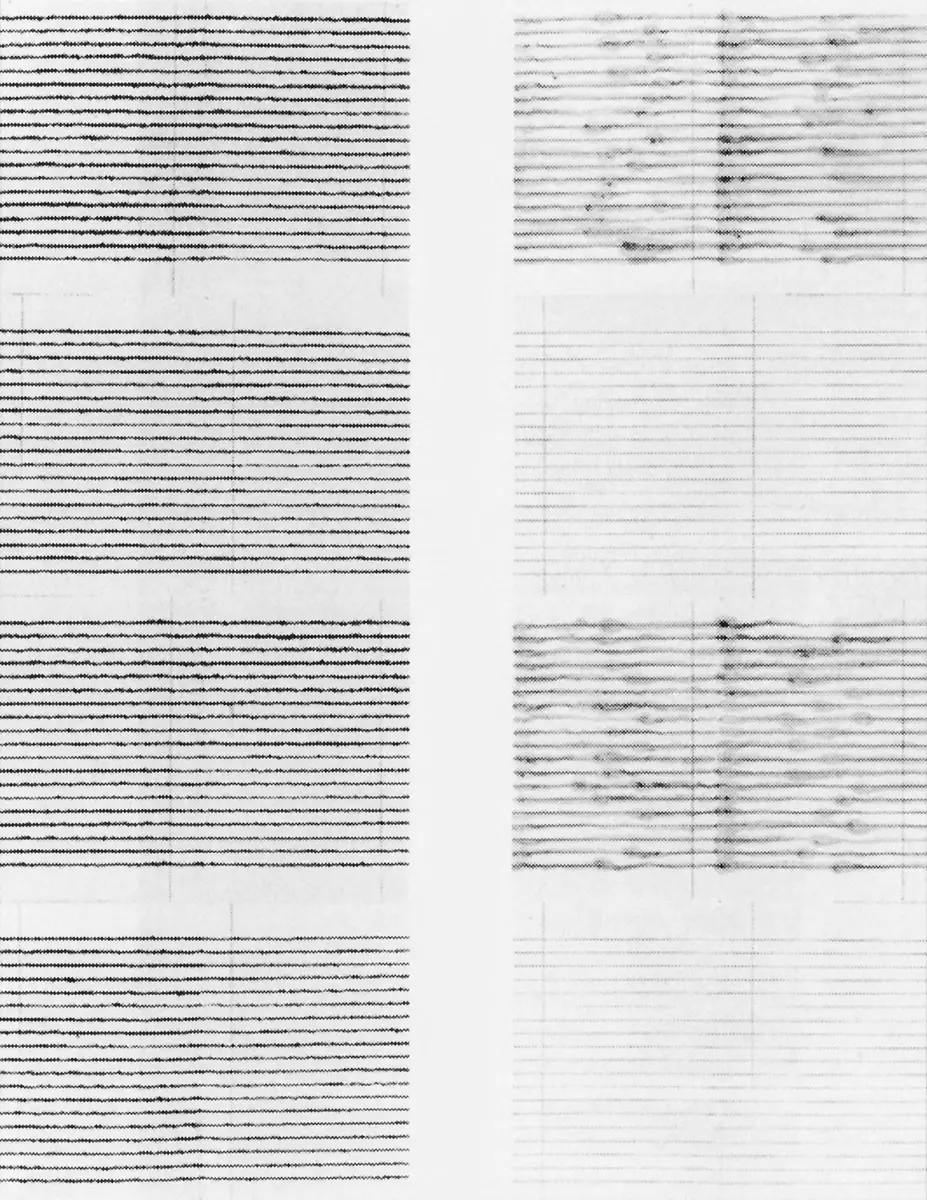
Projection is defined as a term related to conceptual issues, the materialization of abstract ideas, and the representation of lines in space. Ivens Machado is one of several artists in the exhibition who uses non-traditional materials and supports linked to industry to critique notions of progress and institutional attempts to enforce "ideological conformity."5 In a series of untitled works (1978) and Rolo (1974), Machado altered the process of industrial production at a paper factory, thus creating flawed leaves of lined notebook paper. Displayed singly or in the form of a roll, their intended function is undermined in both cases. Through this conceptual project, the artist re-defined drawing while attempting to destroy an entire order related to the military dictatorship in his native Brazil.6
The works grouped under the rubric withdrawal explore spatial qualities, particularly the extension of the line beyond the flat support called for by traditional definitions of drawing. Gego’s (Gertrude Goldschmidt) Meccano (1985) is a non-functional object fabricated from industrial materials. Its components are suspended in space and form lines whose shadows fall on a white surface behind the object. The artist goes beyond traditional drawing materials and supports, using space and the play of voids and surfaces to create lines. At the same time, Gibson points out that this use of "urban/industrial debris" calls into question utopian views of industrial development formulated by governments in the region and evident in the work of kinetic artists.7
In organizing the exhibition around what Ramírez calls a "constellation" of terms, the curators avoid the limitations of survey exhibitions organized by strict national, chronological, or formal categories. The varied connotations of these intertwined categories parallel the linked conceptual, formal, and technical questions posed by the artists included in the exhibition. Text panels, regarding the conditions surrounding the development of the Boom, the characteristics of the Argentinean group Otra Figuración, and the artistic development, historic and political situations in individual artists' respective countries, avert the tendency towards homogenization evident in group exhibitions that assemble artists from disparate nations under thematic categories.
The accompanying catalog is sure to become an important reference for scholars of contemporary art. Ramírez's essay "Un-Drawing Boundaries: A Curatorial Proposal" offers an insightful analysis of the limitations of the survey format while introducing the innovative framework for this exhibition. She compares the aims of European and North American modernists to the generation associated with the Boom and demonstrates that the work in the exhibition goes beyond pure aesthetics while not renouncing its artful positioning in the world.8 This essay is followed by an interview with the collector and art historian Barbara Duncan, curator of Lines of Vision, which offers her perspective on that project twenty years after the fact. Other essays included in the catalog are: Beverly Adams’ discussion of the curatorial model behind Duncan's Lines of Vision and contemporary critical reception of drawing in South America and Paulo Herkenhoff’s examination of artists’ varied responses to "contextual factors that shaped their production."9 Individual entries on participating artists, general and individual bibliographies, and a section reprinting contemporary writings on drawing by critics, curators, and artists, complete the well-illustrated catalog. Co-curator Edith A, Gibson analyzes the exhibition and institutional practices, political and economic factors, and critical reception which contributed to the development of the Boom in her essay, which sets a standard for other histories of art in Latin America. Both Gibson and Ramírez point out the limitations of art historian Marta Traba's interpretation of the Boom, which relied on a strict form versus content binary and hindered the recognition of much of the work included in the present exhibition. Gibson and Ramírez demonstrate that defining drawing in South America as characterized by a return to traditional craftsmanship, figuration, explicit political commentary, and rejection of post-war avant-garde tendencies cannot fully account for the complex redefinitions of the medium developed by artists beginning in the 1960s.
NOTES
1. Mari Carmen Ramírez,-Un-drawing Boundaries: ACuratorial Proposal, Re- Aligning Vision: Alternative Currents in SouthAmerican Drawing (Austin: The Archer M. Huntington Art Gallery, The University of Texas at Austin, 1997) 22.
2. Edith A. Gibson, "Carlos Alonso," Re-Aligning Vision. 118.
3. Mari Carmen Ramírez, "Óscar
Múnoz," Re-Aligning Vision, 178.
4. Ramírez, "Un-Drawing Boundaries," 20.
5. Paulo Herkenhoff, "Ivens Machado," 170.
6. Ivens Machado, cited in Herkenhoff, "Ivens Machado," 170.
7. Gibson, "Gego," 152.
8. Ramírez, "Un-Drawing Boundaries," 25.
9. ibid..24.
MIRIAM BASILO