
The ontological ramifications of Santiago Cárdenas’ artistic concerns experience a re-efflorescence in his latest body of paintings. The paintings themselves have undergone a change in tone—from nearly monochrome, earthen and subdued, they have become a cornucopia of color and brushwork, and their effects range from beatific to agitated. Nevertheless, it is not hard to place these paintings within Cárdenas’ oeuvre.
The heritage of his interest in issues of the real and the illusory, as evinced in the trompe l'oeil paintings he is known for, has entered a new chapter as Cárdenas turns to the artist’s studio and its traditional and typical paraphernalia for subject matter, and narrows his focus to reality and illusion in art and art history.
The freshest of these works, two large paintings from 1996: Escultura en el Taller and Libros, Maracas y Frutas, function similarly. By way of color and lively gestural patches of paint, they both add some levity to Cárdenas’ metaphysical inquiry which has formerly tended toward austerity and purer illusionism. In each of these paintings, there is a way of seeing at work—gravity-bound images of table-top still life reside in a central aperture while, at the periphery, the edges of the objects blur into an aura of wild paint.
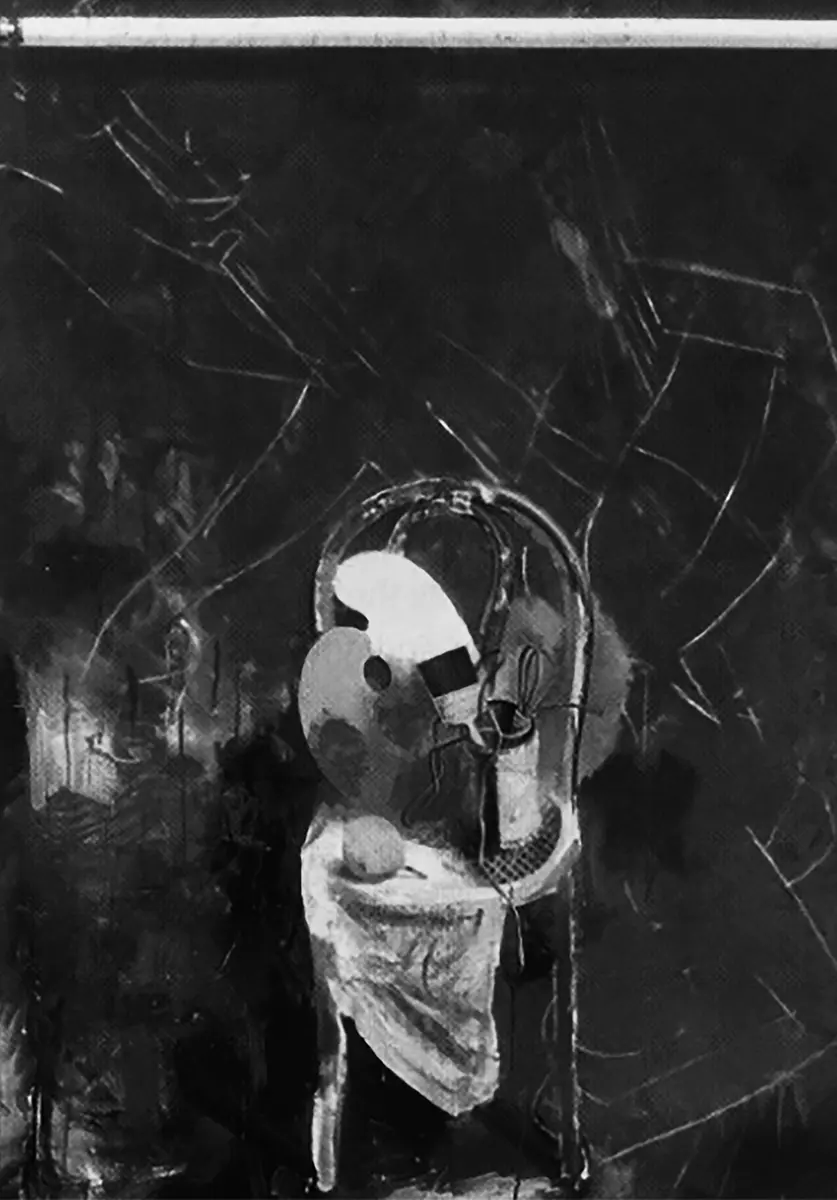
Bodegón con Mandarina (1997) illustrates this process at its most formal with its linear transition between figuration and abstraction. The foreground chair dissolves into the paint as the eye moves across it, away from the still-life on the table that is an island of serene rendering amid a cacophony of slashing strokes. Tarro Azul II (1994) functions under the same premise but commands a much different emotional response. Its elegant and spare arrangement of blossoms is bathed in a luscious wash of ultramarine, looking like a cross between a Chinese brush painting and an early Mondrian watercolor.
But the increased emotionality of these canvases is not the only way that Cárdenas has upped the ante here. The loose ends of Cárdenas’s intellectual ball of string dangle everywhere, begging to be unraveled. A few starting points: the reflections or patterns on his objects are picked up in the backgrounds as a way of unifying both the space and the surface of the painting. Secondly, the way the still life objects are painted appears to be a stylistic quotation from analytic Cubism, a reading which in turn suggests that the action painting background, while certainly painted with physicality, is also an Abstract Expressionist quote. Another possibility, as cued by the cropped figures scrawled into the outline of a Matisse-like figure in Bodegón con Neón, is that Cárdenas is merely representing a section of a backdrop using the mimicry which he has shown himself so adept during the course of his career. The realistically rendered light tube that is painted across the top of that painting sheds little light on these questions.
The art-historical connotations of these stylistic variations, together with Cárdenas’ subject matter, suggest less a form of appropriation than the assertion by Cárdenas of a linkage or legacy between his precursors and himself. In his studio in Bogota, the sixty-year-old painter fights the good fight, staring at the bottles and gourds, etc. that comprise the age-old studio detritus. He confronts the seminal 20th-century standoff between representation and abstraction, just as all the masters of the styles he resurrects have done, and invokes it in this series of paintings.
The paintings in the group only loosely resemble each other. Cárdenas appears to be painting his various thoughts about this multi-layered subject. The labyrinthine conundrums posted here do not attempt to resolve this issue of reality and illusion so much as embrace the resolvability of its paradox.
K.K. KOZIK