
The exhibition Camporeale: Works 1993-1996, sponsored by the Ministry of Foreign Affairs of Argentina, has embarked on an impressive journey throughout the continent. Inaugurated at the Latin American Art Museum in Long Beach, California in February 1997, it was recently presented at the Museo de Arte Contemporaneo in Panama. From there it will travel to Guatemala, El Salvador, Costa Rica, and Mexico, before concluding its run at the Museo Nacional de Bellas Artes in Buenos Aires next year. The show is accompanied by a beautifully designed full-color catalog with useful content that includes reproductions of all the works in the show, several texts, and an interview with the artist.
The catalog also contains a biographical survey in which Camporeale describes his artistic career stretching over 30 years, including his participation in the 1970s in the influential graphic arts workshop known as the Grupo Grabas, and a long period as a painter of oils characterized by their rigorous existentialism. It was in the mid-1980s that Camporeale moved towards the production of watercolors because of a medical problem with his arm which prevented him from continuing to work at an easel. This injury forced him to draw from a horizontal position, and in so doing, he discovered a new aesthetic world.
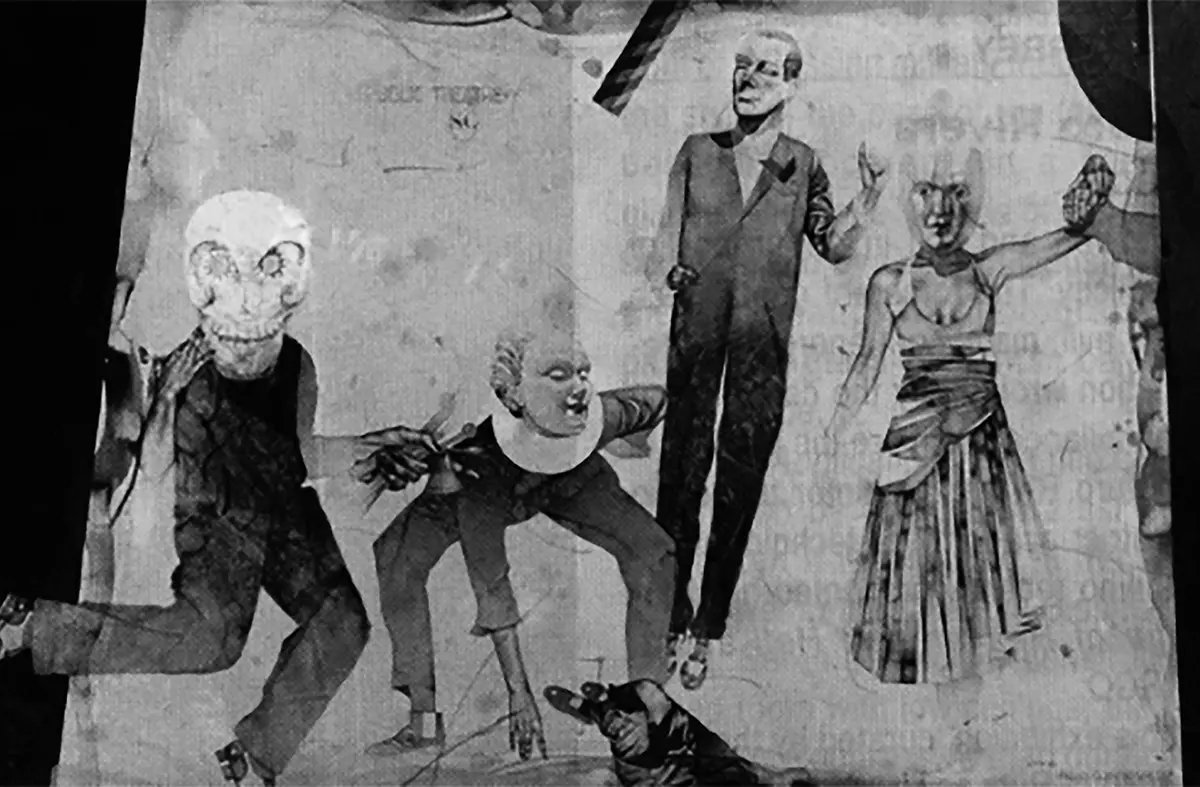
The recent work of Sergio Camporeale is paradoxical. The compositions of this Argentinean artist who resides in Paris, reveal a thematic depth, a sense of cynicism, and a sureness of linework which are the result of his long artistic career. They also reflect a bold attitude and freshness in execution characteristic of Camporeale’s youthfulness that belies his chronological age. His work seems to have a split personality, both mature and cynical, as well as youthful and insolent. On the surface, one kind of message can be perceived; but deep down we know that the work is subtly transmitting another.
The first impression created by the watercolors in this exhibition is a dangerous one. The attractive colors— both delicious and acidic—and the clear sense of drawing catch our attention and invite us to look closer, though in some cases preventing us from getting too close. These are works that initially express an easy sort of appeal because of their considerable technical skill and their figurative character that recalls to some extent the language of advertising, the lingua franca of our times. In addition, the homogenous nature of the physiognomy allows the spectator's glance to wander freely and easily over the pictures. In a sense, they take a single picture, a single history which is prolonged in each image, like a theater full of characters entering and leaving the stage.
Thus, beneath the pleasant surface of the large-scale watercolors that make up the series Family Portraits and Public Theater, there lurks a fantastic, mysterious, and even violent world peopled by fragments of human beings, caricatures, and well-known figures, objects, and spaces only half suggested in compositions which play with the traditional concepts of scale, proportion, balance, and perspective. The bodies are incomplete, the limbs do not necessarily belong to the trunks from which they emerge, and the figures float and seem to move around, or to be frozen in dynamic attitudes of interrupted movement, apparently governed only by the irony and audacity of the artist.
The background paper plays as important a role as the forms and figures painted within the composition. The space in which the plastic forms are developed is indefinite and the figures appear within a landscape in a void, which suggests depth as it emphasizes the surface of the paper. The figures seem both anonymous and familiar: they are human beings apparently taken from daily life, but in fact, they emerge from some corner of our memory or subconscious.
These incongruities constitute the central discourse of Camporeale’s work. It is tempting to describe that work in terms of the series of visual and conceptual counterpoints which make up its structure. But above all, what is apparent is what these watercolors suggest. They are participatory works in which the artist obliges the spectator to enter an unpredictable world that conjures up sensations that are both pleasant and disturbing. We are in the presence of an artist who, with considerable technical skill and obvious knowledge of the history of popular culture, is fully conscious of the pure and inalterable artificiality of art through work that suggests the idea of realism, but which does not present a real world.
Camporeale creates a sensation of discomfort with the painted, televised, publicity-oriented and computerized reality of the modern world and the popular images which characterize it. Everyone from New York to La Paz, recognizes Mickey Mouse and Donald Duck—ostensibly symbols of children’s amusement that become, in Camporeale’s world something macabre, vehicles and obstacles of vexation. The laughing woman who appears in Madame Butterfly and again in The Annunciation does not make us burst into laughter but chills us with a sense of anguish. Her prismatic and incomplete face suggests aggressiveness, rather than the joy we associate with laughter. Camporeale addresses us in a subversive language that we all understand in some part of our unconscious. In the final analysis, we all share an international "language"—we are all familiar with the same symbols and we all feel the same sense of unease as the century draws to its close.
MÓNICA E. KUPFER