
Three works from the Astronomers series form the chronological starting point of the show. Reproductions of landscapes of the French Impressionists or the Hudson River School artists cover the surfaces of large wooden spheres, suspended at eye level by metallic tube supports. The complexity of the sphere as a format allows Jusidman to experiment not only in terms of pictorial dimensionality but with the spectator, who plays a fundamental role in the illusion generated by the image. The landscapes are intervened upon in different ways which highlight their pictorial qualities. The artist superimposes on the image’s circles painted in flat colors and at the same time, uses the format to manipulate the image by making the landscape appear, for example, flattened at the poles and extended in the middle. In Astronomer XXXI (1990), where large clouds appear compressed together and seem to be projecting themselves outside the circumference, the effect is particularly impressive.
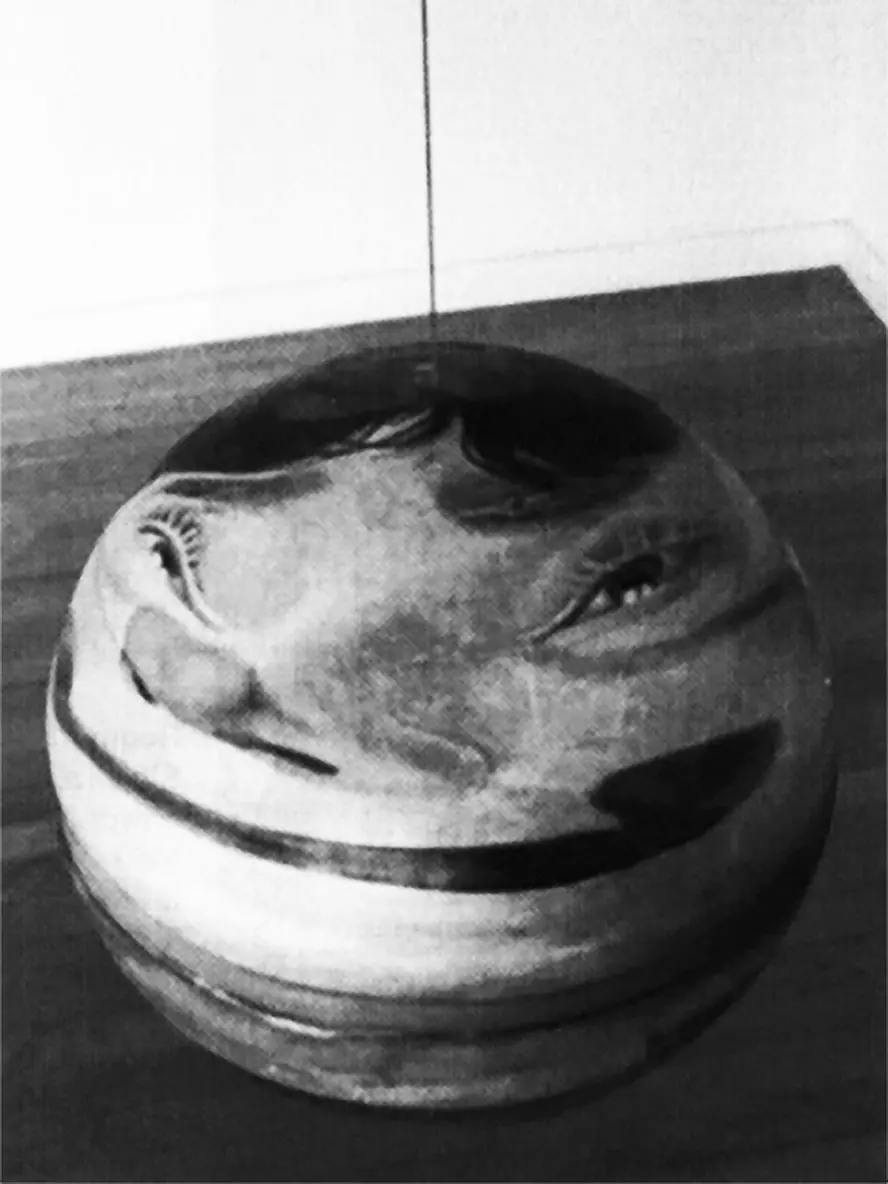
Using the same format, Jusidman subsequently developed a series of clowns (1990-1991). Six of these portraits, inspired by photographs of famous clowns, were placed at different heights using wires (a subtler alternative than the use of metallic tubes in the previous series) to make up an installation. The pictorial nature of the pieces is made clear by leaving the grain of the wood exposed in some places, an alternative used again in later works. At the thematic level, the clowns effectively become a metaphor of the artist’s philosophy, not only because of the twofold nature of their identity, reflected in the use of makeup, but because of the range of meanings, they express as cultural symbols.
The clowns are the subject of another series represented in the show by four large-format square canvases which reproduce, like the spheres, close-ups of the faces of famous comedians (1991-1992). In this case, the disproportion of the enlarged image (the canvases measure 1.75 x 1.75m. and the faces fill nearly all the space), combined with the grotesque expressions and the near monochrome tones of the paintings, both shocks, and intrigues the spectator.
The most recent series was inspired by Oriental figures. The relationship between the clowns and the geishas is evident in the context of Jusidman's work. Both figures have an illusionist function and a double identity. However, the move from the clown to the geisha remains surprising. Three paintings in oil and egg distemper on the wood are undoubtedly the most outstanding works in the show. At first sight, they seem to be minimalist, white canvases upon which we can superficially distinguish the shadow of the public cast by the illuminating reflectors. A closer inspection reveals figures of characters which are difficult to make out, either because of the titles of the works—Trio of geishas II (1993- 1994), Geisha with a knife (1994), Geisha Dance (1994)—or because of the bodies or faces which surprisingly appear in an oneiric-like vision. The effect, created by the lack of layers of painting (in some parts we can even see the grain of the wood), is masterful, as incredible as that conjured up by Kabuki actors. Those men disguised as geishas could easily be Jusidman’s referents.
The most recent series, represented by six sumo wrestlers painted in small format (1996), is a combination of the two previous efforts. Sumo I show an experimental phase in which the two abstract bodies, colored in flat tones, occupy all the pictorial space. The other works show the figures in a more realistic form, using a technique like that of the geishas. Using less paint and exploiting the grain of the wood, Jusidman gives the bodies well-defined anatomical features. In some cases, the wrestlers depicted figuratively face one another in simple silhouettes colored in a single tone, once again highlighting the pictorial character of the works. The scenes are set within geometrical compositions with asymmetrical borders recalling, in a sense, the frames of Jusidman’s early works. Since then, he has developed his interest in three-dimensional expressions and in the illusionism of painting. Today, his work can be seen as a solid philosophical project through which he documents the direct relationship between representation and the real world, with representation asserting its existence as a world.2
NOTA
1. Pictorial Investigations will be on view at the Nevada Institute for Contemporary Art in Las Vegas (September-November 1997) and at the Blaffer Gallery at the University of Houston, Houston, Texas (January-February 1998).
2. Greene, David A., "Yishai Jusidman and the Re-enchantment of Painting,” Yishai Jusidman: Investigaciones Pictoricas/Pictorial Investigations 1989-1994 (Instituto de Cultura de Morelos, Cuernavaca, Mexico, 1995) 13-25.
FRANCINE BIRBRAGHER