This retrospective exhibition of work by Antonio Seguí (b. 1934, Argentina) titled City Men was much more than one might have imagined. Seguí’s work, in particular as regards extemporaneous proposals in expanded space, can be seen as a manifesto concerning the possibilities of representation. In each of the resources he invents, based on his knowledge of perspective, color, photography, caricature, or film, he adds psychological levels to the form and enters an intimate universe almost without our noticing. Take pop art: the well-known and clear object is complemented with the knack (a word which of course is related to minute observation) of discovering and describing hopes, desires, the sense of places, dreams, and love.
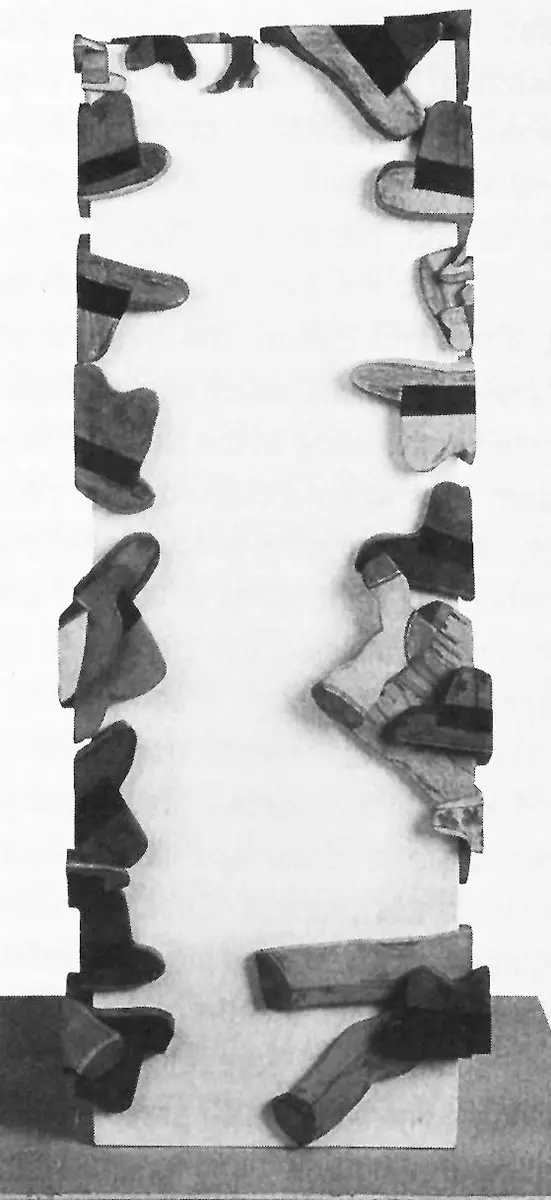
In his wood boxes from the 1960s, for example, the cube was no longer scenography but magnetic support and center of gravity for ordinary clothes or there was the clear presence of an agglomeration, the first word which defines a city. The clinging presence of bathers, figures with hats, legs, high heels, and ties. Surface for Seguí's like a magnet in which everyday elements come together in one way or another—just like in cities where we can see all kinds of fragments but the totality of which eludes us. Where networks are woven which do not try to duplicate a historical or family origin.
In principle, Seguí’s figures are caricatures, but the linework does not distort the body in order to judge it, as in irony, but is continuous, accepting reality as it is, as in humor. The men in his pictures run along nimbly but at all events, they are supported by a system to which they belong—who knows whether consciously or not. But they still recognize the gesture of a neighbor, glances in the park, the good passes in football, the waiting, and love. The gestures are only small ones, but they are living. These are people on the roofs of buildings, people who come and go in the street or can be seen at the crossroads in the cities.
Seguí's system for uniting these events as in Reading for everyone (1966) or Still lifes (1992) is the surface which is separated from within, with periodic or written elements like the cords hanging between the houses which seem to be unimportant, but which support the entire scheme, the conversations and perhaps the choice of going to one place or another, because between yes and no anything can happen, as Cortázar says in Hopscotch. In other words, in literature, sculpture, agriculture... in all the ures of the world.
But the main focus of his canvases is color. In After Rembrandt (1978) and Theater Class (1978), based on the anatomy lesson, the charcoal and pastel prepare the entire surface and become dark and light as color in Rembrandt is already a sign which for Seguí’s sometimes synonymous with the encounter of worlds on the margin. For this reason, these lessons are above all a meeting between friends, in which without a kind of solemnity or focus, anything—stories, little deaths between graffiti, glances, and gestures—can happen. Once again, charcoal, pastel, and sfumato are used to capture a moment in the life of an idol: Gardel in Paris (1977), You left and we didn't even notice (1977), and Birth of a myth (1978) — three huge canvases in which the composition and color are used to narrate another urban phenomenon, endowing imagination with a form to ensure survival. And so sometimes his city is shrouded in a heavy atmosphere, coldness, indifference as in What do I know? (1966).
It would be interesting, bearing in mind the work of Francastel, to examine the exact reasons why at a given moment the representation of ideas and perceptions about a two-dimensional surface ceased to satisfy the intentions of artists. For the moment, Seguí’s work shows us that the meticulous observation of small events can lead to an understanding of the fabric within which we all live our lives.
NATALIA GUTIÉRREZ