In the rectangular exhibition space of the GANAC, the work of four Costa Rican artists was grouped together by curators Efraín Hernández and Vivianne Loria under the title Body, Fragment and Memory. Jorge Albán (1967), Mirta Castro (1967), Karla Solano (1971), and Sussy Vargas (1967) made up the group who had in common their unconventional treatment of photography, or its incorporation as a central feature in the construction of artistic objects. These objects subverted the codes and uses of the body established by Costa Rican society.
The concept used for the montage was based on the idea of dividing up the space into three parts. The works of Vargas, Solano, and Castro were presently independent, whereas those of Albán crossed the room from one end to the other, engaging in a controversial dialogue with the other works due to the hardness of the component elements: pieces of cars. This allowed the spectator to establish two kinds of relationships: between the works of an artist and between that artist and the other participants.
Thus on the far left of the room, there were 12 works by Sussy Vargas. Using as her support old pieces of wood, desks, windows, and window frames marked by the passage of time— materials with their own histories and meanings, Vargas created altarpieces that had been scraped and painted, with intervened photographs and unrelated objects attached. The artist alluded to the imaginary world constructed by human beings on such subjects as sexuality, tradition, the family, and popular culture. As regards the last-mentioned aspect, Vargas refers in particular to the sacred component, the symbolism of catholic imagery and ex-votos.
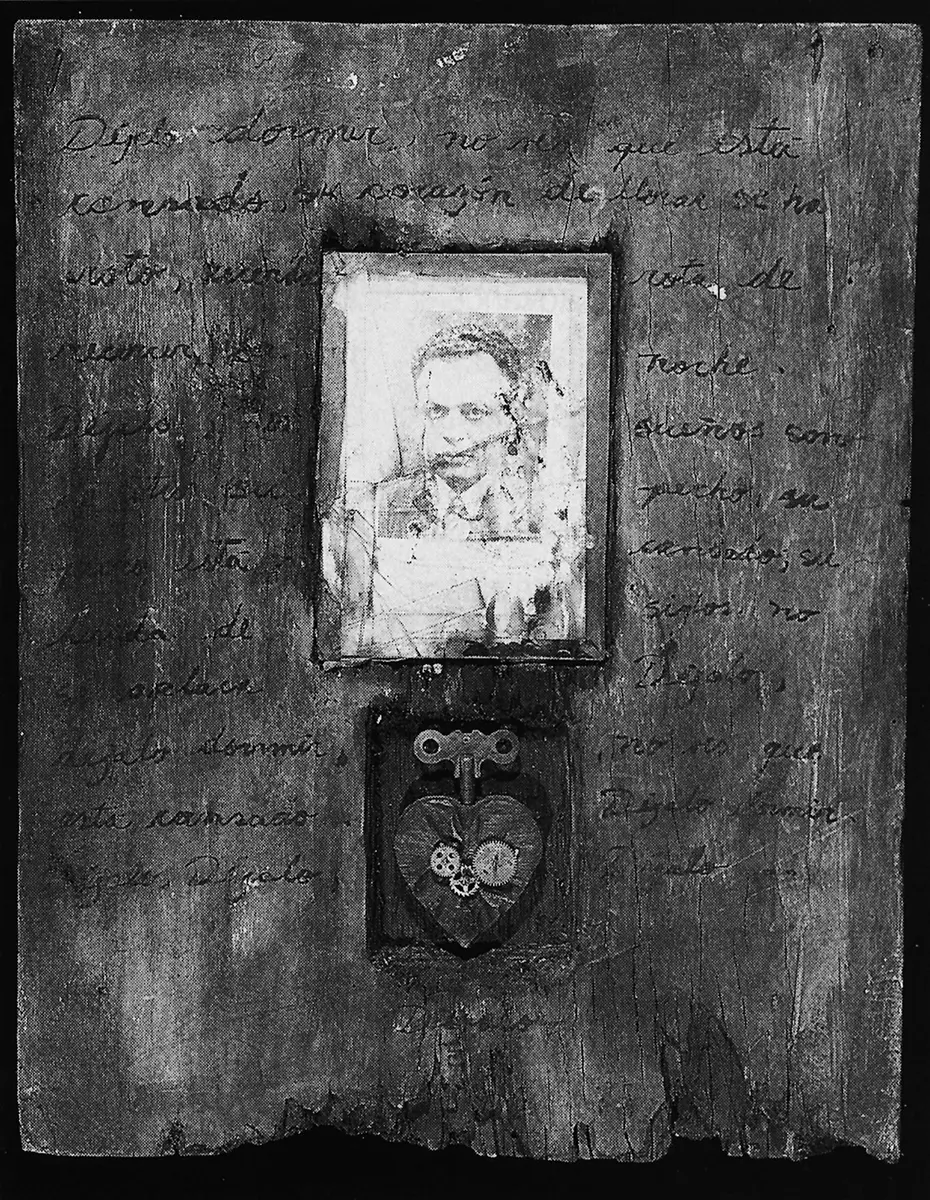
In her investigation of popular religion, the artist restores and recreates myths about figures who have not been sanctified, thus inverting the catholic canonization criteria. Impossible Prayer is dedicated to Dr. Moreno Cañas, a figure who performed extraordinary operations on ordinary people and who was subsequently assassinated. His repeated appearances in the hospital where he worked, San Juan de Dios, have made him into a miracle worker. His faded photograph appears on a wooden support, which evokes a religious retablo, under which a heart is kept in a cavity. The internal mechanism is of the clock-making kind and recalls the already traditional image of the Sacred Heart.
This inversion of established iconography places the work precisely at the separation point established by the western Christian tradition concerning the body: the opposition between flesh and the spirit and male/female. In these retablos the woman occupies the place historically held by Christ, thus suggesting the asexual character of the figure of Jesus.
The installation of Ex-votos can be seen as a supplication that summarizes all the various spheres in which Sussy Vargas tries to intervene in an attempt to heal or cure her memory. One hundred pieces of wood, each measuring 8 cm x 12 cm were arranged on a wall, along with vestiges of paint. On each, the artist screwed in a rustic metal frame enclosing different objects, such as family photographs, self-portraits, fragments of a naked body, prayers, ex-votos, little medallions of saints, etc. The photography of anatomical parts is the document that attempts to fulfill the same function as the ex-voto: the body appears fragmented into painful images since it is through pain that the essence of a woman is reaffirmed, that which identifies her sex and which sanctifies her.
Jorge Albán begins by questioning the socially and historically established symbolic structures, which he inverts in order to propose other iconological paradigms. He offers a reinterpretation of the traditional Virgin and Child binomial and proposes a review of the role played and assumed by the sexes in terms of their social function. On pieces of wrecked cars, Albán creates photographic emulsions in which he appears with his daughter in an affective relationship that society does not show or whose representational role is assigned to the female. The nakedness of the two bodies both emphasizes the protective-paternal image and conjures up the fragility of the body and its vulnerability.
What is symptomatic is the basis of the relationship. The automobile, a symbol of status and economic power, becomes an ambiguous vehicle. Movement and speed imply social life and death. The violence evoked by the materials underscores the fragmented nature of the iconographic image which appears to disappear in the oxides, creases, and stains produced by the violence of the act. There is furthermore the anonymous and impersonal effect suggested by the titles of the works which refer to the model and year of the car. In this way, Albán transcends the merely self-referential nature of his work and collectivizes his experience. The agglomerated montage of the pieces emphasizes rather the sculptural nature of the work to the detriment of the suggestive qualities of the printed image.
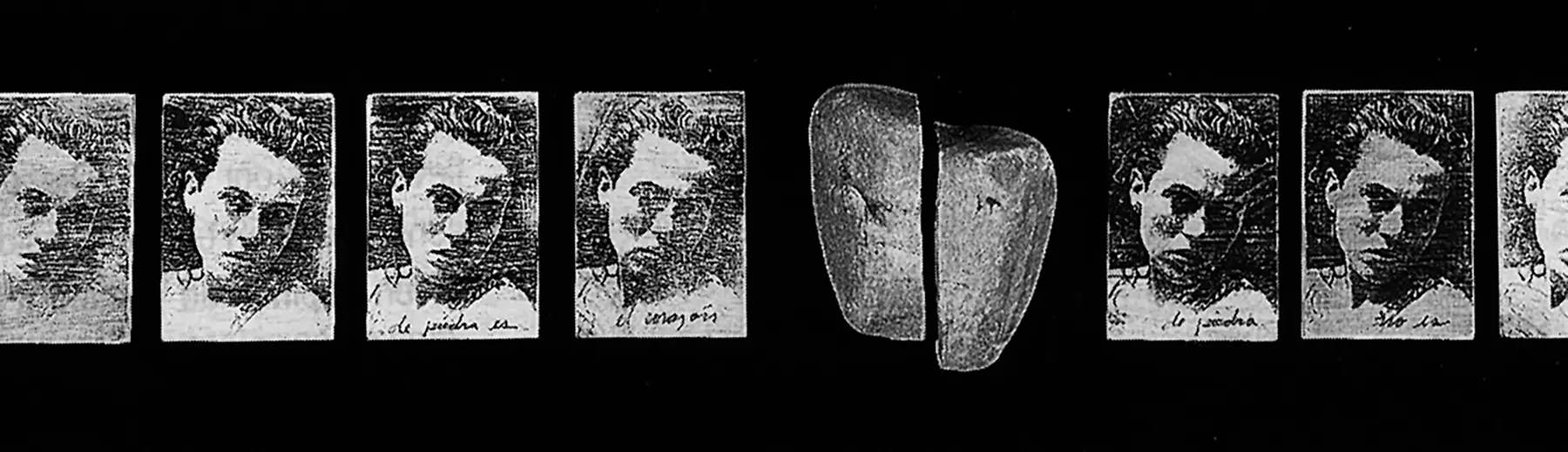
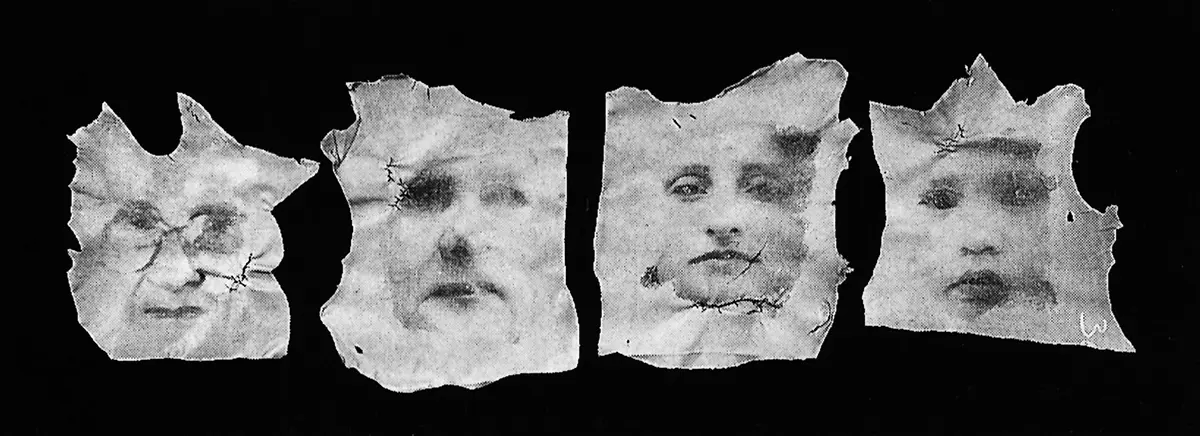
The contrast between matter and spirit and the search for unity was continued in the work of Karla Solano, which was placed in the center of the room. Using six ensembles, she reworked the construction of spiritual elements through the archeology of the body. In Metamorphosis, she questions the rigid categorizations of race, age, and gender by combining various images of heads, torsos, pubis, and legs printed on fabric.
Solano attempts to recuperate the important role played by the family in the continuity of a tradition through lithographic enlargements of her mother, father, spouse, daughter, and herself. She incorporates mellow texts at the bottom and Braille script which goes unnoticed since the work does not have the expected textural dimension and fails to transmit visually a tactile sensation or an effective emotive impact.
The two most satisfactory works in the uneven selection presented by this artist were those in which the objective dimension has not lost its value. It is precisely here that she manages to create an equilibrium between the concept and the form in which it is structured in her ensembles. The artist combines photography with objects which refer to the failed attempt by human beings to perfect their anatomy by technological means. The Smile ironically includes a photograph of the smiling mouth of the artist with a container embedded into a wall with different sets of molded irregular false teeth and plaster angelic figures.
The diptych titled Boxes of Life presented ultrasound images of a baby in embryonic form. Lit from behind, the central part of each contained a little picture frame, one showed the artist with her little daughter in her arms, a clear reference to the Madonna and Child; the other was an autobiographical picture of Solana as a child with a doll.
Mirta Castro, whose work was placed at the far right of the room, also examined the themes of the family, early motherhood, and the continuity of life in the major cycles of experience. Like Karla Solana, she proposes an ironical critique, but with an even more bitter sense of the meaning of these experiences. Thus The Garment, which hung from the white pristine ceiling, a virginal symbol of the young girl’s first communion, contained inside a circular fish bowl with a live redfish. In this way, the artist challenged the innocence of the moment of the sacred communion through the sense of erotic awakening and the presence of desire in the woman.
Castro recycles various kinds of found materials whose nature, which has been transformed by man and by social convention, suggests the idea to be developed in her work. A fragment of found wood, which evokes the image of the female womb, formed the basis of the piece titled The Navel. Against a piece of canvas covering the wall from top to bottom, she sketched out the figure of a female body. In the center, she placed the object showing a baby in the fetal position, with a long strip of twisted paper hanging down like an umbilical cord.
This use of objects in the work of the four artists was an attempt to establish a semantic relationship with the ritual character implicit in objects with strong autobiographical content. The spiritual power which they communicate is related to the sense of sacrifice by the artists in exhibiting their work and destroying the frontiers between public and private space.
In such a context, the presence of the body becomes meaningful. By using the body as a place of meaning, the artists engaged the spectator in a process of self-discovery and participating in a dialogue involving the exploration of some of his or her own existence.
This aspect was further strengthened by the use of popular elements within each work—objects and figures made sacred by the collective imagination of society (Vargas). The same applies to the use of experiences characteristic of women: maternity, menstruation, sacrifice, family unity (Solano, Castro, and Vargas), and those which evoke the socially determined generic roles played throughout history and which the artist inverts and questions (Albán and Vargas).
DERMIS PÉREZ LEÓN