If the installation is indeed a contemporary art form that intends to involve the viewer as a participant rather than a mere onlooker, the work of Carlos Capelán, made specifically for the New York Gallery of the Miami Art Museum in collaboration with the Monique Knowlton Gallery in New York (where there is another installation created in conjunction) not only succeeds but goes beyond expectations of participation usually set up by the artist. For A Painting Representing Space, he has created an environment that functions on multiple levels and is interrupted, intruded upon, and disrupted by sound, smell, whispered secrets, is hooked by a variety of deceptions, and discovers that there is no place to hide, Participation is essential, because one’s every comment can be heard by someone in the adjoining space and because each work in the exhibition is so different that it demands close scrutiny be appreciated and understood, This is not merely an installation that can be experienced quickly or from a single vantage point. Nor can one merely stroll around the gallery and glance at the images on the walls. Until each work is carefully surveyed and put into the context of the artist’s entire message, the full scope of the installation’s meaning can not be understood.
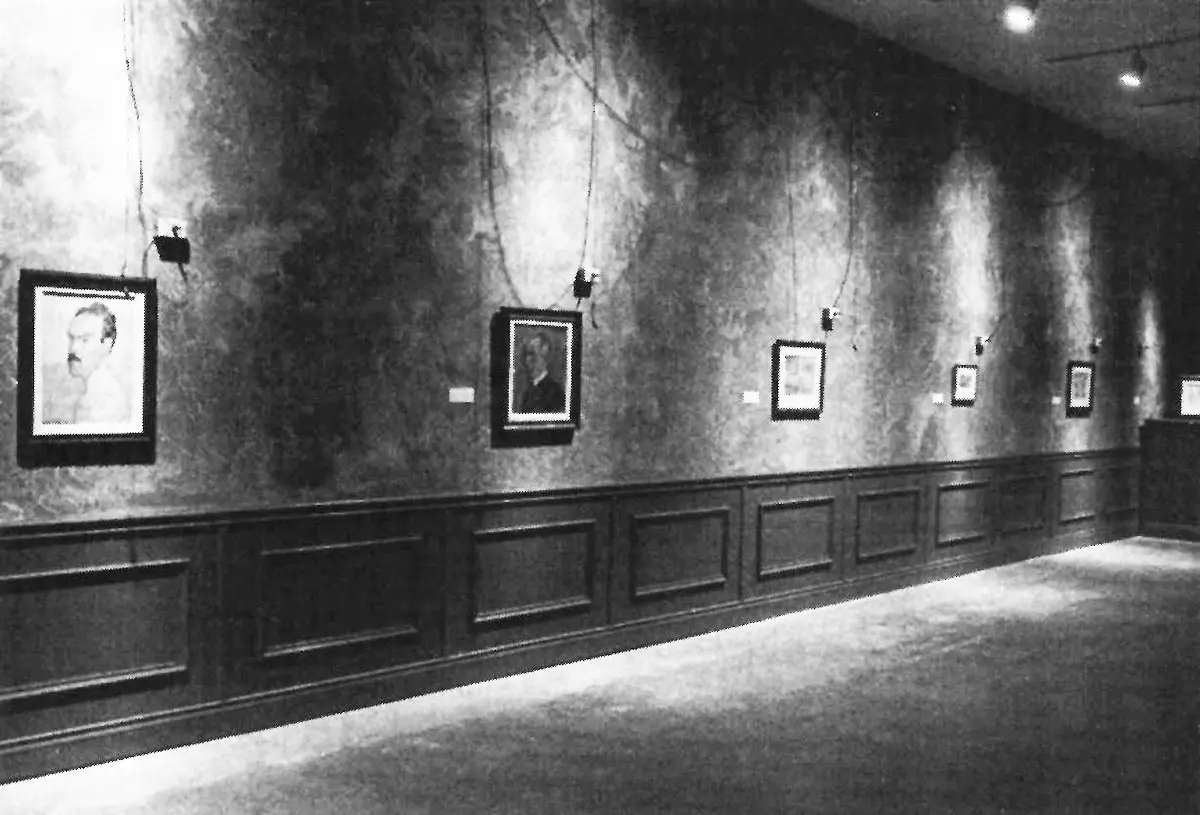
The space, pretending at first glance to be a comfortable nineteenth-century drawing-room hung with artwork (the drawings of his father), is divided into zones distinguished by painted wall textures made from mud, the distorted faces of film stars that change with each vantage point, paintings, handprints reminiscent of cave paintings, and a small room with its own sounds and selection of banal objects. Microphones and speakers record and play the comments of visitors; business cards with quotations by well-known personalities (who did not actually say what the card states) are available in trays on the wall.
The microphones and puzzling array of images and objects to serve as the point of discussion ensure the visitor's participation.
Carlos Capelán plays with ideas of memory and recognition to draw the audience into the space and involve it in its strange distortions. His own sense of identity, so influenced by his grandfather and father, both artists, and affected by forced exile from his native Uruguay, has motivated him to explore such polarities as sacred versus everyday space, grand versus small, rational versus emotional. Because the art is part of himself and it is important that he share his experiences with his audience, he is not content to simply present his ideas. He must contextualize them within the environment that forces participation, and perhaps understanding or even commiseration.
The confounding images of movie star faces are familiar drawings from his work and he intends to repeat them for a period of ten years (three years remain). The contorted faces confront the long wall of mud paint that appears at first to be an earth-toned textured surface in a traditional gallery arrangement. However, this wall is not made of paint that looks like mud prints, but mud, applied by the hand of the artist as a reference to the ancient markings made of dirt and water that were communicators for pre-historic peoples. Today, in contrast, we communicate through business cards.
Liquids play a role in the small separated space that houses the microphones and a squeaky wooden plank floor. The beverages —milk, Coca-Cola, and wine— relate to life's experiences over time. Their very odor permeates the space. The bottles become more than just a Pop art arrangement; they evoke response and comment, recorded on the microphones and revealed through speakers in the main gallery. All of the senses are compelled into action and provoke the participant to share in the artist's past and present.
In every place in the gallery, the viewer is forced to react, question, and look again. In an emotional arena gilled with components from the everyday world, elusive sounds, smells, and images assume palpable existence and take on strong mental associations. The installation of Carlos Capelán functions like a gateway that is as profound and challenging as the viewer’s receptiveness permits.
CAROL DAMIAN