
Diego Gravinese, a representative of the young generation (Buenos Aires, 1971), has won well-deserved recognition in Argentinean art of the current decade. His work has been developed through experiences brought about by the fatal seduction of objects which make the subject, as Baudrillard would say, a mere terminal in the consumer networks.
This time, using the suggestive title of Surfer, Gravinese presented a vast installation consisting of a group of paintings that, like an enormous mural, enveloped the spectator, filling all four walls of the room. As a surfer rides over the crest of the waves on a board, the artist navigates in a sinuous and random manner over a group of heterogeneous images, both public (those of consumption) and private (extracted from a family photograph album). Like the surfer on the waves, the spectator can also skim over these dissimilar images. Using one of these images might result in being projected towards others, through a process of similarity which, circumstantially, links them together. In this kind of pictorial zapping, it becomes impossible, at least initially, to focus on any particular picture. Jumping from one to another, without any apparent solution of continuity, the spectator’s gaze converts the pictorial field into an unusual struggle made up of excessively communicable images and others, which are secret, and of an intimate kind.
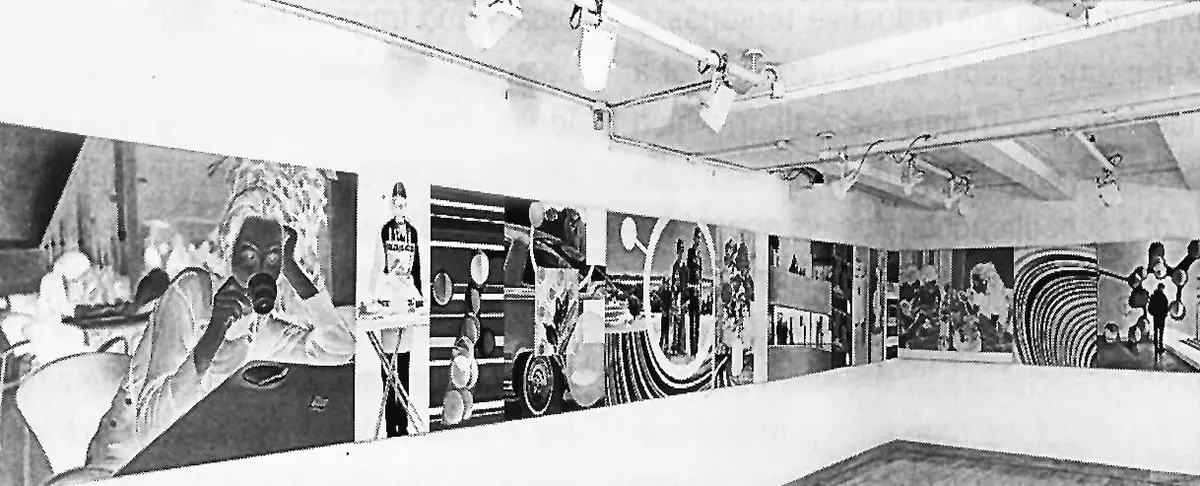
As with his previous work, Gravinese emphasizes the vertigo of consumer seduction by recourse to codified information, advertising design, and a plasticine version of reality. These images are strategically juxtaposed with pictorial transcriptions of photographs recording scenes from the artist’s childhood, with his parents, as well as other periods closer to the present, such as his visits to the Guggenheim or the Pompidou Center.
Contrary to what one might have supposed, a unique experience does not stand in stark contrast with consumer hyper-communicability. In the final analysis, everything appears to dissolve into one current, into a cold and transparent linear succession in which intimacy is also subject to the implacable logic of public exhibition.
The model of the public permanently invades, controls, and distorts the private sphere. This is what Gravinese has also shown in his previous series, such as Everyone Needs a Madonna. Here the image of the artist's own mother was invaded by the iconic stereotype of modernity suggested by the traditional representation of the Virgin with Christ.
In the almost schizophrenic oscillation between the private and the public, there is however something that escapes all control—recalling the movements of the surfer, the artist cannot avoid being swept along by the free movement of his own memory. This is why there are images, like that of his mother, which is repeated obsessively, as are abstract images which were previously absent from his work. Furthermore, given the importance acquired by fragmentation and the rhythm invading the composition, Surfer in its totality also looks like an abstract environment.
In the same way, although the artist copies photographs in a hyperrealistic manner, they lose their figurative contents and become disseminated in a neutral flow. This effect is also enhanced by the distant register of the diapositives in diluted tones, in contrast to the more realistic register of the strident color of advertising.
Through the circulating disorder of the images —the title of the prologue text by Jorge Lopez Anaya accompanying the show, Gravinese speaks about other kinds of disorders, such as those in which the profundity and complexity of unrepeatable experience are flattened and made ephemeral. He also speaks of the authentic objects of desire. For this reason, he scratches out and hides things, foregrounding the fascination and vertigo of images on which we, like the surfers in the sea, also surf in search of a direction that will become our own.
ELENA OLIVERAS