Ernesto Pujol presents an unsettling and playful dysfunctional family gathering in his latest installation, The Picnic, organized by Senior Curator Marysol Nieves at the Bronx Museum of the Arts. The Picnic marks a turn towards a focus on United States’ domestic culture, following a body of work in which Pujol’s explorations of exile, memory, and racial and gender identities were sited in his native Cuba. As was the case in his earlier work and in recent installations such as The Children of Peter Pan (Casa de las Americas, Havana, Cuba, 1995) and Saturn's Table (Centro de Desarrollo de las Artes Visuales, Havana, Cuba, 1996), Pujol examines intersecting constructions of masculinity, race, and culture as they are formed within domestic contexts. This shift to American family values and popular culture began with the exhibition Cowboys and Indians (Galería Raíces, Hato Rey, Puerto Rico, June 19-August 1, 1997) in which small format paintings and objects referencing 1960s games, storybooks, television, and films were presented to suggest their role as bearers of racial and gender hierarchies for children growing up in Puerto Rico (and the United States) during that period. Pujol was among those children, whose formative experiences of gender and racial identities were as much molded by relatives’ nostalgic stories of the Cuba they had left behind as by U.S. television shows, cartoons, toys, and books ubiquitous in Puerto Rico.
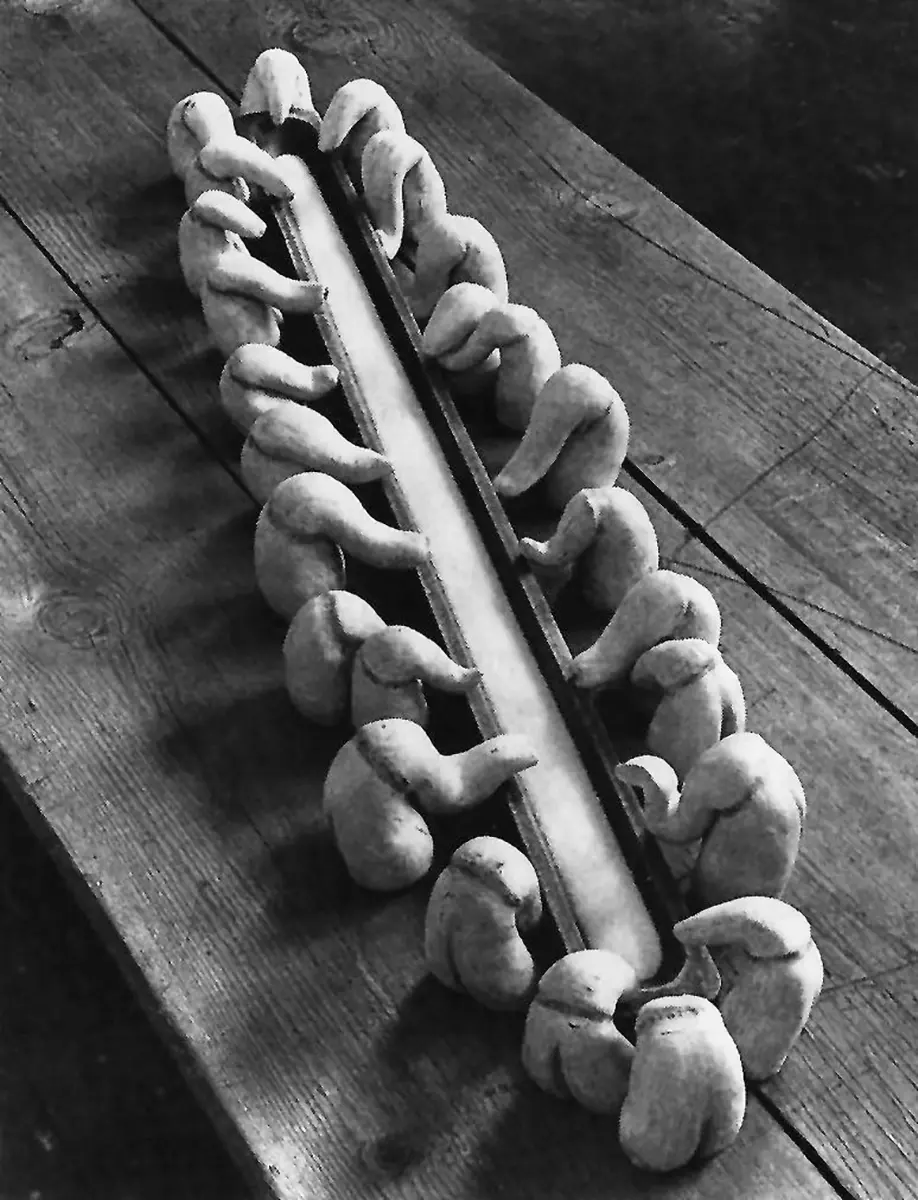
The Picnic, like Pujol’s recent installations, presents a fictive domestic environment incorporating found objects, small sculptures, and dramatic lighting. Two weathered wooden picnic tables rest on a bed of cedar mulch. Implements related to farming, hunting, and landscaping are methodically arranged on one table while pristine table settings adorn the other. The illusion of an orderly, immaculate all-American suburban family gathering is disrupted by the dark indoor setting and the proliferation of small clay pre-pubescent male genitals. Five place settings, each serving a clay genital, rest on Mother’s Table along with other items associated with women's traditional roles as nurturers and caretakers: a basket, milk jug, and parasol. Mother's Table has been compared to Judy Chicago’s The Dinner Party (1974 -1979) and Pujol has cited the work of early feminist artists as an important model for his own explorations of the formation of masculinity and queer subjectivity within domestic settings.1
In Father’s Table, objects designed to exert control over nature including bird and chicken feeders, iron tools, fumigation devices, and toy guns allude to activities associated with U.S. myths of masculine prowess. Clay boys’ genitals are progressively lured to the animal feeders and entrapped within bird cages, surrounded by threatening implements. These clay figures, present in Pujol's installations since 1994, act as surrogates for young boys and reference castration as a metaphor for physical and psychic violence associated with the performance of traditional masculine gender roles. At the same time, the white clay figures and domestic objects allude to the obsessive whiteness2 that pervades Latin American and U.S. society in general, and to the particular fixation with passing for white in racially- mixed societies such as Cuba and Puerto Rico, in which racial identity has historically been intertwined with the class position. In The Picnic, these individually-modeled genitals take on unexpected resemblances to small animals or cartoon characters (the Disney chipmunks Chip and Dale, for instance).3 The sheer number of them also suggests parodic visual punning on the emphasis placed on narratives of castration in Freudian theories of childhood development which posit homosexuality as a pathology.
The presentation of everyday objects which act as surrogates for the body, while evoking the seriality and controlled display associated with Minimalism, suggests another, more recent, context in which to situate The Picnic. Pujol, along with many other artists informed by feminist, postcolonial, and gender theory, deploys conventions of Minimalism to mine the varied possibilities for viewer-object interactions while presenting props and accessories tied to the enactment of identities. The artist has referred to The Picnic as a diorama4 and the dramatic presentation, lighting, and orchestrated placement of the objects throughout the installation recall the illusion of documentary accuracy created by such museum displays while inviting parallels with the social conventions and rituals whose repeated reenactment gives gender and racial hierarchies their air of natural, timeless authenticity.
NOTES
1. See Marysol Nieves, "Ernesto Pujol’s The Picnic: A Domestic Ritual Re-membered," and "Ernesto Pujol, A Picnic," [exhibition brochure, The Bronx Museum of the Arts, 1997], This relationship to feminist art practices was first recognized by Lydia Yee, who included Pujol’s work in her exhibition Division of Labor: Women's Work in Contemporary Art (The Bronx Museum of the Arts, 1995).
2. Pujol, A Picnic.
3. Author's conversation with the artist, Bronx, New York, October 21, 1997. The artist has cited a number of North American popular culture sources among them the Joshua Logan film The Picnic (1955) and the television series The Twilight Zone.
4. Author’sconversationwiththe artist, Bronx, New. York. October 21, 1997.
MIRIAM BASILO