Le Temps du Sommeil (The Time of Sleep) gathered together a series of small-format paintings, a series of drawings, a video titled Patriotic Tales, as well as a video projection, and a couple of installations.
This was to date the exhibition that best seemed to integrate the two parallel activities which Francis Alÿs has been developing in recent years: the first, which is perhaps the better known, consists of his painting of small-format oil works with absurd but likely scenes (for example, a man sitting on a table, creating a mini-installation with kitchen utensils) which a team of Mexican poster artists reproduces and transforms into enamel paintings; the second, which Alÿs has pursued since his arrival in Mexico in 1989, consists of ephemeral interventions —documented by photographs or videos— in urban settings, such as for example, dragging a block of ice through the streets of Mexico City until it has completely melted.
Le Temps du Sommeil synthesized these two activities. The video titled Patriotic Tales represents his practice of urban interventions: the artist appears, followed by a herd of sheep, going round and round the Zócalo in Mexico City. In another part of the gallery, there was also one of the paintings from the series carried out in collaboration with the poster artists. But the most interesting element in the show, and the one which achieved the greatest degree of synthesis, was the series of little paintings which provided the title of the show.
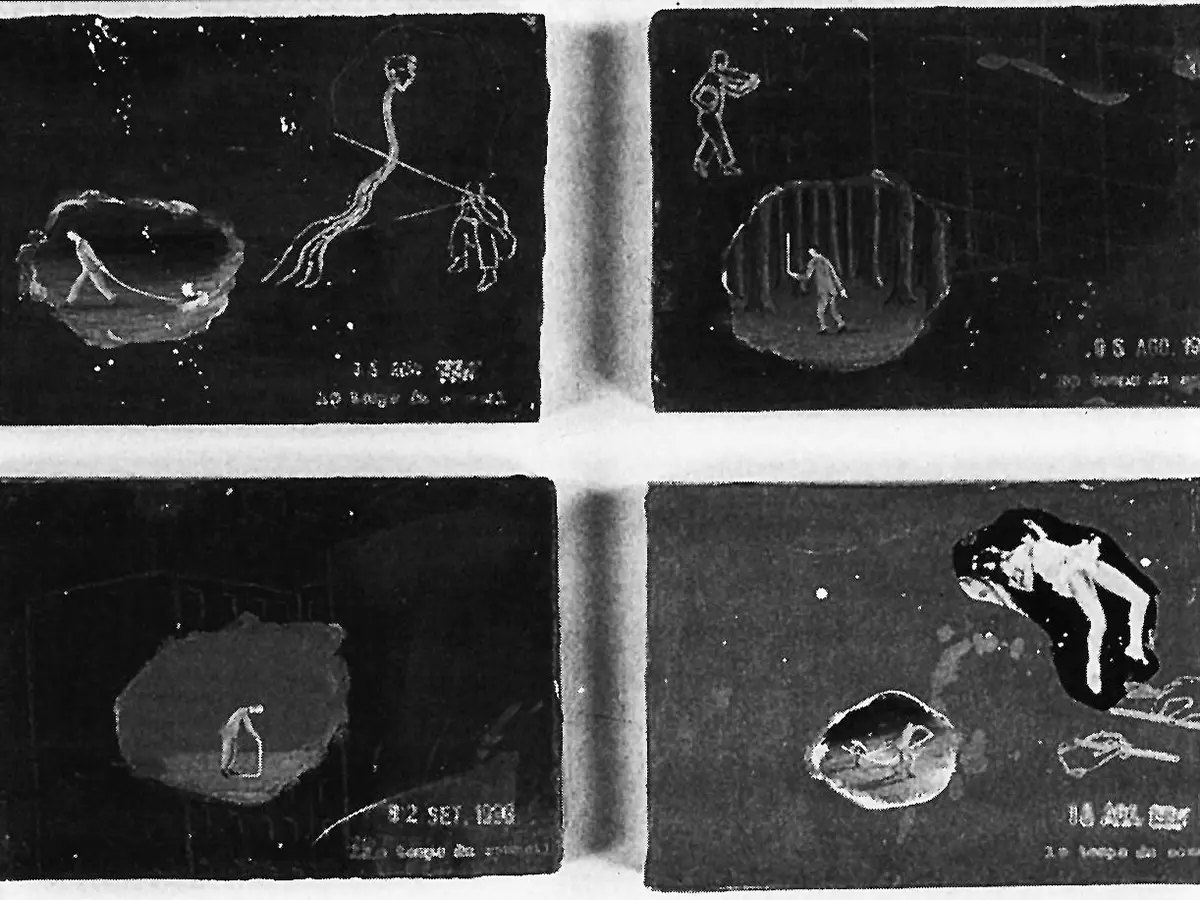
Le Temps du Sommeil is an open-ended series, begun in May 1996, and which to date includes 70 paintings measuring 4.5 y 6 inches. In each picture, the canvas has been treated with a polyester resin, so that the irregular texture and the other color of the surface seem to resemble the tiles which decorate the floors of old houses in the historic entrance of Mexico City, where Alÿs lives and works. The surfaces of these little paintings reveal few strokes: in each case, there appears, like a stain or a thick brushstroke of oil, a small pictorial space inhabited by the absurd figures we have already encountered in the series done with the poster artists: anonymous men, dressed in suits and who are playing seriously with mysterious objects in the form of spheres or lines. Outside this space, the surface of the picture has been treated like a small piece of slate onto which Alÿs has drawn with chalk indecipherable texts and forms. Finally, each picture has, in a corner, a stamp with the date on which it was made as if it were a document stamped at the time of its receipt by some Government office.
This series establishes some degree of tension between two kinds of time. On the one hand, there is the time of the story, a time which —such as that of the stamps which mark the paintings with texts reading "22 April 1997 or II June 1996"— can be measured by clocks, dates, and calendars. The time of history obeys a simple logic: time moves forward in a straight line, and thus each event has its own temporal mark, date, or time. However, there also exists another kind of time that has a different kind of logic —the time of the unconscious, which we can discover in dreams and in other creations of the human mind. Unlike history, the time of the unconscious is not linear and cannot be represented by clocks or calendars. In this time of sleep, as Alÿs calls it, there is no distinction between present and past, between real events and imaginary ones.
The time of the unconscious is represented by the figures inscribed on the other surface of the paintings. In his note on the Wunderblock, Freud thought that he had found an excellent model of the psyche in a strange childish toy —a kind of magic blackboard made up of a sheet of wax covered with a sheet of paper and a sheet of plastic— the surface of which recorded, like the conscious mind, the marks of a point. When the paper is lifted up, all the traces disappear, except those recorded, almost imperceptibly, on the wax sheet. The wax, like the human unconscious, records the marks of all the inscriptions which have passed through the memory. On the wax, all these images —or remnants of images— accumulate irrespective of the temporal order in which they were produced. Like the Freudian Wunderblock, the surface with its tilelike appearance in Alÿs paintings records and accumulates marks from the time of sleep, that other time which does not follow the logic of history.
Between the time of history —represented by the dates stamped onto the pictures— and the time of the unconscious —represented by the chalk marks on the other surface of the picture— there is a third possibility: the time which Freud associated with the creative act of the artist, and which combines the logic of history with the products of the unconscious. This third time is represented in the small oil-painted spaces which appear in each painting and which combine historical elements —movement, narrative, structure— with unconscious qualities, the absurd, and the illogical. Like Freud's Wunderblock, Alÿs series is a brilliant metaphor for the process whereby the artist manages to translate the creations of the unconscious into the language, and time, of history.
RUBEN GALLO