It had been some time since the Centro Atlántico de Arte Moderno (CAAM) on Grand Canary had organized an exhibition from its own center. Generally, independent curators are the ones with the pull to bring resources to the museum. Until Orlando Britto Jinorio, artistic director of the CAAM armed himself with all the fury necessary to commission Islas (Islands,) a project whose poetics deliberates between geography and metaphor. It seeks to uncover, through history, past, and present, the presence of an "insular sensibility" in the creative human nature of these overseas territories.
It is no coincidence that this cause for inspiration would originate precisely in the Canary Islands, a volcanic archipelago located out past the Pillars of Hercules and whose characteristics closely relate it to Atlantis, the Garden of the Hesperides, or the Fortunate Islands. There are people who, even today, arrive with a heavenly expectation that an earthly paradise exists — an ideal place to spend some good vacation time or perhaps to live, even to die.
And so the odyssey began, touching on more than twenty islands around the world and bringing together twenty-eight artists with some island connection — be it origin or residence — that conformed to this exhibit, deserving of widespread recognition from whatever perspective one chooses to look at it.
Around the World in Twenty Islands
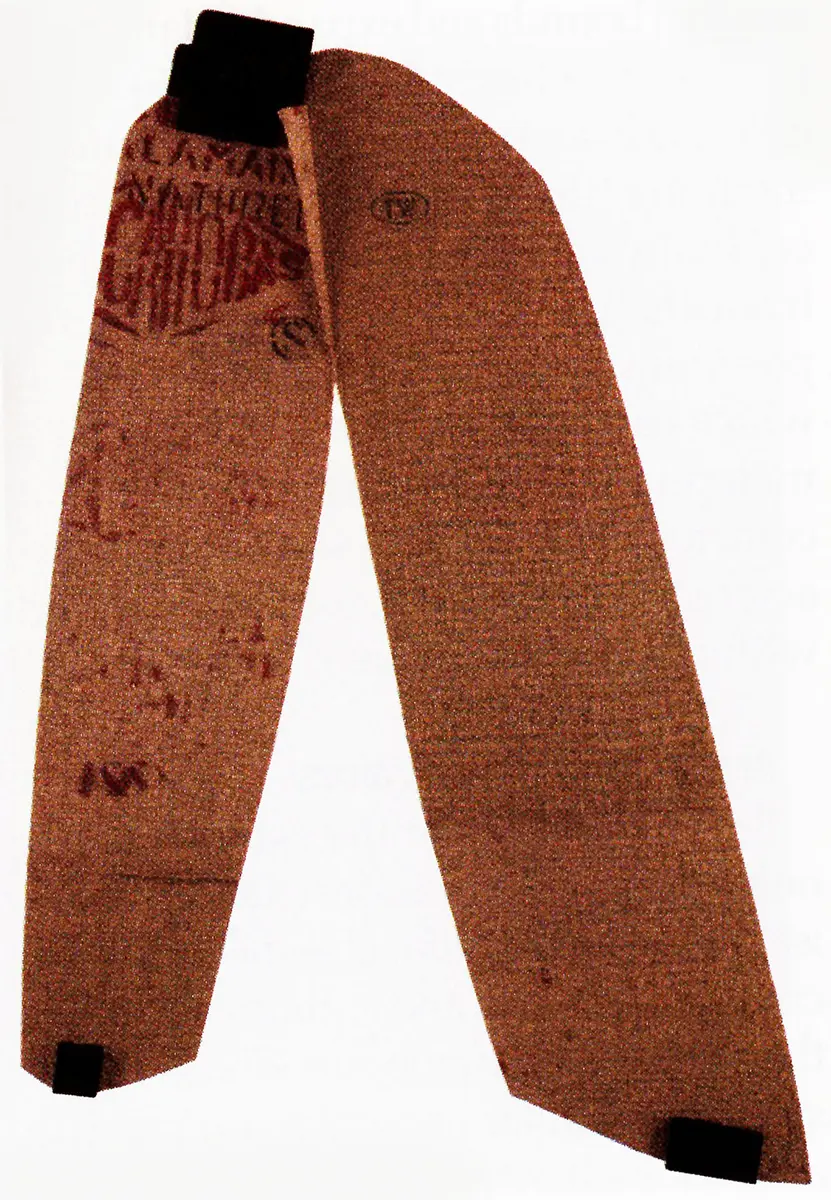
As one enters the museum two works of art leap into view, revealing, each in their own way, the insular nature of the show. Mar Latamie (Martinique) has been working for years on the Proyecto Azúcar (Sugar Project) in which he ponders the systems and elements of production that physically and culturally transformed the Caribbean. In the exhibition, Latamie presents a gigantic model —containing another smaller one within—of sugar cane processing factories, a type of building so common and so integral to the economic and cultural history of the Caribbean but curiously in a goodly percentage of the insular spaces on the planet that have also undergone processes of colonization. To the right, taking the entire wall bordering the museum staircase, Marcos Lora Read (Dominican Republic) constructed a great oceanic horizon theater, especially for the occasion and space. Forty-five days working in situ produced this tremendous 11 x 7-meter scene that pictorially contains the artist's version of Canarian geography— volcano, sea, sky—and technically causes the wall to sweat with a constant flow of water. Two artists take the walls that lead to the first large room: Herve Télémaque (Haiti) and Ashley Bickerton (Barbados/Bali). Both presented assembled works, allegorical construction of the Caribbean. The former uses coffee sacks and variously shaped pieces of wood, the latter utilizes organic and inorganic materials relating to the sea.
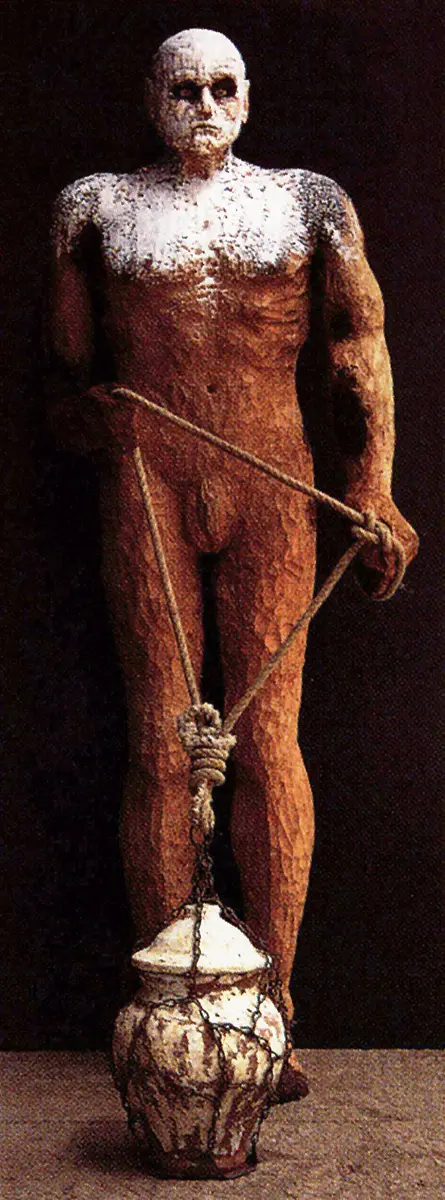
In Room 1, Moustapha Dimé (Senegal, Island of Gorée) employs debris collected, for the most part, from the sea. A sculptor of incredible sensibility, he constructed for this show a work titled The Soul of People, starting with African morters displayed in such a way as to reveal at once a great belief in the sea as a profoundly religious charge. Three Cubans —Santiago Rodríguez Olazabál, Manuel Mendive, and José Bedia — pack their works with a strong, often enigma tic content originating from Santeria and other Afro-Cuban cults. Yo desplegaré las velas (I Shall Display the Sails) is the title of the piece Olazabál made for this show, and word of mouth suggests that it was one of the pieces the local Hewing public found most fascinating.
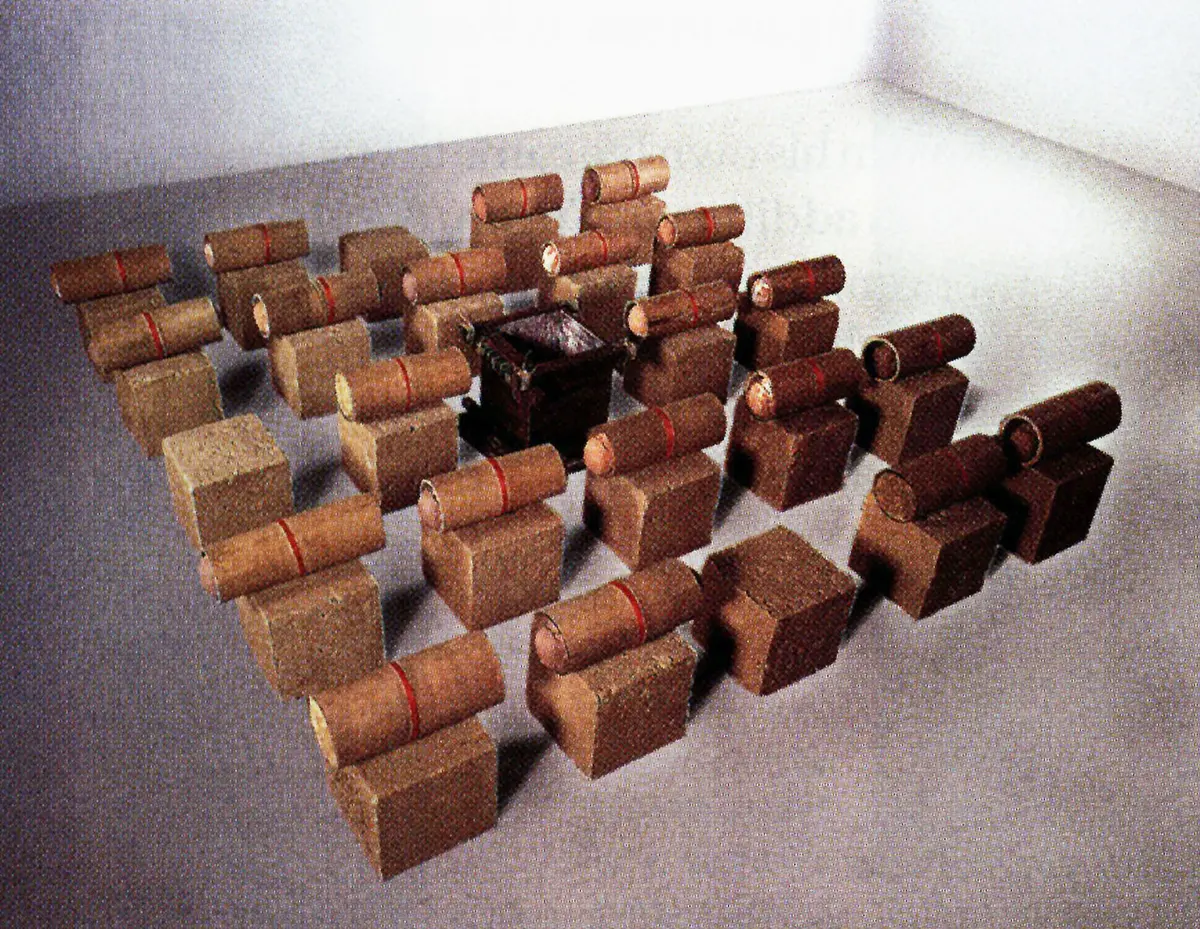
From Japan, the artist Yutaka Matsuzawa offers interesting cosmologies that ponder the universe through Eastern theories and philosophies. Another site-specific work is that of the artist Jack Beng-Thi (Reunión) titled 21st South, Islands, Sugar, Solitude, and Fear, another public favorite, even among specialists. In this work, 21 compacted sugar cubes are the base upon small bodies wrapped in a bamboo lie, focusing one's attention once again, and with great poetry, on the productive colonial economies. Finally, the artist Sigurdur Örlygsson (Iceland) was inspired by Jules Verne and Leonardo da Vinci to paint a great, almost surrealistic geography of that Nordic land.
By the descending staircase, Barbara Hess (New York City) works with the photograph, in some cases with her own image, and in others, with strange landscapes which she reuses or distorts, achieving quite mysterious territories rife with loneliness, or constellations of faces that peer at us with the widest range of expressions. Willie Doherty (Northern Ireland) speaks to us in his photographs and videos of the violent social-political situation in his country. In Iris series, The Factory, he portrays abandoned spaces filled with rubble, that are, paradoxically of great artistic beauty. Nikos Charalambidis (Cyprus) also alludes to the complex social politics of his homeland but in a language thick with irony. The great powers—the ecclesiastic, the military, and the consumer—are the critical points around which his work circles and in which he sometimes makes use of technological resources as well as appropriating art classics.
On the second floor, Bemardí Roig (Palma de Mallorca) composes hyperrealist paintings in which perverse, lascivious, and mutilated characters speak to us of sex, death, and religion, suggesting to us that other image of the island as a space of no inhibitions. One of his canvases, Pietà engages in a dialogue with the piece shown on the other side of the banister, that of the artist Richard Redway (England) who composes a Christ out of many small photographs that, as in the rest of his collages, reflect about the body and its place in the construction of society. Francis Naranjo (Grand Canary) produces a minimalist work in which whites and clean geometries attempt to present a certain sense of claustrophobia particular to island man. Several steps prove disconcerting regarding the uncertain future of man at the end of the century. Mark Waller (England) focuses his work on the isolated, autonomous space. Specifically, he gathers the images in his video installation from a 24-hour gas station and the spectator reviews the resulting video clip by peering through the tubes of some mechanical part of a truck engine. In the large room next door, the majority of the works exhibited have something to do with fire. Nari Ward (Jamaica) lives in Harlem, New York, and his installation Iron Skies uses 365 burned baseball bats placed under a sort of starry sky constructed of household irons, alluding to the violence and the racism which the black community in New York experiences every day of the year. Guillem Nadal (Palma de Mallorca) presents a documentary in which he registers photographically a moment in his performance put on in an old quarry in Majorca in which he set fire to the silhouette of a map of the world made of string. Jean-Paul Marcheschi (Corsica) presents a large-format work composed of the ritually burned pages of his diary. Within his wrecked scrawl, one could glimpse the longings and dreams of the artist. Emilio Isgró melts down approximately 300 kilograms of glass into an enormous glass book, a sculpture titled Las tablas de la ley (The Tablets of Law) in which he invites us to revise and proclaim new commandments in accordance with the contemporary world. For her part, Anna Eyjólfsdottir (Iceland) constructs a large totem sculpture out of clothes racks, proposing a constant in her work which refers to the dialectic between tradition and progress and in particular, to the traditional dress of her country. Guillermo Paneque (Sevilla) lives in Manhattan and exhibits in photography and a video a reflection on time in which everyday people wait for what is to come or live in that moment after that which has already occurred. There is no action whatsoever, just the patience, or impatience, of the lack thereof. Toland Grinnell (Manhattan) isolates and insu-larizes, a topmast in a sort of white coffin, a kind of relic like a museum piece, no longer of use, or the shell of a memory of some extinct territory.
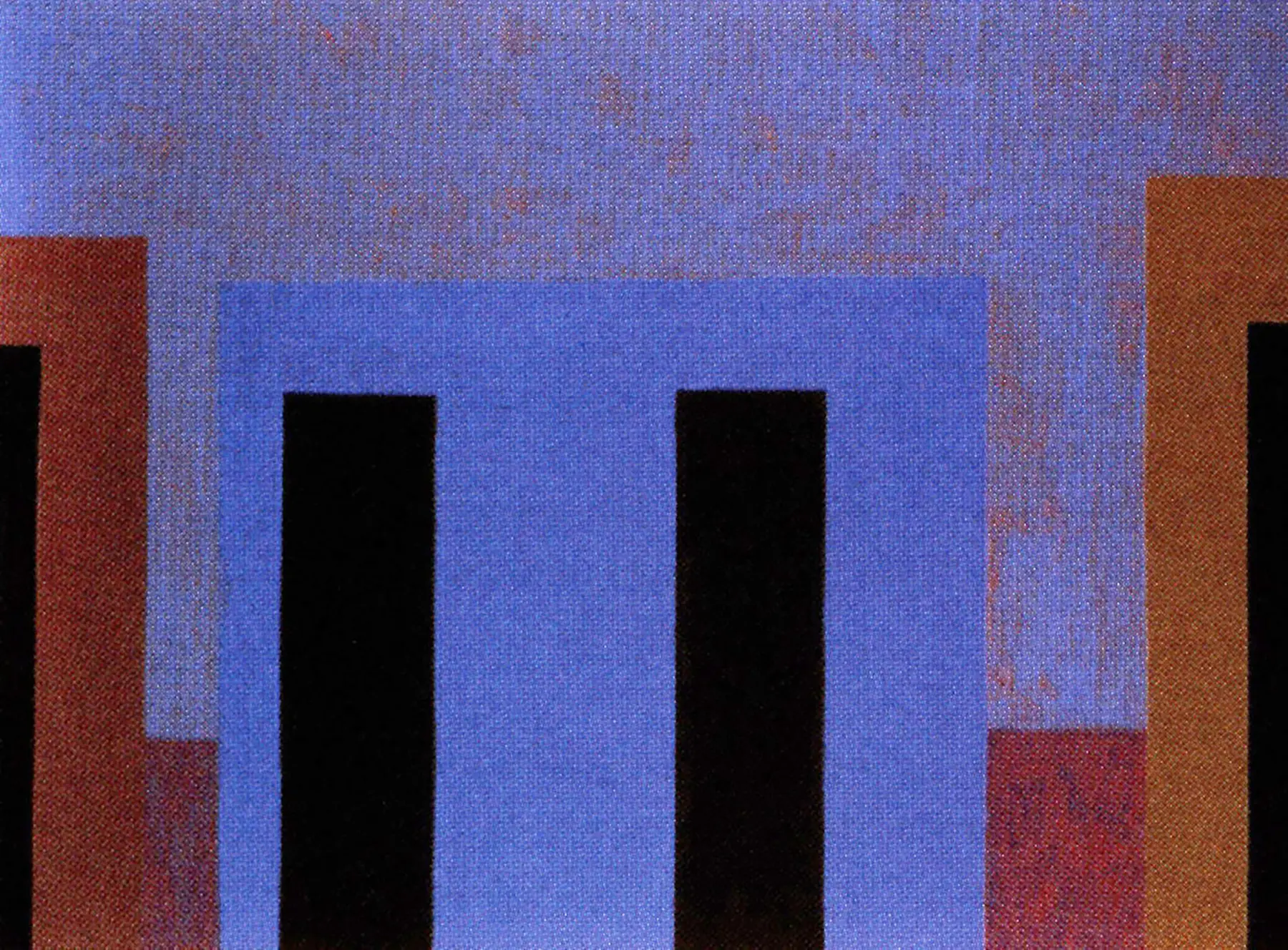
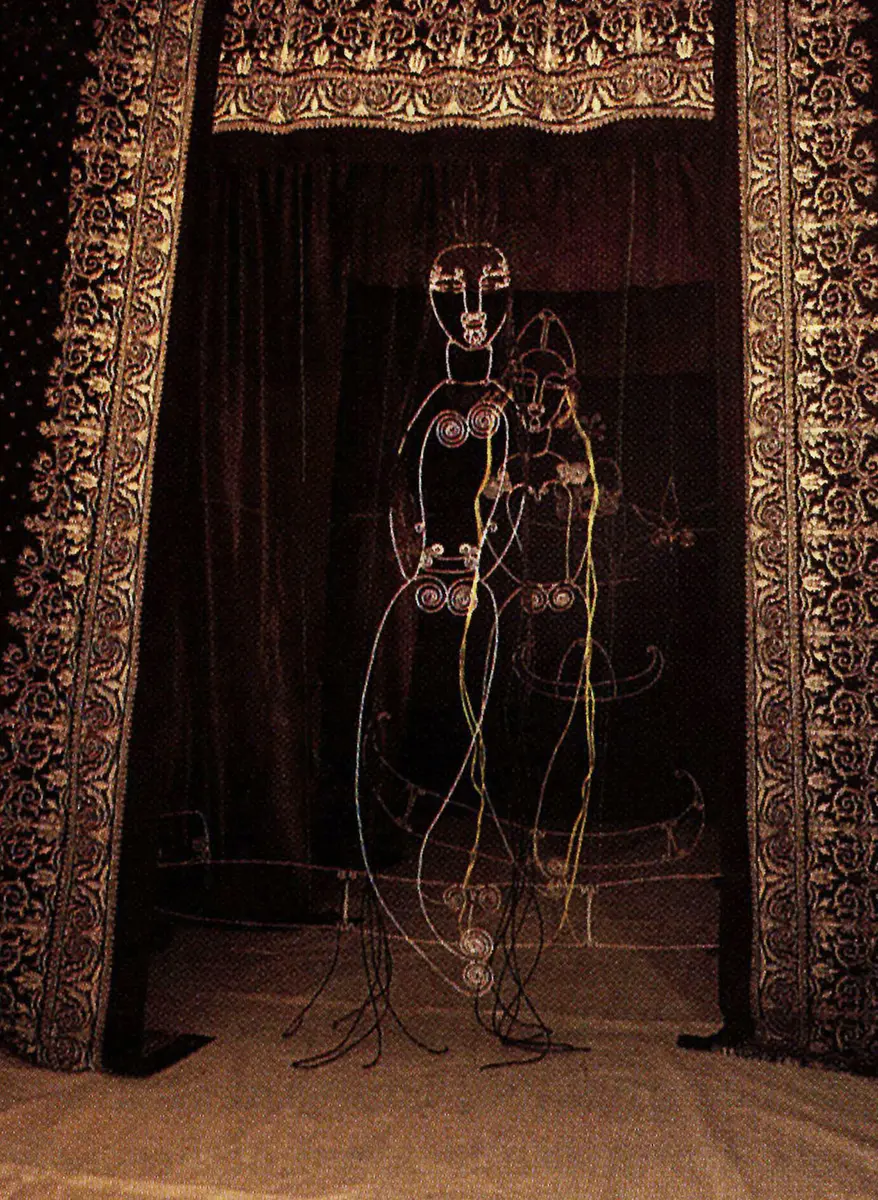
On the upper floor, two Canarian artists, Luis Palmero (Tenerife) and Serna Castro (Grand Canary) provide a prelude to the end of the show. The former paints color and geometry in small formats, like small and beautiful pieces of architecture with boundaries as clear as the islands themselves. The latter, in contrast, fills his/her paintings with movement and an organic quality—imaginary flowers that evoke for us a strange mixture of the Flemish tradition with Surrealism. Finally, the curator wished to end this island passage with a supremely poetic work, that of Jacqueline Fraser (New Zealand). Here the Maori artist constructs a theater stage with wire and fabric upon which various scenes take place, one after another, comparing the image of Pania, a little Maori mermaid, with that of another mermaid whose image is embodied in a sculpture in Copenhague. The artist works with that duality of traditional and more modem iconographies. Perhaps the most striking theme in an overview of this exhibition would be the presence of the sea, the dual horizon that bounds and expands island reality. Nevertheless, while not true in every case and far from being the curator's intention, the works seek to refer conceptually to the island theme. Or rather, from their infinite realities, they propose universal artistic discourses in which can be glimpsed certain poetics, metaphors, realities, and critiques that coincide with a sort of sensibility characteristic of the artist, a creative island within its own universe.
Archipelago in Five Voices
For the opening of the exhibition, not only was an assorted constellation of artist-islands present but also theoreticians, critics, professors, and authors of some of the texts in the catalog who came to speak about their particular approach to art and insularity during their seminar: two ex-islanders, the Cubans Antonio Benítez Rojo and Iván de la Nuez, master and disciple, colleagues in thought and literary translation, educators; Remo Guidieri, essayist, writer, and professor, who arrived from Paris accompanied by nearly all the glamour and delay of those people who love be waited for; Eugenio Padorno, from and discussing the Canary Islands, who also devotes the whole of his literary knowledge to his students; and Dan Cameron, critic, commissioner, and conservationist, who came from Manhattan, that paradigm of the contemporary and multicultural island.
"It is the Ithaca longed for by Ulysses and the space of the Robinsons azvaiting their opportunity to escape. It is Elba's confinement and Thomas More's Utopia. The passion of Homer, Lemma Lima, Agustin Espinoza, Derek Walcott, Pedro García Cabrera, André Breton, and Saint-fohn Perse [. . .], confirmation of a reality that is perceived as different and unique in relation to other realities, writes Orlando Britto in the introduction to this intellectual debate. In this case, the island theme enjoyed the pleasure and pain of being the sole target of this quintet of thinkers."
Guidieri opened the session with a polemical quote from Gilles Deleuze, "Pragmatism is the dual principle of the archipelago and hope." This is a pragmatism whose origin lies next to the industrial revolutions at the end of the nineteenth century when water-bound territories are discussed for the first time at the Berlin Congress. Everything had to be of some use then, Gudieri commented, the seas and in them, the islands. The world, from that moment on, is a process, an archipelago of mobile, isolated worlds without limits. Truth has a limit; we become transpost-neo-travelers, infused naturally and absurdly with frenetic movement, surpassing that of the nomad. At this moment in time, one can only speak of the archipelago as a figure in space, the space of expansion.
Benítez Rojo in his own life came to feel himself to be, in addition to Cuban, Antillean, Caribbean, and even Canarian, and in his study of archipelagos located in the tropical and subtropical Atlantic, proposes an integration of them all into one single macro archipelago which he insightfully terms the New Atlantis. The islands of the Caribbean, the Canary Islands, the Azores, the Madeira Islands, Cape Verde, geographies aside, share a number of historic, economic, and cultural coincidences that join them. For example, the processes of European conquest and colonization, plantation economies, slavery, contraband and piracy, and economic dependence. In short, to know ourselves better, to establish a new force, to continue advancing toward the great worldwide archipelago, Benítez Rojo proposes to extend the discourse of the Caribbean to that of the New Atlantis.
The islands, zones of confluence and passage, of foundation and flight. For Iván de la Nuez, they are the site where the anxiety of displacement is felt. Islands as a space for flight, like the figures in the work of the artist Luis Cruz Azaceta; land-bound islands, like those constructed by Chicano art; islands of the body, as is the case with Ana Mendieta who turns the silhouette of her own body into an island. Artists who transform their art into geography by which to inhabit or intervene in the world. Initially, I thought that this exhibition doesn't make sense but had a certain sensibility. Then I understood that it makes sense precisely because of its sensibility, says de la Nuez.
From the notebook of the motionless voyage of an islander, that of the poet. Eugenio Padorno delves deeply into those poetic and metaphorical expeditions originating in the Canary Islands and refers to their island condition, the condition of the insulario Canary islander, as the Grand Canarian writer Alonso Quesada called him.
Dan Cameron considers the concept of the islander as an invitation to develop the complexity of the artistic world, taking every artist as a self-contained unity. The postmodern world creates a situation in which the core of human identity is being questioned. So is that a long list of contemporary artists, identified visually with certain of their works, is reviewed by Cameron in his reflection on displacement, space, and identity.
ALEJANDRA POZO
Venezuelan Art Critic. Resident in the Canary Islands, Spain.