Perhaps art like myth is responsible for giving the order to experience. More than order, to bear witness to our experience. Then why not consider that the space of an installation might be like a score with its intensities, intervals, and silences? A space not only to be read from left to right, as we read stories but from top to bottom or back to front. A space that is not walked through like a gallery hung with paintings, one after another, but like sound which leaves the body quiet and attentive for a moment and allows it to evolve in a world of resonances.
Myth and music are intimately joined for the value of those primordial explanations of our nature—which we call myths—lies not in their being true or false but in all their many versions that appear within an interval of time.
José Alejandro Restrepo (Bogotá, 1959) has his own way of looking: myth. The most intense experience in terms of space: music. The most intense experience in time: The search for lost time. A truth: the body. A method: the journey. He works with the audiovisual space of video that seems to characterize our time. Nevertheless, in his case, all those technological complications are connected to an energy source fueled by these principles which simultaneously question and enrich the image. For this reason, with all legitimacy and without pretension, his works pose an ethical problem: how history is told and how the artist represents it.
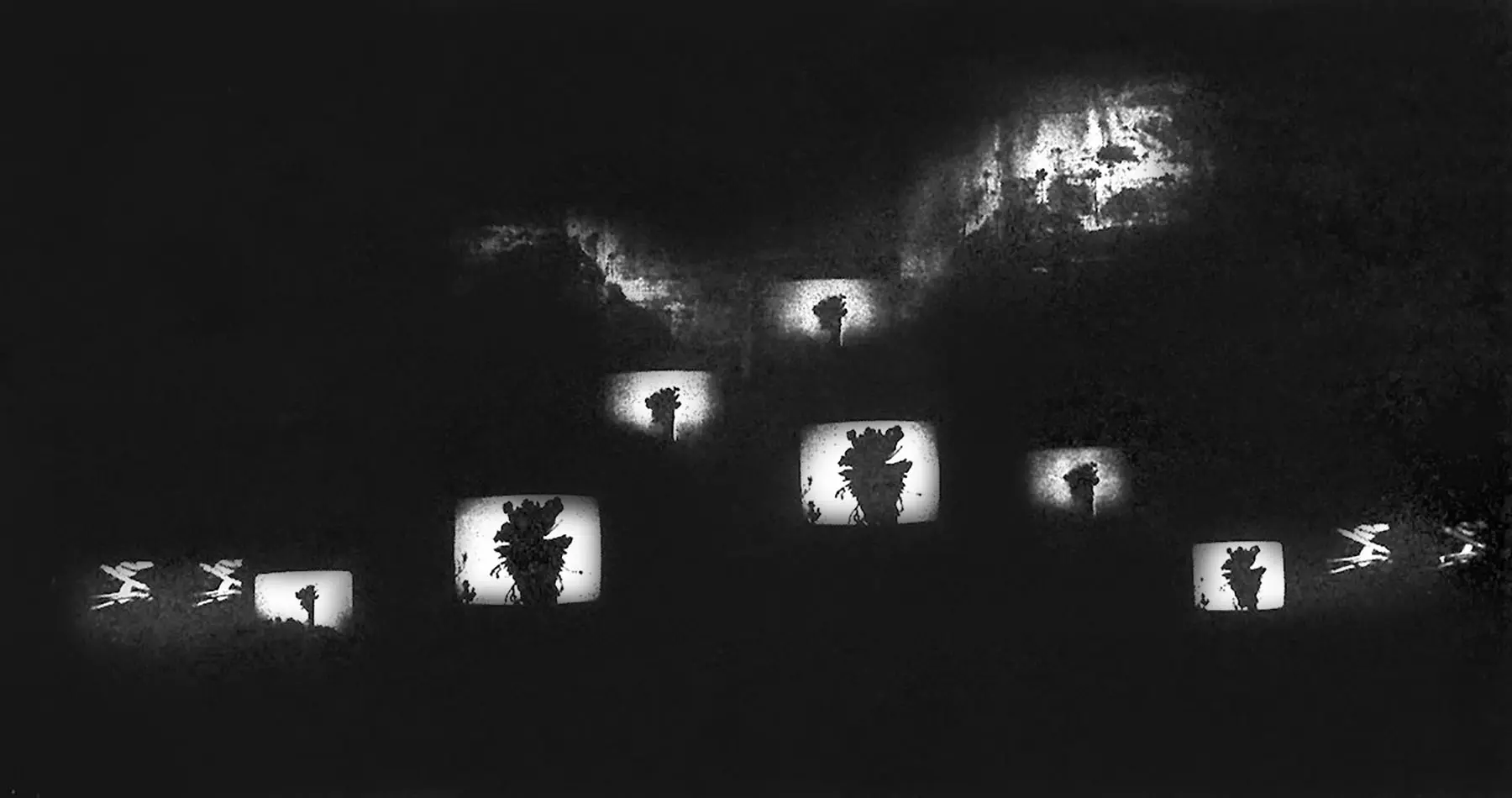
The European voyagers who described Colombia so many times in the nineteenth century like previous colonizers helped to shape a continent with their images and writings. Perhaps the Romantics as well with happy and exciting stories that are in the end a judgment of a partially known reality. José Alejandro Restrepo has for years walked again Humboldt's routes across our country and the result of that experience is his piece El paso del Quindío (The Passage of the Quindío), a video installation in which the high plateau with its wax palm trees and Frailejones (a common plant found in the high Andean plains) trembled on the lines of the television monitors.
But nuances have been added to these first trips through the mountains by means of the image printed on an engraving or on television. Each time he is more aware of the stories that lie there like dusty remains. Looking through them allows him to investigate the profound sense he has given everyday life, our chaotic, sensual, and above all violent history.
"I have a project. It is called Color Theory. It's about black. A theory of the subtle way our society treats black people." And in his method, he also maintains the capacity to react to the events we experience every day, a quality some call sensitivity, and above all to remain attentive to the signs of chance, which is another sort of journey, or rather, a displacement. The encounter with a print, a phrase, the face of a politician printed on a t-shirt, gesticulating senselessly—all the more so because he's covering the back of an indigenous man rowing impassively on the Amazons—all this allows him to escape as if he were discovering the entrance to a lock, in the conventional way events are joined together to create their own constellation. From the dust of history and myth, other universes are born.
He found much in Humboldt's travels and writings. For example, a polemic between Hegel and Humboldt regarding the size of American crocodiles, when closely read, ends up strengthening the exercise of power. Hegel, in Readings on the Philosophy of History, says, "America has shown itself to be and even today is shown to be physically and spiritually impotent. Its lions, tigers, and crocodiles, to the extent they resemble their homonyms in the Old World, are in every respect smaller, weaker, and less powerful." Humboldt, in his American Letters, says, "I voluntarily renounce the beef which Hegel in his ignorance believes to be far superior to American beef and would like to live nearby the delicate and weak crocodiles which unfortunately are 25 feet long." Witnessing this polemic, the crocodile in the video installation slowly winks its third eyelid, for Restrepo makes no judgments. He sticks to verifying the facts. Perhaps the only real ones, for the 25-foot length—rigorously marked out on the wall—of the crocodile he found in a breeding site on the Tolima River is no tall tale. He approached to take a picture of the crocodile. It looked at him, unmoving but prepared to show all of its teeth if he made a single wrong move. Uninterested in the polemic but alive.
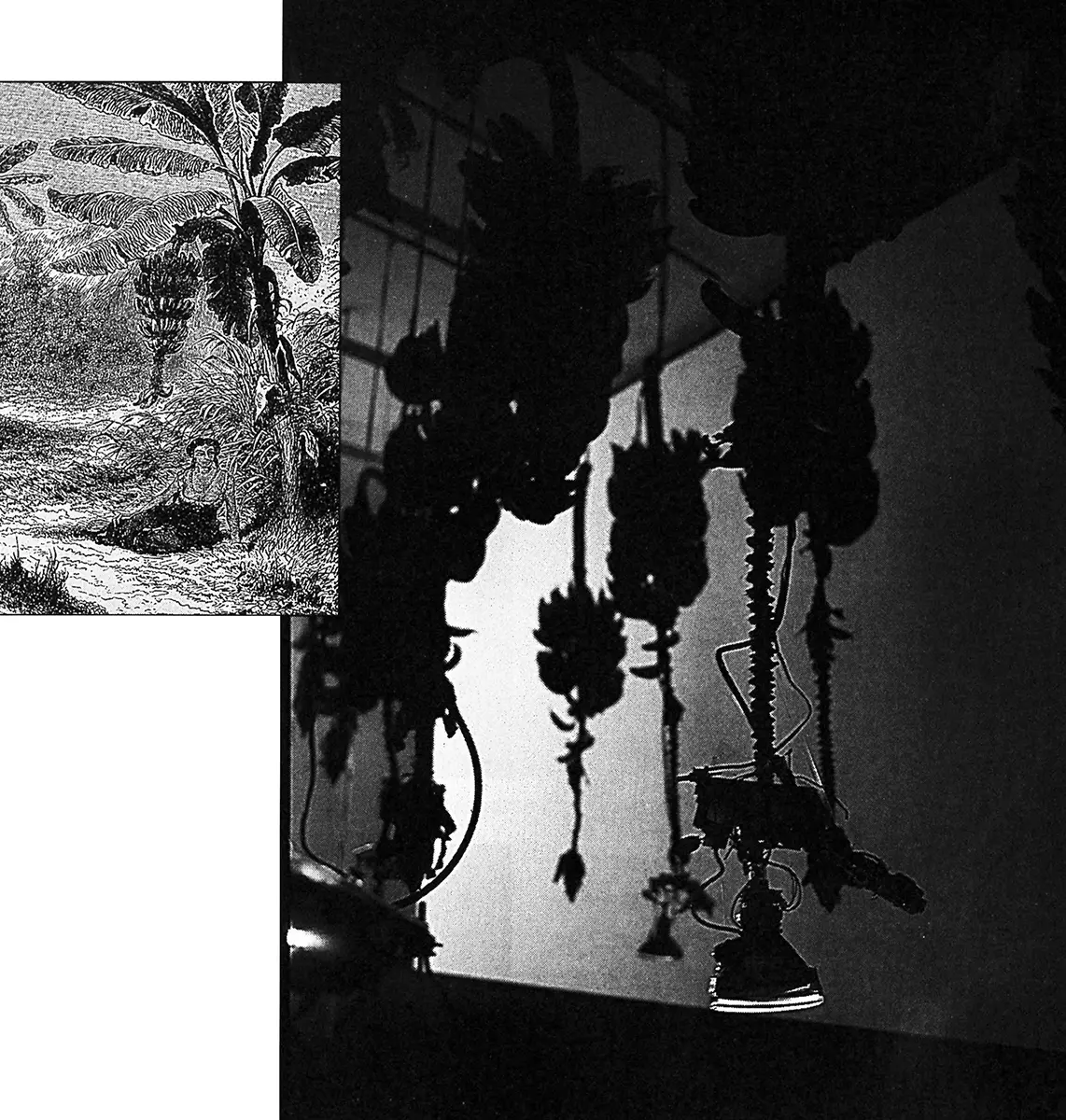
And Restrepo also found the love of his life: The Muse of Paradise, a mulatto woman sitting on the ground under a banana flower in an engraving by Charles Saffray. When one enters this space one feels a lack of certainty that transports the viewer to other territories. In this case, the shades of light created the atmosphere. The engraving on the wall was illuminated. The bunches of bananas hung from the ceiling showed the official story of the exuberance and abundance of the tropics. But in the half-darkness, they were a physical presence, nearly existential, charged with bearing the images reflected against mirrors on the floor: a naked couple, as in paradise, and fragments of news reports sent from the most violent region of our country. The sound was just a murmur and at times turned into static. And yes, one of the characteristics of his work is his respect for reality. This is not a matter of making complacent images that contribute to culture and violence as entertainment. One cannot write or make art with absolute impunity.2 But in contrast to a unilateral vision of the problem, human experience is always present in Restrepo's works as in a ceremony, making art occupy a place in life and even in people's bodies. It could be that it is his dedication to music that gives him the ability to bring what is distant very close, make it pass through us, and cause us to wonder if we are not the beginning and the end.3
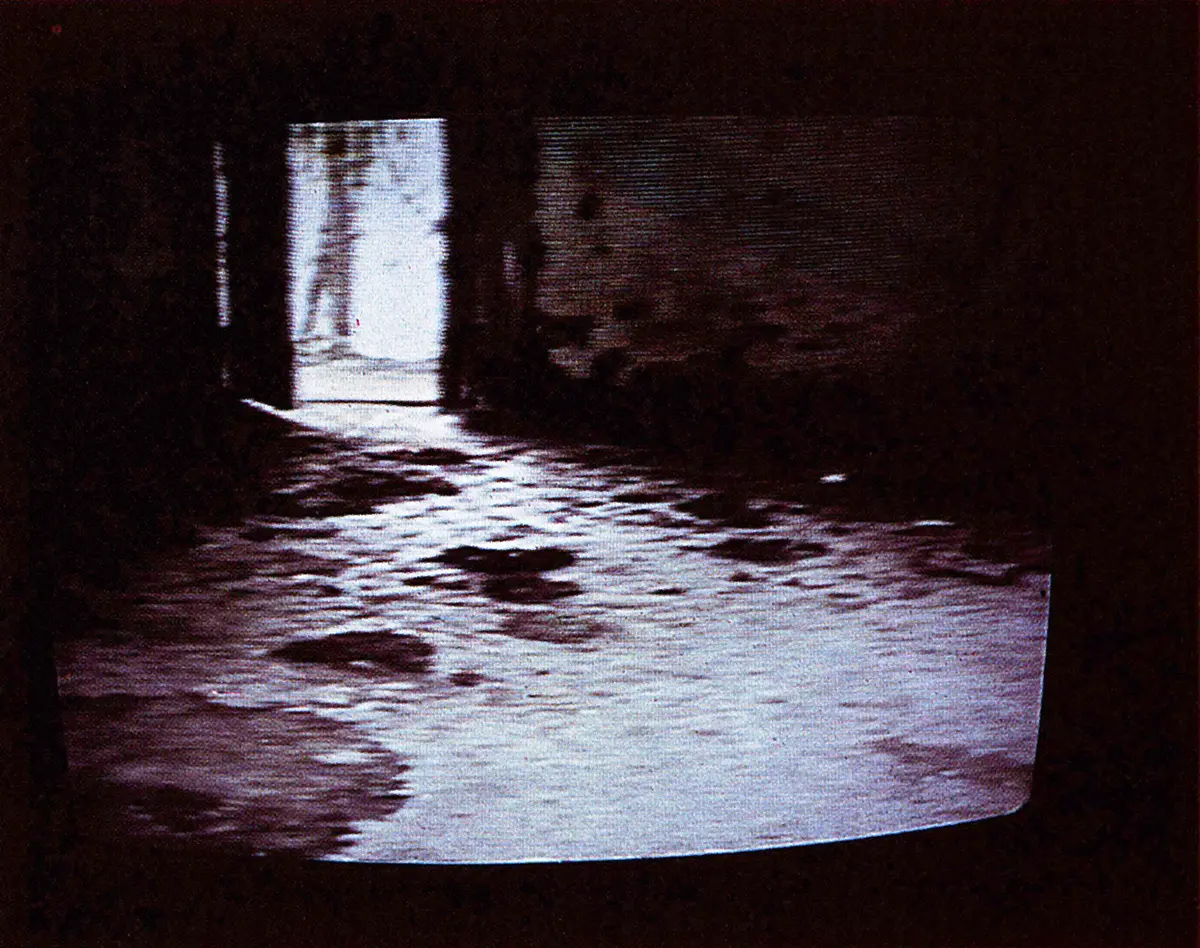
Orestíada (Oresteia) is an example of sound as tension that involves us and in the end, gives sense to what we are seeing. The subtitle is "Oda a Orestes Sindici" (Ode to Orestes Sindici), the Italian who came to our country in the middle of the last century as a singer in an opera company and who composed the national anthem. The images of the video demonstrated the power of Nature imposing itself on an abandoned house in a stifling town where he lived until his death and on the "glory" of an anthem that in the end is a military march sung as an aria from an operetta. What seems to be the sound of applause is a downpour on a zinc roof.
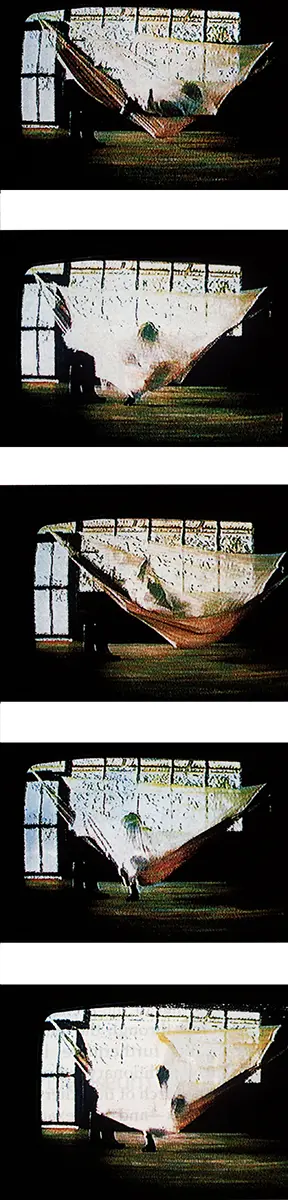
The body is also to be found in the gaze as in baroque art which invites the participation of the viewer. In Ojo por diente (Eye for a Tooth), the photograph of the smiling indigenous man, classified as a cannibal, is placed side by side with that of the archeologist who interprets through the lenses of his glasses. But furthermore, in the videos that expeditionary who goes arrogantly in search of the other finds himself in a fix—and not exactly a philosophical one. He is simply trapped in a hammock with a mosquito netting, unable to get out or feverish with the malaria of his displaced images. And the point is that not everything can be controlled. In Meninas contradanza (Contradance Meninas) staging of the painting by Velázquez, we discover that principle of reality as a questioning of representation. The works of Restrepo try to break the closed circuit of video with an encounter with common expressions of everyday life. In the work, the actors try to be what they are. They play, they get tired, and they have discussions. The idea is not to give in to the seduction of an image nor to the disconcerting nature of life, but rather to find the line between the two. "An error was longed for in order to brush against the truth,"4 says the video. Spanish romances and the songs of blacks recorded in the Chocó— romances as well as their stories of princes and princesses. The actresses play, brush against one another, and finally, their hands clasped in a gesture of complicity. To join together in the attempt to be is perhaps the way to truer images. Time has passed since Restrepo's journey through the study of medicine—of which remains Terebra, a modern attempt to extract the stone of madness as in the painting by El Bosco—the study of the drawing and the engraving, the Department of Art at the National University of Bogotá, the lectures by Foucault and Deleuze in Paris and, of course, the meeting with Beuys, Bill Viola, and, artistically, the experiences with Mapa Teatro, a group that has questioned the stage with the knowledge of bodies in other cultures, and his trips through so many regions of our country. All this by way of remembering that practically 10 years ago, I asked José Alejandro Restrepo in this magazine, What is an installation? And he answered: Cruce Chiasma (Chiasma Cross), his piece of the same name in which two realities of our society literally crossed on the floor: the static policeman and the nervous peasant in constant motion. The reflection that leads us to this point lets us see the space of his video—installations that are not only the crossing of references but a small universe in which myths are pulverized and reinterpreted amidst intervals of silence and sound that glue the viewer to the spot, perhaps because sound locates memory in the body, where it no longer remembers nor forgets but simply is.5
NOTES
1. Franz Boas, quoted by Claude Levi-Strauss, "The Structure of Myths," Antropología estructural.
2. Julio Paredes, "La impunidad divina, A propósito de Juan Carlos Onetti," Sunday magazine in El Espectador, Bogotá, November 9, 1997.
3. Ciorán, El libro de las quimeras, (Tusquets: Barcelona, 1996).
4. Fragment of Rafael Cadena's poem As if.
5. This article is based on conversations with José Alejandro Restrepo, 1996-1997.
NATALIA GUTIÉRREZ
Dean of the School of Fine Arts at the Jorge Tadeo Lozano University in Bogotá.