
In 1967, when José García Cordero was 16 years old, Miguel ángel Asturias became the first Latin American novelist to win the Nobel Prize, Che Guevara died as a revered martyr in the mountains of Bolivia. The Colombian writer Gabriel García Márquez published One Hundred Years of Solitude, the first Latin American novel to achieve international best-seller status. It was a heady combination for the young: a decade of the utopic, New Cinema, New Song, the New Left. Even 1968 remained new with student demonstrations exploding across the globe from Tokyo to Paris, from Berkeley to Mexico City. Hippies and Yippies spread new political doctrines across the United States where generational gaps widened between youth and their elders; special police opened fire on a student-worker demonstration in Tlatelolco, Mexico, creating an unforgettable rift between the old Mexico and the new. South America, Brazil, and the Southern Cone countries were exploring the latest avant-garde art like Pop, Conceptual, Performance, and mail art opened up new avenues of expression for particularly Latin American issues just as the long night of the dictatorships began to fall. Cuba astounded the world with its outstanding political and film posters, while Argentina and Mexico pioneered a continental movement of existential and socially critical art in the first few years of the 1960s which employed the device of monstrosity as evidence of human corruption and decadence in the post World War II period.2
José García Cordero, born in the city of Santiago de los Caballeros of the Dominican Republic in 1951, received the tremors of all these changes and inventions, beset in his home country with the corrupt and enduring dictatorships of Rafael Leonides Trujillo Molina (1930-1960) and that of Joaquín Balaguer (1966-1996), the former assassinated, the second retired at 89, and both ruling with the support of the United States which, in 1963, curtailed the democratic election of Juan Bosch.3 It was Bosch's brief tenure, and his attempt to democratize the nation, that produced a period of euphoria shared by the nation's artists in contrast to the growing unrest and non-conformity under the dictatorships in the face of strict controls over freedom of expression. Artists under Trujillo, for example, were forced to express their ideas in subtly disguised forms.
By the 1960s, a quest for Dominicanness had become compulsive and by 1968, amid reductions in art funding and the rise of commercial patronage (which many artists rejected), there were aesthetic revolts and a search for international ties which caused many young artists to go abroad. Those who remained, or were too young to go in the 1960s, formed sprightly cultural groups, one of which, the 1974 Grupo 6 counted García Cordero as a member. Trained as an architect and historian, it was as a painter that in 1977, he moved to Paris, traveling in Europe and the Americas, but constantly returning to Santo Domingo. By 1989, he shared his time between Paris and the Dominican Republic, spending long periods in Monte Cristi where he built a home and studio, while in 1996, he also established a studio in Montreuil in the suburbs of Paris. This bifurcated existence is epitomized by the 1993 painting Bilingual Dog, the portrait, against a crimson background, of a delicate sad-eyed dog dressed in black, with a pointed snout and ears from whose mouth dangle two long pink tongues. I have been bilingual for fifteen years,» said the artist in 1993. “I live with daily bilingualism. Two languages... are two worlds, two past, two histories.4
Paris, of course, has long been the Mecca for many Latin American artists, considered the metropolitan center of the art world (until partially replaced in the 1960s by New York). It is also a congenial location for speakers of Latin-derived languages. It has also been the city for Latin American political refugees as poignantly epitomized in Fernando Solanas' 1968 film Tangos: The Exile of Gardel which traces back to the days of Carlos Gardel in Paris the large Argentine exile population that fled the dirty war of the dictatorship in the 1970s and 1980s. The 1970s also witnessed a huge influx of Chilean refugees numerous enough to have established their own (now defunct) art gallery and restaurant.
Not only did García Cordero join this population, but he had reasons similar to those of the Argentines and Chileans for going into exile: the asphyxiating atmosphere of the Dominican Republic under its sixty years of dictatorships, its history of repression, assassinations, and Desaparecidos, especially under Balaguer, made continual residence painful for a free spirit.5 Under the status of self-exile, his history since 1977 also became one of the restless and exploratory journeys, apparently attempting unsuccessfully to reintegrate himself into the Dominican Republic. It is notable that his paintings, like Goya's before him, remain dark— not in color—which is usually brilliant, but in spirit. Their other characteristic is their nationalism— their symbolism and thematic elements, though informed by an international mindset of both literary and artistic sources, generally derive from the Caribbean. They are sea-based and tropical, they reflect the plant and animal life of the islands, and they are comments on the social, political, and mythological life of Hispaniola—or Quisqueya, the Taino-Arawak nomenclature equivalent to Puerto Rico's Borinquen— that designates today's division between the Dominican Republic and Haiti. That García chose the northeastern site of Monte Cristi for his permanent home, close to the Haitian border, is not only symbolic of his personal African heritage but of his father's political exile by the Dominican government.
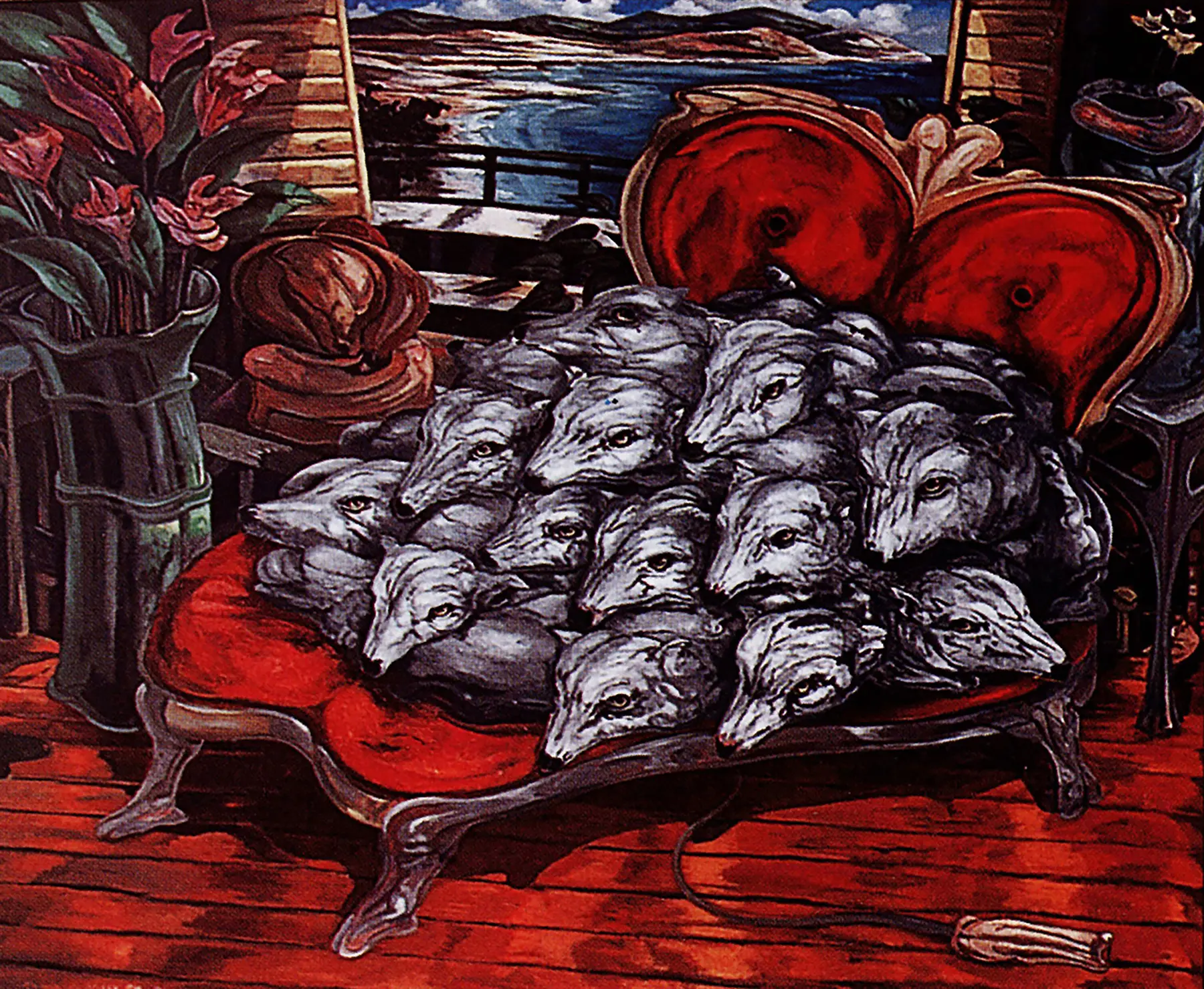
In fact, the self-image of the Bilingual Dog, and all it implies, could be the logo for several generations of people (including the French-speaking Haitians who migrate to the U.S. and the Dominican Republic) dispossessed from their homelands for political or economic reasons (or both) who live bilingual lives, many without the luxury of visiting or returning to their natal countries. A related idea is represented in The Myth of Sisyphus of 1995 in which the short stocky body of the artist holds above his head a gigantic horizontal bow-shaped serpent that extends the length of the painting. Painted in tonalities of grays, the only colors are the fiery tongue of the snake and the pinkish skin tones of the sharply-dressed artist, reflecting his Parisian residence. According to the Greek myth, Sisyphus was punished for his arrogance toward Zeus by being condemned to the daily labor of pushing a heavy load to the top of a hill, only to begin again the next day.
The true lesson of this repetitive punishment, so characteristic of Greek fatalism, came to García from Albert Camus— particularly his essay The Myth of Sisyphus where Camus first articulated his theory of the absurd, a metaphysics that seems to play a central role in the philosophy of García Cordero. Conscious man, confronting an unintelligible universe, aware that absolute knowledge is not achievable, must reject despair and suicide. Sisyphus, accomplishing his daily task is, therefore, an exemplary here of the absurdist, one who finds his happiness in his daily work.6 As García himself has stated, being bilingual has been difficult. Despite his Latin roots, learning French took much effort. I seek abandonment, a life without a time clock, but I live enclosed between dates, with proposals for actions to be realized. I need this order, just as I need the sea. I have to give form to the idea of "madness"; only there lies subversion, and attaining it does away with duality.7
A clear signal was also given by García Cordero from Latin America—that which is fabulous can also be political, social, and critical. Sex and the erotic could be revolutionary and liberating, from the Songs of Solomon to the Hippies. Social Realism was dead but long live Social Criticism dressed in Caribbean plumes, placed in settings like Macondo or the tropical Dominican forests and beaches. Magritte could be appropriated for the act, as could Aesop's fables, or the fantastic myths of the Old and the New Testament. The artist is not familiar with the bestiary of the late Uruguayan master, Luis Solari, whose graphic moral admonitions were populated with clothed animals and birds, demons and saints, nor perhaps with the monsters of Mexican caricaturist José Guadalupe Posada, but he is familiar with Goya's prints of similarly invented donkeys, chickens, and other creatures meant to criticism Spanish society, high and low.
There is little doubt that García drew from the great storehouse of European painting and prints—available to him in the Louvre and other museums since 1977. However, in the century of what André Malraux called the museum without walls, and which Walter Benjamin referred to as the age of mechanical reproduction, books of all varieties are always available to the curious seeker, albeit not as plentifully in the Third World as the First. Certainly, motifs like the medieval paintings of the Ship of Fools were utilized, or moralistic Renaissance works such as those of Hieron-ymous Bosch—particularly the amazing and heretical Garden of Earthly Delight after which García named his 1994 exhibition, The Gardens of Delirium. The theme painting within this series pictures fourteen glass jars containing gray organic forms in fluid, each topped with a waxy crimson Anthurium flower, resting on an ornate coffee table covered with a cloth beneath which appear his famous soulful dogs. This interior landscape is complemented by another possibly indebted to Camus, Project for an Interior Garden of Circumstances where seven bald human heads have been inserted into the nose within terracotta pots on a table sporting a mechanical device within and an electric plug without, before an easel and an open window.
It was not only Bosch crossed García's horizons, but also Pieter Bruegel the Elder, particularly his well-known Tower of Babel. In fact, primitive Flemish realism with its suggestive and often microscopic detail proved more fascinating to this artist than the rationalism of the Italian school and is more closely akin to the naturalistic surrealists like Rene Magritte, whom he occasionally references. They are part of García's Caribbean potpourri enhanced by influences from Francis Bacon (both form and meaning) and a kindred fascination with the period of the Baroque. Another source is the ornate, claustrophobic, crowded furnishings and knickknacks of post-Victorian middle-class homes, memorable nostalgic revivals that can also be found among the younger artists of Puerto Rico and of Cuba-in- exile, often with a wry, humorous or dolorous exaggeration. Many homes in the northeastern area of the Dominican Republic where he lives, says the artist, display antique furnishings (including stuffed sofas or chaise longues) with carved animal feet, brilliant fabrics, and curvilinear shapes such as appear in his paintings inhabited by dogs. Fancy tables, flower vases, and the famous Regency-style Duncan Phyfe tables with curved legs fanning from a central column that holds the round top, so popular in still-life paintings by Braque, appear in variations of his interior landscapes.
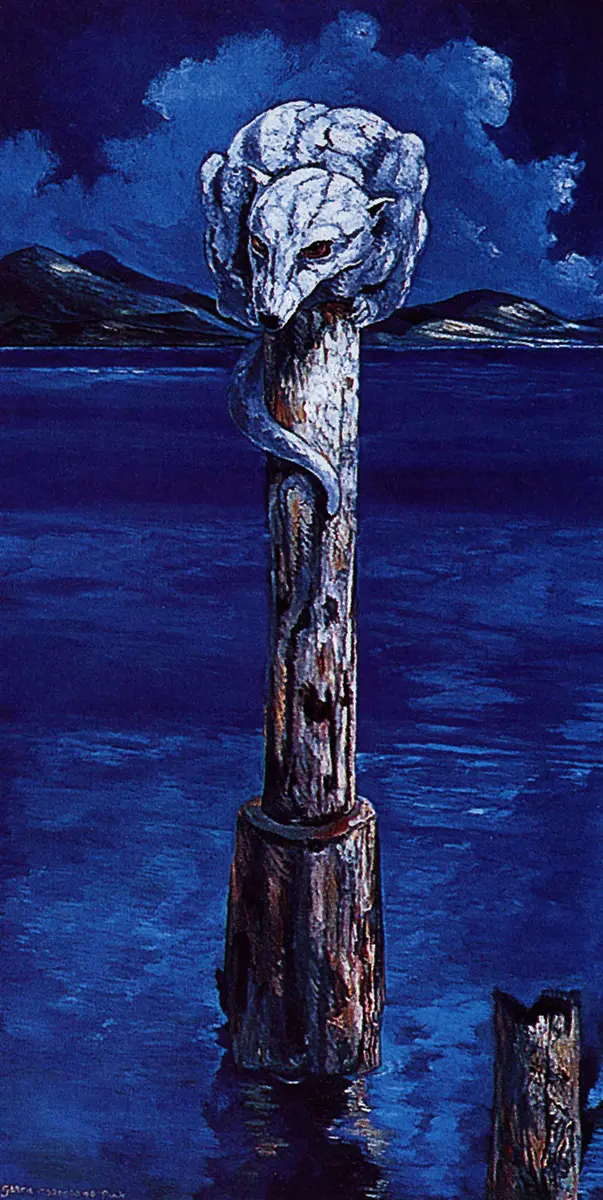
García Cordero's world is indeed fabulous: each work is a singular fable, illustrating not only a moral but a critical social text. Nor does the artist entrust the full dimension of his concepts to painted iconography—titles and brief texts further elaborate his ideas, in a cherished tradition of Latin American literacy long criticized by European and North American modernists and formalists. Such titles as Head on a Baroque Table, The Mirror of Reason, The Little Devil of the Night Table, Red Riding Hood, and A Fishing Day in Haiti, coexist with homages to specific painters and writers, e.g., The Dream of García Márquez, Magritte's Dreams, Flowers of the Sea (in which a redfish filet on a silver platter has a real eye at the joint, like Magritte's slice of ham on a plate), or The Discrete Charm of the Bourgeoisie which derives from Luis Bunuel's famous film. García is an insatiable reader, including Dante, the Marquis de Sade, Jorge Luis Borges (surely the mediations on The Library of Babel in which researchers spend their lives in hexagonal rooms in a constant search for meaning: of The Babylonian Lottery referring to a state-run like a lottery with totally haphazard rewards and punishments, would be parallels for García, especially his two Babelian paintings), the stories of Julio Cortázar, or the poetry of José Lezama Lima, and so forth. The more political motifs, though still in the realm of the fable or the allegory, include various versions of Boat People, Crimes of Impunity by J.B. [Joaquín Balaguer] (Forest of the Hanged Man), Apotheosis of a Dictator, the Cocaine Man, Torture Never Stops, and Welcome to the Caribbean—in which a group of dogs mounted on columns immersed in water before a paradisical scene of hills and clouds extend a ferocious glare of red eyes to visitors; the pilloried animals, i.e. the natives of the paradise, are no longer receptive to exploitive tourism.
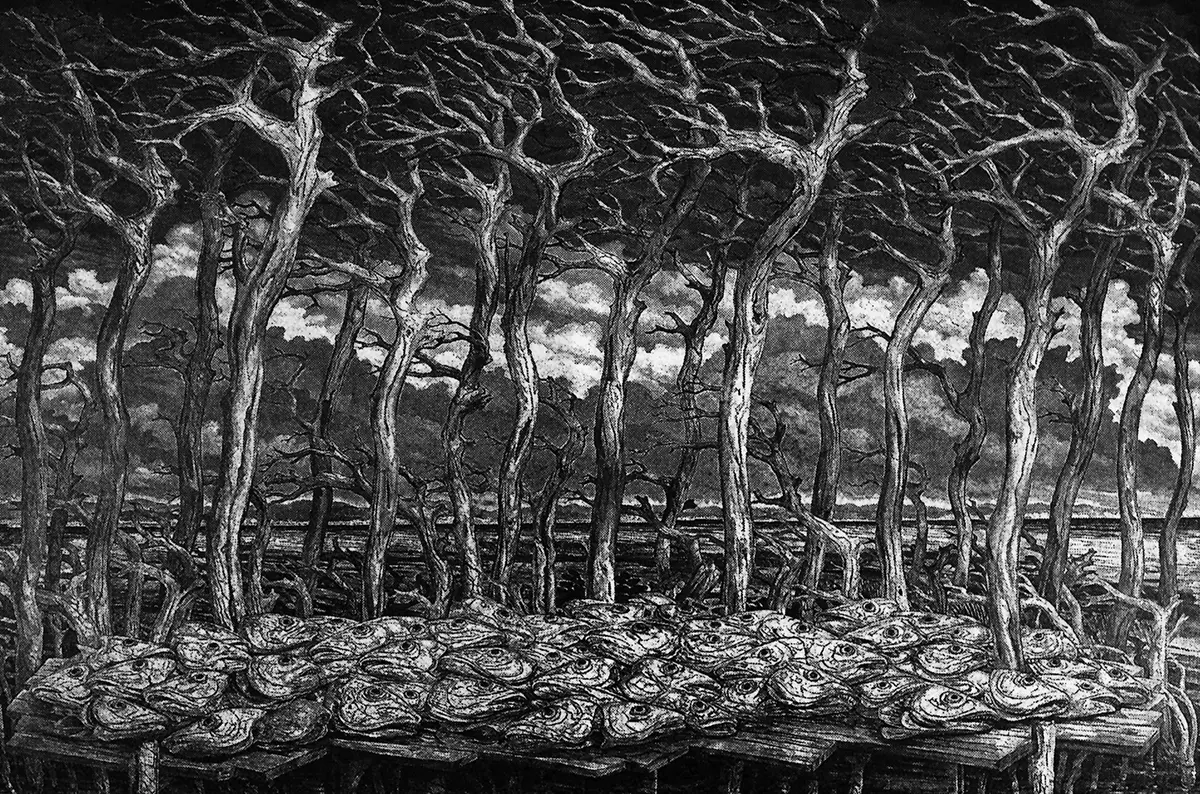
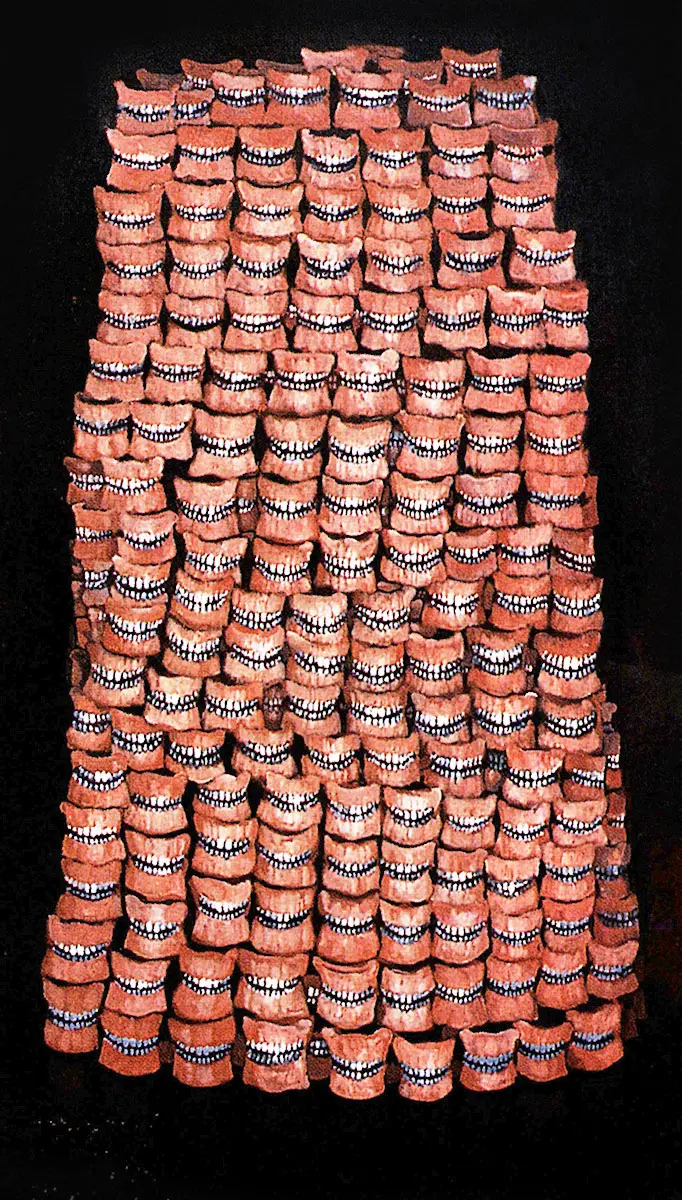
The Tower of Babel has two versions. The first tower (1994) is startlingly composed of entire dentures of teeth—actually skeletal in intent as the skull plays a repeated role in García's iconography. The idea of dead mouths representing the allegory of Babel, in which the Hebrew God replaces Zeus to punish humankind for its transgressions against heavenly power, contains multiple levels of new meanings. Speech has been replaced, in the postmodern era, by mass media and mass entertainment. Dumbness is a form of death since it goes further than linguistic incomprehensibility; it extends to the brain, struck dumb by corporate manipulation of the means of communication. On the other hand, the artist considers these grinning mouths a political satire on the toothy smile of former U.S. president Jimmy Carter. The second version, named Watch Tower, after a Bob Dylan song performed by Jimi Hendrix, All Along with the Watch Tower, replaces the teeth with eyes in an even more frightening Orwellian prediction of being constantly watched. Conversely, they can refer to the giving of testimony based on what can be seen and observed. These towers of Babel are distinctly contemporary.
The Last dog (1994) employs a leitmotif of the artist, one which on occasion serves as a surrogate for himself. Meek, erotic, soulful, sad, with large eyes and pointed noses, the dogs appear constantly. He considers them victims: a parody of people who don't resist oppression and assume the characteristics of dogs —either meek or ferocious. Those of the middle class who sit on a chaise lounge (Discrete Charm of the Bourgeoisie II) ensure their status with meekness; those who suffer may bark or snarl, but never attack their masters. The last dog curls his tail meekly around the column in the water: the belligerence of Welcome to the Caribbean is nowhere in sight. Only the Filet is Considered Important (1996) imagines another ubiquitous actor in the García Cordero theater: the most common in his category of sea animals. This is a mix of the dorado (dolphin) caught as a sporting and food fish, to which sharp barracuda-like teeth are added. Among the barren trees, the saltwater, and the hills of Ocoa Bay—despite its enervating humidity and heat—many sportsmen (tourists/entrepreneurs?) use the bay as an excellent location for sea fishing. García Cordero uses the site as a metaphor for the exploitation of Caribbean resources and population. Once the meat has been consumed, nothing else matters.
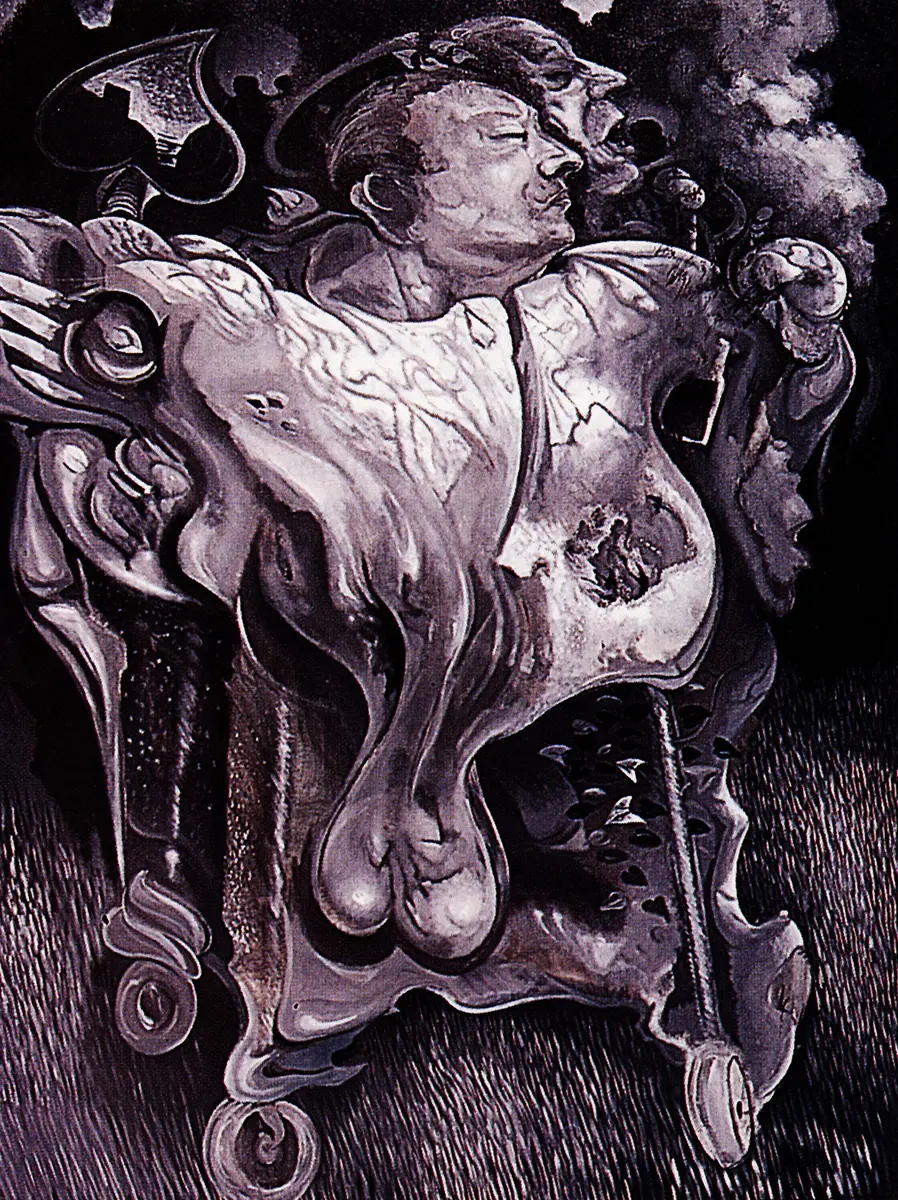
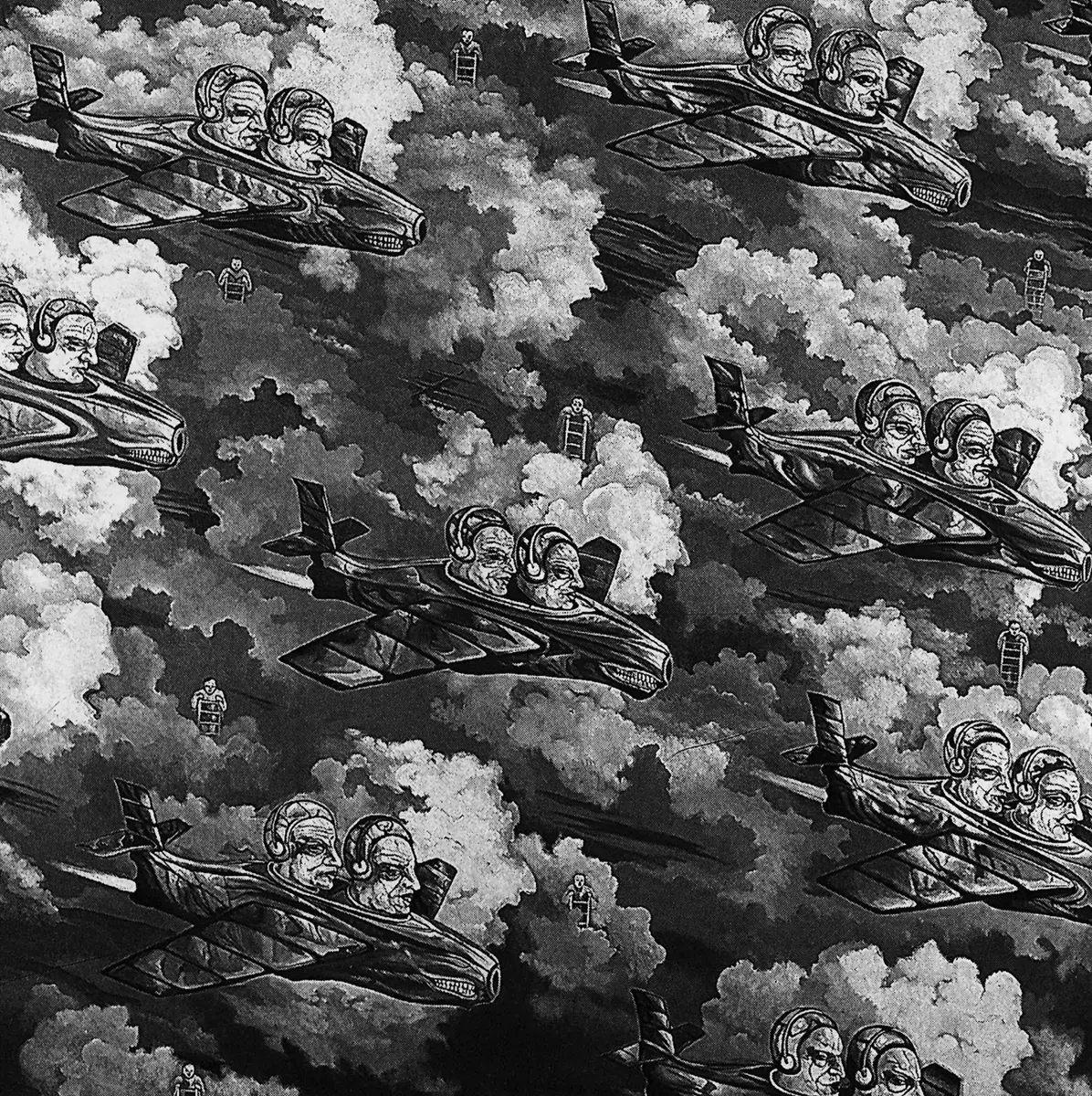
Finally, two very recent paintings, Come Down From That Cloud (1996), and Apotheosis of a Dictator (1997) temporarily abandon color. The cloud may refer to the atmospheric apparition behind which hide small shark-like airplanes with grim aviators connected to earphones, or to the concept of coming out of a dream, reinforced by the boyish figure of the artist on a ladder that thrusts through the clouds. The reference here is to the running of cocaine through the Caribbean, unobserved accidentally or deliberately by those on the ground. Apotheosis is a direct but grim reference to Balaguer—in his youth and his old age. As a younger macho or an old man who still exercises power, though blind and toothless, he remains a fearful symbol paraded on a wheeled cart that provides the power behind his throne.
NOTES
1. José García Cordero: Gardens of Delirium, catalog, Lumbreras-Fisher Fine Art, 1994 Coral Gables, FL. The French essayist in this catalog invokes the "passionate intensity" of Gauguin, the "spatial symphony" of Matisse, the "expressive escapism- of Van Gogh, and the "realism" of Diego Rivera's “tortured trees" as explanations for the work of García Cordero. I would be remiss not to point out my disagreement with these comparisons—both the descriptive adjectives for the European artists and the reference to Rivera's brief flirtation with surrealism after his friendship with André Breton—as well as their noticeable impact on García's work. García claims his trees derive from hurricane devastation, not Rivera and that neither Gaugin nor Matisse played an important role in his painting. In his article, all translations are by the author.
2. Argentina’s Otra Figuración and Mexico’s Nueva Presencia were the tip of the iceberg. Though not yet documented, a wave of interest in such expression manifested itself throughout the 1960s and 1970s in many countries, forming a bridge between concrete and neo-concrete abstractionism, and the internationalization of conceptual art which remains a strong component of critical statement in Latin America. Practitioners appeared in Brazil, Colombia, Chile, Venezuela, and even Cuba where the paintings of Antonia Eiriz should be classified with this continental movement.
3. In 1996, a young candidate with no political history, Leonel Fernández Reyna, raised in New York, won the presidency with a second ballot on the ticket of the Dominican Liberation Party after an alliance made with the blind and elderly Balaguer who, though retired, still controls a dominant block in the nation’s Congress. The third candidate, former mayor of Santo Domingo, José Francisco Peña Gómez, was defrauded in the 1994 election, and isolated in 1996 by an insulting campaign based on an old Dominican political policy of anti- Haitian, anti-black racism, exercised despite the interracial character of the nation and its popular culture.
4. "Un bilingüe entre dos mundos," interview of García Cordero by Kael Phillips Hartung, El trío cálido 1, No. 1 June 24, 1993 (Paris and Santo Domingo: Prensa de la Negra Noche) p.18.
5. Author's telephone interview with the artist, August 17, 1997.
6. Algerian-born French writer Camus is notable, as well, for his novels like The Rebel, The Plague, and The Fall in which the absurdity of existence by no means precludes rebellion against circumstances.
7. Ibid. "Un bilingüe entre dos mundos".
SHIFRA GOLDMAN
Art Historian and Researcher at the Latin American Center and the Art History Department. University of California, Los Ángeles.