Juan Downey, who was born in Santiago de Chile in 1940 and who died prematurely in New York in 1993, belonged to that category of artists whose work was inseparable from their experience and intellectual development. Although it may seem a commonplace to say so, his work was intimately linked with his life in that in most cases it was the reflection of his journeys throughout the American continent, his direct experience with the various realities which he encountered, and the conclusions to which such experiences led him. The video was his central language, and he used it as a tool that enabled him not only to experiment with the results of the work itself but to try out, through video, communication strategies with receptors and spectators who were alien to the artistic process.
The video which he made during his travels and which took shape in the project titled Video Trans Américas, is not a documentary in the strict sense of the term, but rather a plastic reflection on the reality and its documentation: the objectives are to reveal forms of life and American realities in various places and socio-cultural contexts of the continent which maintain no connection as such amongst themselves. The act of recording and immediately showing what has been collected in other contexts implies an artistic and vital attitude that is very seriously committed to the search for identity, and above all, to a determination to intervene at the political and social levels in the widest sense. In a sense, his artistic experience can be assimilated with the impetus that inspired certain artists and writers of European Romanticism who looked upon travel as a decisive experience of life. But whereas those writers and artists emphasized the exotic as a kind of refuge, which opened up the way to an Orientalism of an imperialistic, dominating, and colonial kind, in which aesthetic experience was diluted into a superficial image, Juan Downey persistently sought something very different—the elements which would allow the construction from a critical stance of an American identity which was impossible, improbable and contradictory, but which took account of permanent resistance to that which was colonial. This was the case, for example, with his video-installation project Rewe (1991), the title of which is taken from the Mapuche language from Chile, and which referred to a carved tree—rather like a totem— which a priestess climbs to address the spirits, in an interpretation of a ritual which includes the use of drums, cries, and lamentations from the community. The work reconstructs a tree with eight television screens showing images of NASA space expeditions and scenes from films about Christopher Columbus and others recorded in a New York studio in a dramatization of the legend of the Columbus egg, and a retro-projection screen above which cyclically shows texts highlighting the contradictions contained in the words "Indian (geographical error)," "America (chance which led to the omission of Columbus)," and "Latin (the language of the Catholic religious power which suppressed the native religious identity)," to define a Latin American identity. These three words define by negation, by error, and by mistake, so the fight for identity also requires a fight at the level of language. According to Downey, Rewe shows that there is no real Latin American identity.
Downey can, without doubt, be considered as one of the first Latin American artists who energetically initiated video art in the 1970s, actively involving himself with the incipient new technologies—although his work was not circumscribed to the formalist dimension of controlling and using video and film media, used them to make a heartrending reflection of Latin American identity, as history, as a social and cultural problem, as an exponent of a vital experience and as a framework for a political attitude.
This exhibition, subtitled With Energy Beyond These Walls, which IVAM presented in its Carmen premises, was curated by Nuria Enguita and Juan Guardiola. It makes an exhaustive review of the artist's various kinds of production, with a selection of projects, drawings, photographic collages, mono-channel videos, and multimedia installations, as well as a parallel section on the artist’s video works.
The montage was organized around two of his most emblematic and significant series: Video Trans Americas (which includes the videos, maps, drawings, and projects of installations carried out between 1973 and 1976 during various trips to Mexico, Guatemala, Peru, Bolivia, and Chile, as well as all the material prepared between 1976 and 1977 during a period of residence with the Guahibos and Yanomami in the intermediate and upper Orinoco in Venezuela) and The Thinking Eye (a series of productions devised for television in the form of cultural documentaries in which Downey reviewed critically, at the beginning of the 1980s, the symbols, and systems of representation in Western culture). Downey's penetrating and profound eye struggled to understand the contradictions of the world in which he lived, in which the most advanced technology enabled him to work with the most primitive existential registers. There are no pre-eminent categories, and each aspect of reality helps us to understand the complexity of the global whole.
The interest shown by his work in the European baroque or the indigenous cultures of the Amazon forest forms the basis of a reflection whose objective was not documentation but the questioning of understanding. Nothing is contradictory. On the one hand, the Meditations series—the drawings done in the Venezuelan jungle during his period of residence with the native inhabitants in the form of meticulous, infinite spirals—is a way of perceiving the world in terms of contemplation and light, while The Thinking Eye focuses representation by centering on the problems resulting from the use of the mirror in the architectonic and pictorial space of the European baroque to define its character, which was not only spectacular but centered on the power of representation and the glorification of power.
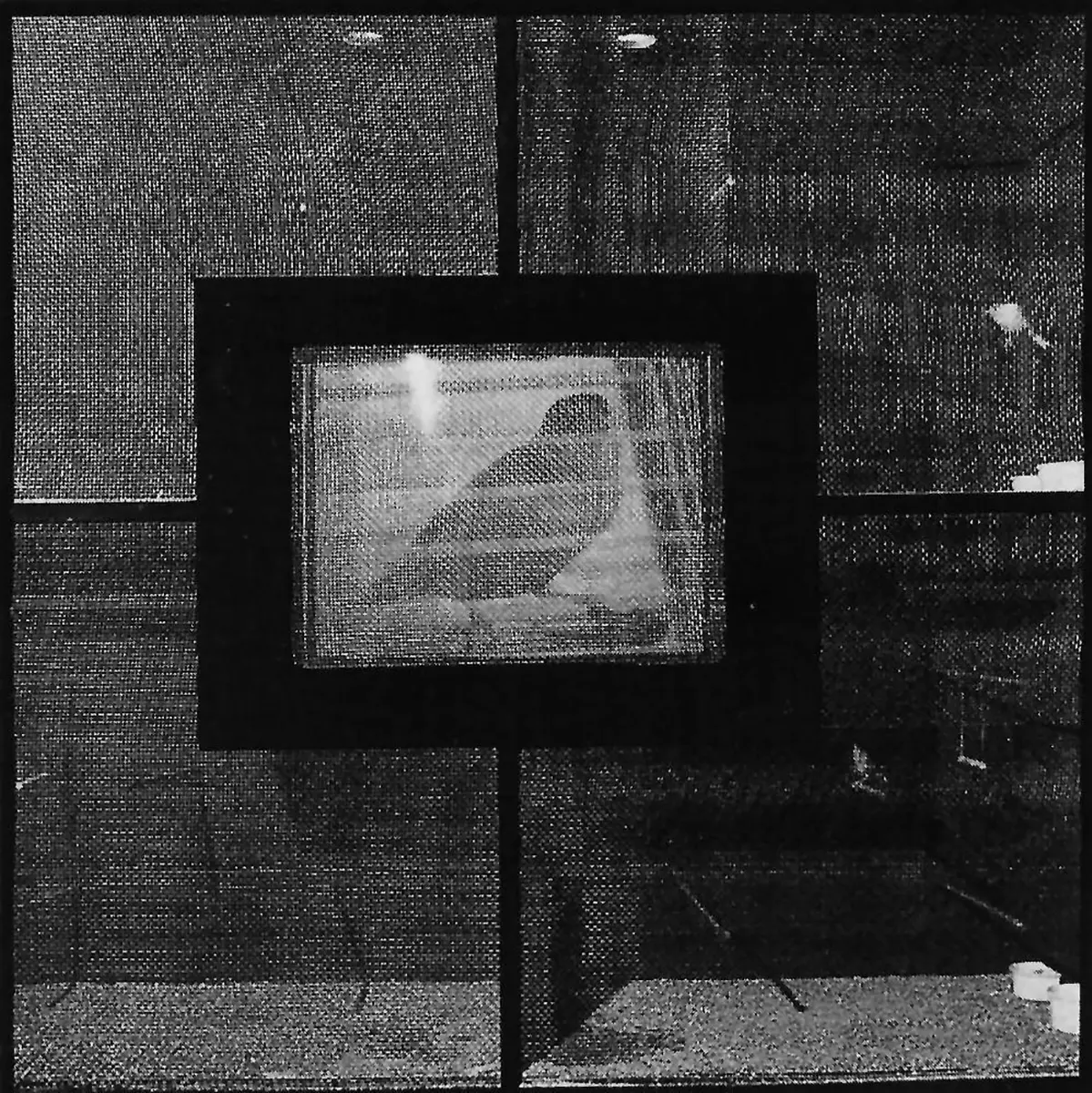
The political problems of his own country, Chile, were not disregarded by the artist at a time when he could see from the United States the destruction of Allende’s project of democratic socialism. One of the most astonishing pieces in this exhibition was about precisely that. In About Cages, presented at the World Wide Video Festival-Kijkhaus in The Hague in 1987, Downey used the drama of the coup d’état of 1973 to comment on the permanent dynamics of the oppressed and their weakness vis à vis the arbitrariness of power and torture- four cages with various living canaries inside were placed around a gigantic television screen which showed the image of a caged bird, with a simultaneous soundtrack narrating from the diary of Anne Frank superimposed over the testimony of a Chilean intelligence agent who describes in detail interrogation and torture activities after the military coup by Pinochet. The voices and the artificial light of the screen created an enveloping atmosphere in which the metaphors become precise allegorical descriptions, which speak for themselves.
SANTIAGO B. OLMO