During the second half of 1997, the National Museum of Bogota presented an exhibition of work by Luis Caballero, Untitled, covering a good part of his production from the 1960s, and specifically during the years from 1966 to 1968, the only period in which the artist, who died in 1995, worked in Bogota. The exhibition, which was curated by Beatriz Caballero, Beatriz González, and Juan Camilo Sierra Restrepo, was one of the most significant national exhibitions this year. Its importance lay not only in the relevance of the artist himself and in the quality of the works on display, but in the way in which the curators focused on this decade, specifically through the work of Luis Caballero. The show was also outstanding in its excellent and audacious installation and its accompanying catalog.
The exhibition centered on the work The Chamber of Love, or Untitled, with which Luis Caballero won first prize at the First Ibero-American Biennial of Medellin in I968. It is a polyptych painted in mixed media on canvas and made up of 18 panels which for the first time were shown here as a whole, creating together a three-dimensional cubic space that breaks with the traditional two dimensions of painting. This work and those which preceded it, seen from the perspective of the present, revealed that the concerns of Luis Caballero were always the same and that particularity of the work which he carried out in that decade lay in the sources to which he had recourse—and which were radically different from those of his later work in which there prevailed exasperated expressionism recalling the more dramatic works of Michelangelo, Géricault and Delacroix. The career of Caballero has become known in Bogota through two retrospective exhibitions at the Biblioteca Luis Angel Arango, one of them titled Retrospective of a Confession, held in 1991.
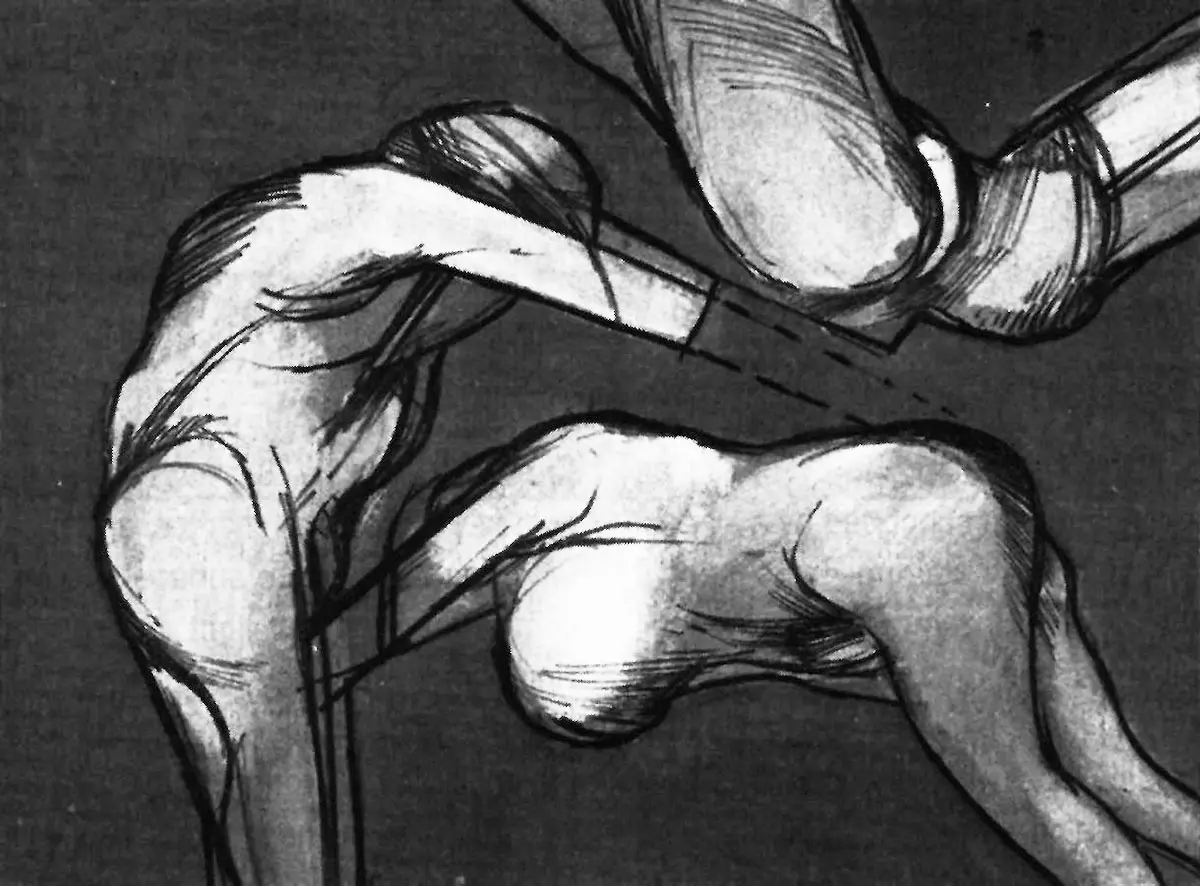
As we look back over Caballero's work, it is clear that the 1960s were a very unusual period—extremely short, but also very intense, a period of training and the beginning of a constant search full of suggestive nuances which are exhaustively examined in this exhibition. In the 1960s, Luis Caballero was searching for his own language and means of expression, a process which resulted in figuration that contained echoes of pop, particularly that of Allan Jones, with the expressionism of de Kooning and Bacon, the gesture of Matta—influences which are all highlighted in this show at the National Museum and which resulted in a very special iconography which Caballero abandoned in the 1970s in favor of another which insisted, like the former, on capturing in an image a sense of ecstasy, violence, the amorous passion of bodies coming together desperately, touching each other and kissing each other. In this process, Caballero used figures which contained monumental elements, in which the strength and tension of the bodies were reflected in the gestural line work which predominated in his drawing and painting, characteristics which are common to all his production in which, as he himself said, he was always looking for the same image. There is the persistent presence of eroticism that in the 1960s was less spiritual and mystical than in his other periods, closer to the brutality of his destroyed bodies of Bacon. It was a time in which Caballero said, "I am devoting myself to copying Bacon in the most flagrant manner."
The purpose of the polyptych becomes explicit in the context of the words of the artist, "Painting is not a matter of making pictures, but of expressing yourself through color and forms. Creating with these elements something which has a life of its own. Something which is moving, disturbing, and which has a genuine presence. . .the spectator generally rejects this presence and does not manage to understand and accept this new world which each artist proposes...Hence the idea of introducing the spectator to a pictorial cube, in the hope of forcing his senses and making him see and understand. Above all see."
The exhibition presented 49 works, including sketches, drawings, paintings, and prints which were organized into four periods in the development of Caballero’s work. The montage was essentially designed to highlight the presence of the polyptych, its background, and consequences, so that when the visitor entered the room, he could see a large format drawing from 1966 which initiated a diagonal perspective that visually ended with the polyptych, including beforehand a painting with strong flat colors. On both sides of the room, very close to the ceiling, there were two paintings that extended out over the whole, so that the visitor, with one initial glance, could cover all the essential periods through which Caballero went in this short and fertile period. The visit began with a series of drawings in oil on paper from 1966, where the excellent and firm draughtsmanship reflected a clear desire for expression based on white and black strokes, very free and thick, which were already pointing ahead toward such typical characteristics of Caballero work as the oscillation between the pictorial and the linear, as well as the presence of massive, closed bodies.
There then followed a second period in the same year, which was definitively influenced by pop, Bacon, de Kooning, and Matta, with some paintings, worked in bright colors, sometimes very flat, and whose images recall those of other Colombian artists who were engaged in similar pursuits during that decade. However, the strength of the bodies signals the quintessential characteristic of Caballero's work. These works included two figures of women in bathing suits with a marked pop accent, a painting which was accompanied by others in more expressive tones. In this exhibition, the period ended with a series of small-format color drawings in which the nervous graphic elements and the stains of the color point forward to the polyptych.
The final period was titled Summary and Apotheosis of a Form in which Caballero abandoned the female form and focused on the prostrate bodies of men which, as in the polyptych, move closer, rise up and fall, bodies with which Caballero emphasizes his habitual pictorial drawing in which the linework achieves a clear formal synthesis that was also evident in some of the prints included in this exhibition. Guiding the visitor at every stage were a number of panels with critical information or comments by the artist himself that facilitated the understanding of the works. The catalog, published with the collaboration of Beatriz Caballero, the artist’s sister who is also a writer, included an affectionate account of the artist that allowed well-known and relatively unknown aspects of his production to be looked at from a new perspective. The catalog also included a piece by the British critic Edward Lucie-Smith, who examines in detail the influence of foreign artists on Caballero’s work in the 1960s, influences which are carefully studied and then examined in the context of the artist's biography.
The research carried out by Beatriz González, in line with the new policy of the Museum, has a marked historical focus and examines Caballero’s work from the 1960s in the context of the national production which from the previous decade had made the definitive shift towards modern art as a result of the critical work of Marta Traba. This detailed examination of a segment of Caballero's production will undoubtedly shed light on his meaning within the history of our national art. All the works in the show are excellently reproduced in the catalog, which also contains a chronology and bibliography. Its publication will make a significant contribution to the small amount of historical research material available in the country.
MARTA RODRÍGUEZ