A major retrospective exhibition of the work of María Izquierdo (1902-1955), one of the most outstanding figures of twentieth-century Latin American art, was held at the Americas Society from May to July of 1997. The show, curated by Elizabeth Ferrer, gathered together a selection of works by this great representative of modem Mexican art known for her poetic and autobiographical style.
Maria Cenobia Izquierdo was bom in San Juan de los Lagos, Jalisco. After becoming an orphan, she was brought up by her grandmother and an aunt, a religious woman who educated her in a strict and devout environment. At the age of 14, she married Cándido Posadas, a member of the armed forces. The two had three children, and in 1921, moved to Mexico City. In the capital city, Izquierdo quickly established contact with the rich cultural milieu of the 1920s, and in a break with the conservative pattern which had governed her life until then, separated from her husband and enrolled herself in the National School of Fine Arts in 1928. But her academic experience was very short-lived. Frustrated by the rigidity of the teaching methods and rejected by her friends after being singled out by Diego Rivera as the most outstanding participant in an exhibition of student works with the celebrated phrase "This is the only one," María Izquierdo abandoned her formal studies.
From 1929, she maintained close personal and professional links with Rufino Tamayo.1 While she lived with Tamayo, she developed her own pictorial style and became recognized as a dedicated artist. In 1930 she showed her work at the Art Center in New York and became the first Mexican woman to have a one-person show in the United States. At the same time, one of her works was included in the Mexican Arts exhibition at the Metropolitan Museum of Art. Her professional success was overshadowed by her break with Rufino Tamayo in 1933. From that time on, her personal life became a constant struggle for survival as a single mother and artist - two conditions rejected by Mexican society. However, Izquierdo managed to remain a pioneer, at both the artistic and political levels, and a leading figure in the women's emancipation movement.
In the early 1940s, her work achieved great success and was exhibited in the United States and South America. In a second attempt to organize her personal life, she married the Chilean painter Raúl Uribe in 1944. In 1948, Izquierdo suffered an embolism and from then on her life declined dramatically. Her difficult recovery was followed by a second embolism and her divorce in 1953. Despite her enormous economic and emotional difficulties and her poor health, María Izquierdo painted up until the end. She died at the age of 53, leaving an important artistic legacy that is presented for the first time in the United States in this exhibition titled The True Poetry: The Art of María Izquierdo.
The exhibition, which is organized thematically and chronologically, accurately reflects the development of her pictorial style. It begins with early work consisting of portraits and still lives. The ocher-earth colors and the realistic feel of such pictures as The Soup Tureen (1929) or Woman with umbrella (1936), possibly a portrait of Lola Álvarez Bravo, marked the beginning of her style and invite comparison with the work of Tamayo. The picture titled Ex-voto (1939) heralded the beginning of her move towards popular culture and tradition. Like the masters of Mexican modernism, Izquierdo exalted the historical and cultural values of her country in her work. But unlike the muralists, she rejected social realism and propaganda art, developing instead a personal, intimate, and poetic style that allowed her to express a universal message while at the same time maintaining her "Mexican-ness."
In none of her works is this clearer than in her allegories, small-format works done in gouache and/or watercolor on paper. Izquierdo's allegories, imaginary worlds where naked women and sirens appear amid the ruins of Greek temples and cosmic settings, clearly represent the world of María Izquierdo, a world dominated by man. In an Allegory of Work (1936), male legs appear as a symbol of this domination under which women live and suffer. Consolation (1933) refers to her break with Tamayo. It was these allegories that caught the attention of the French poet Antonin Artaud in 1936. Artaud, who came to Mexico along with other leading figures of the European avant-garde, became her mentor and introduced her to surrealism, a current which permeated her work without wholly characterizing it.
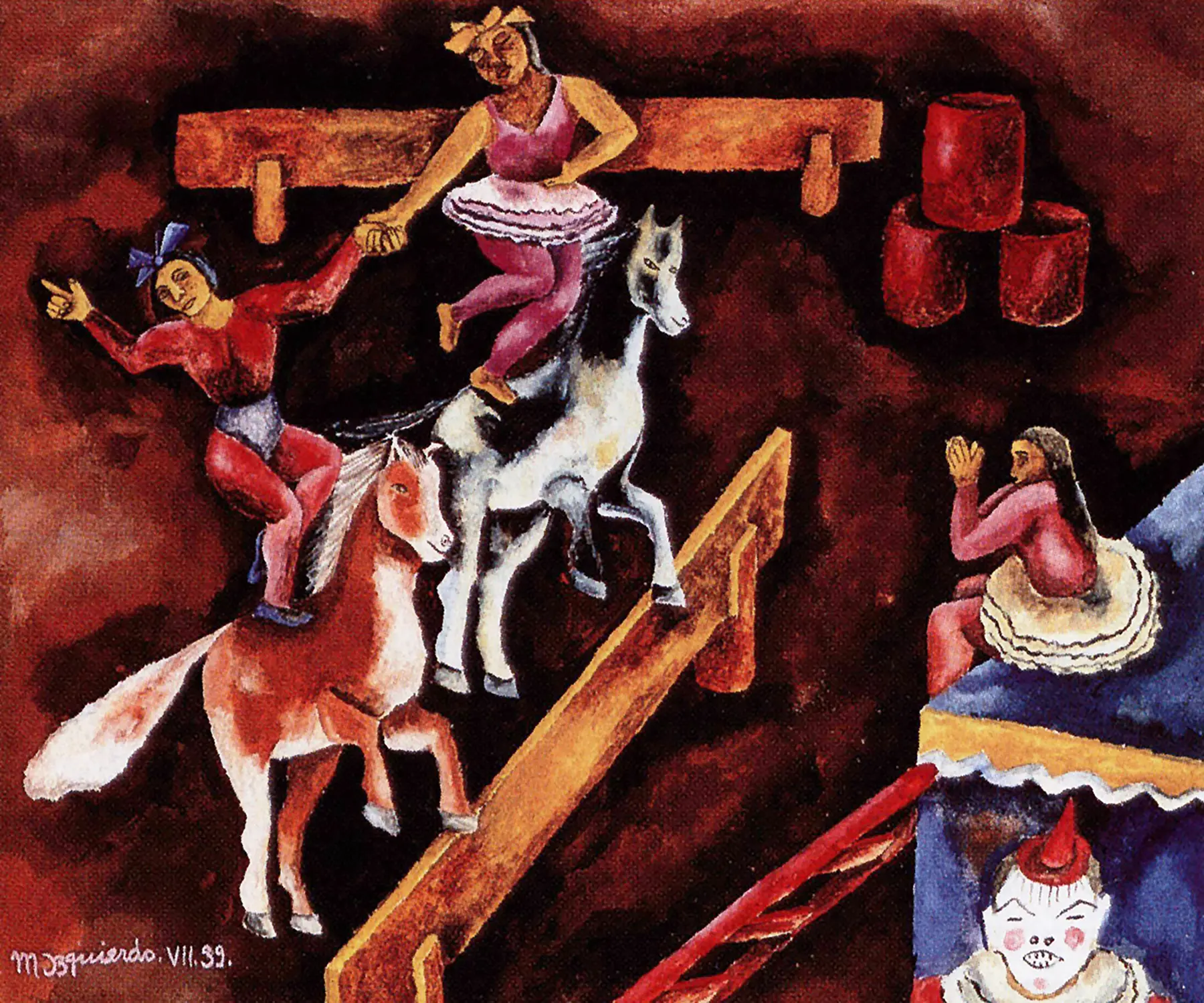
The female world of Izquierdo also takes refuge in the circus, a theme explored in the series done parallel to the allegories. Thirteen works were inspired by her childhood memories (the circus was one of the few moments of happiness she had during her austere childhood in such towns as San Juan de Los Lagos, Aguascalientes, Torreon, and Saltillo). These pieces recreate female figures frozen in time, artists without a public, melancholic and solitary atmospheres - as in The Circus Woman (1932) and Circus Horsewoman (1932). In this series, Izquierdo changes her palette to include pinks, blues, and yellows inspired by the Mexican popular arts. From this time on, this color becomes a constant feature of her pictorial style. The circus works also introduce the horse, a recurrent reference in her later work.
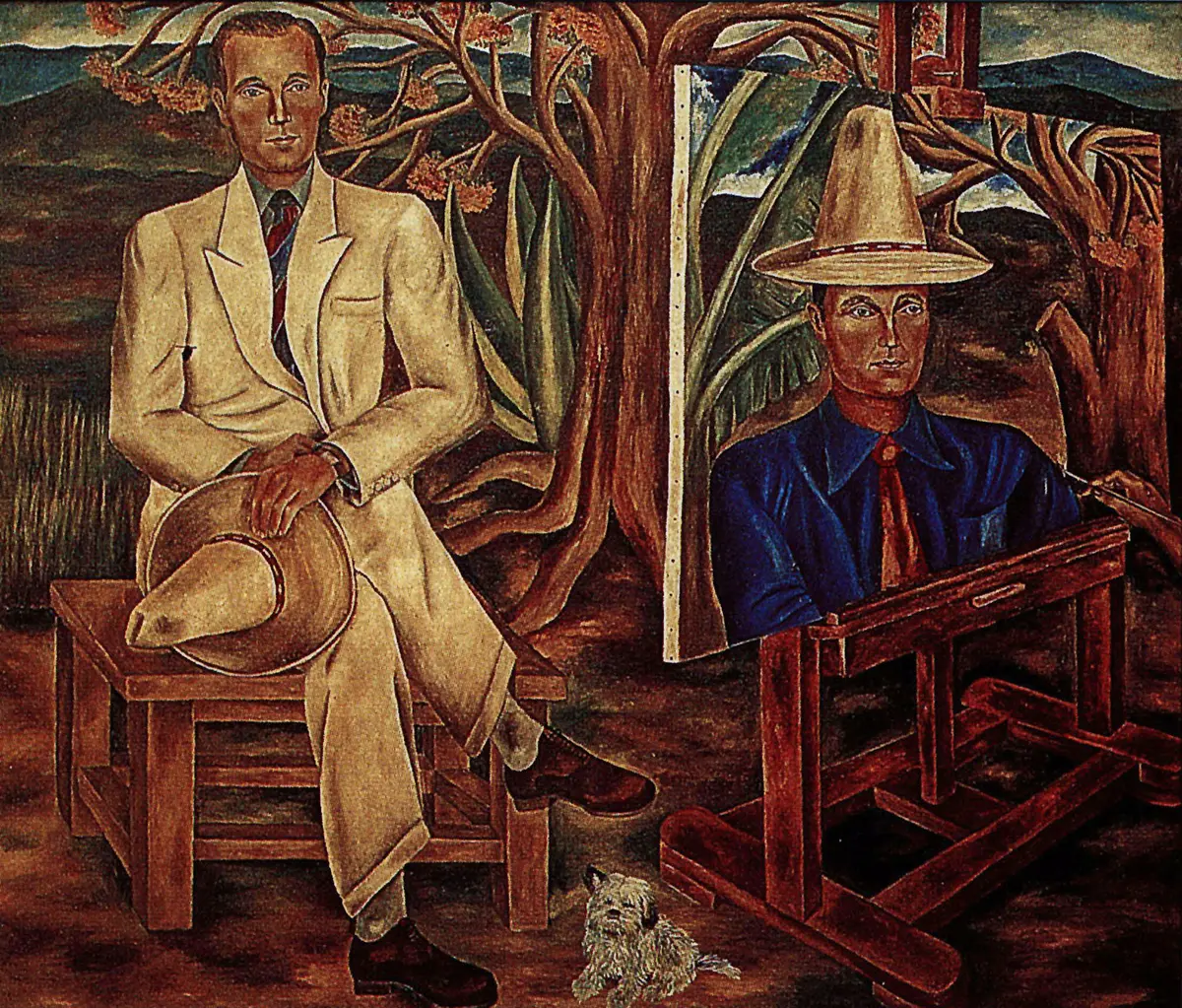
In the 1940s, Izquierdo returned to portraits and still lifes. This show includes a series of portraits (mainly of women), self-portraits (in which she appears wearing a typical dress), relatives, and friends (as in My Nieces, 1940), and popular figures (India Tarasca, 1944). Among these portraits, special mention must be made of Portrait of Henri de Chatillon (1940), a composition that includes a figure posing in European clothing, and the picture with a painted figure wearing a typical straw hat. The handling of the image becomes dear as Izquierdo includes in the canvas her own hand holding the brush.
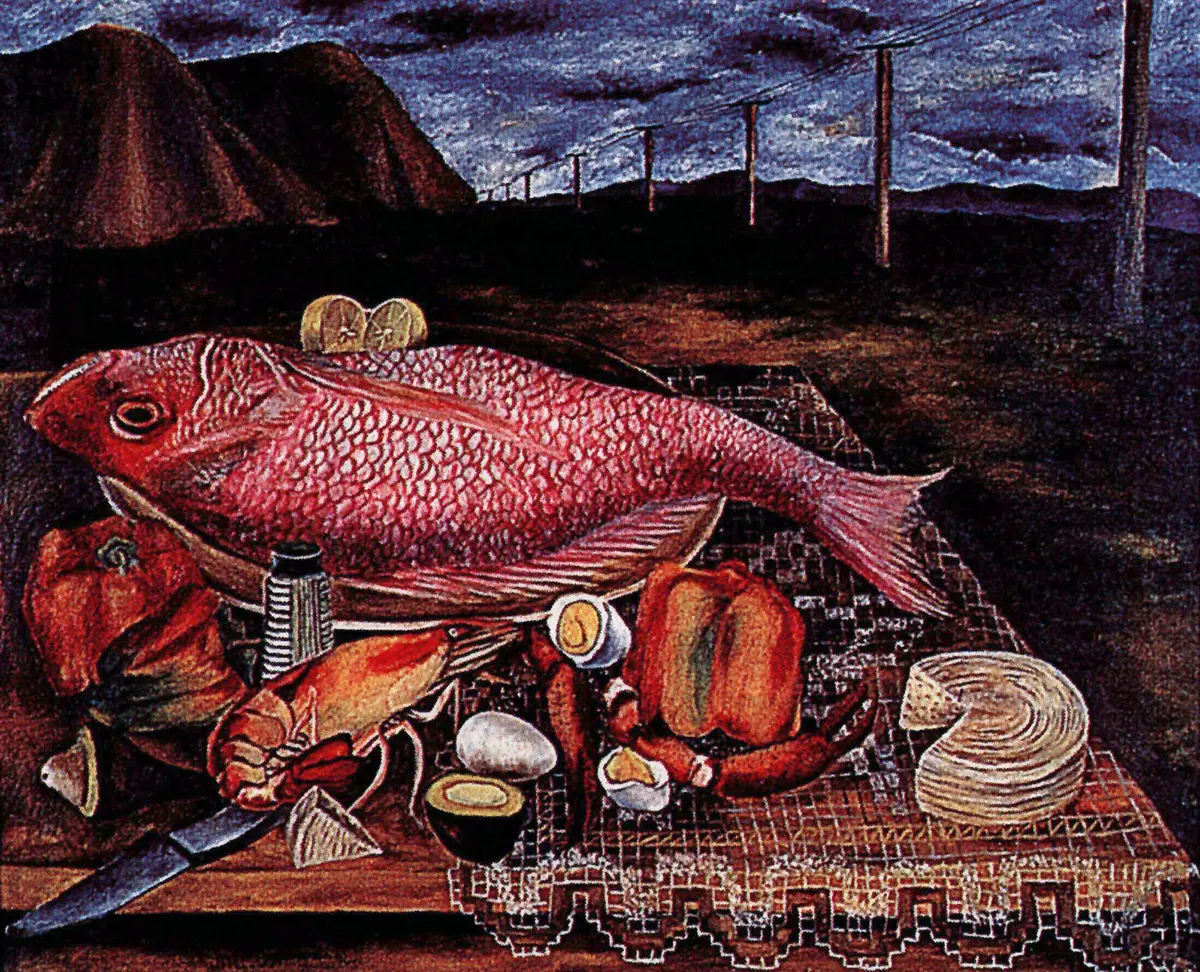
In addition to the portraits, Izquierdo also painted still lifes and altars, which include personal objects, food, and handicrafts, taken from popular rituals and traditions. The curator of the show presented these pictures alongside landscapes inspired by the local geography, and refers to this period as one of "Mexican-ness." All these works are inspired by Mexican culture and landscape and have a clearly autobiographical character. In The Bride's Veil (1943), for example, the composition includes a series of personal objects - a hat, a pair of gloves, a mantilla, a veil, and a bunch of flowers. Izquierdo was to marry Uribe the following year. Cupboard with covered sweets (1946) shows typical candies, little horse ornaments and confetti painted in gay brilliant tones. Live Nature with Huachinango (1946) is an interesting work, which shows a redfish, painted with great naturalism, and set in a darker landscape. Furthermore, the contrast between the vitality of the symbolism of the fish and the arid landscape, inspired in the northern provinces in which she lived as a child, reflects Izquierdo's love of organic elements, which are constant features of her work, considered as an intimate exploration of her own identity.2
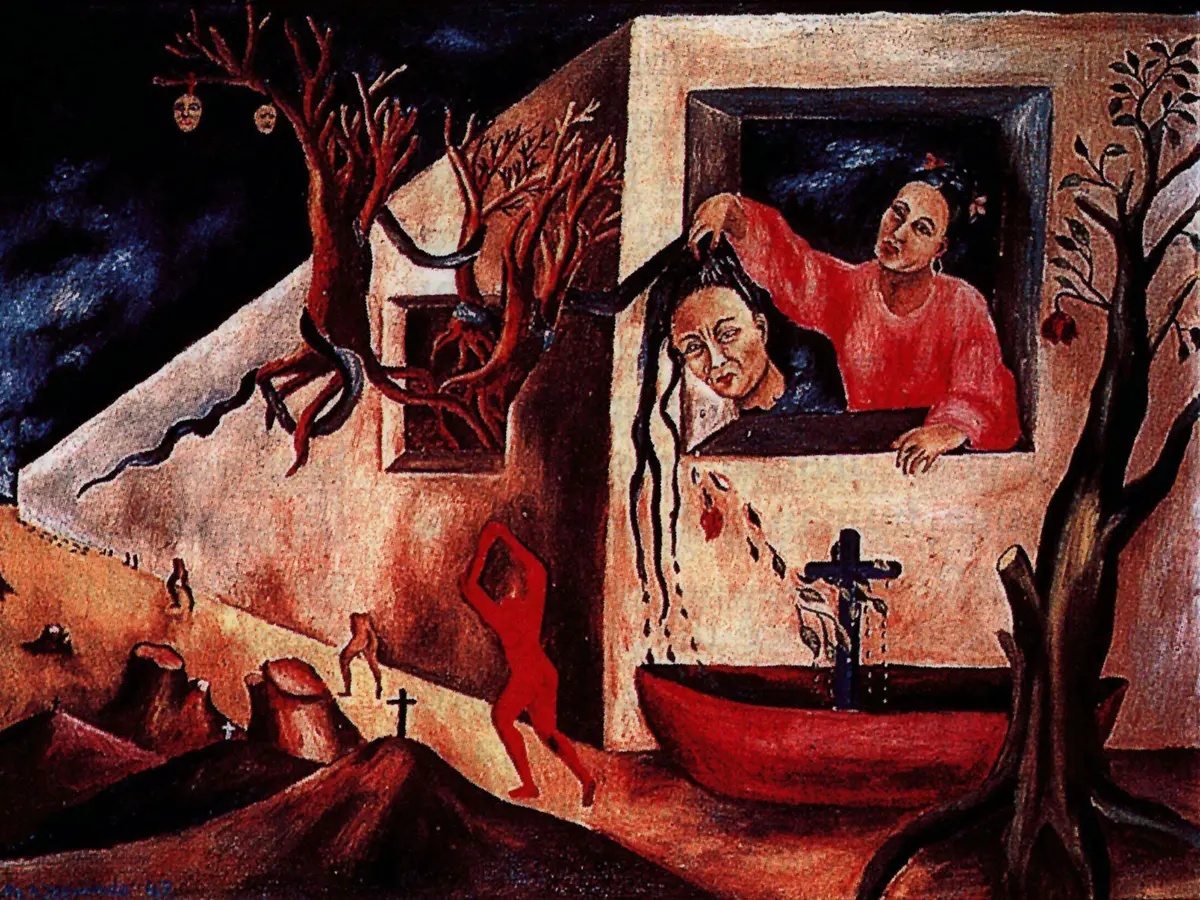
At the end of the 1940s and early 1950s, the physical and emotional problems of the artist clearly influenced her late work which is the strongest, most profound, and most difficult. In Dream and Premonition (1947), Izquierdo's only picture inspired by a dream, there appears in a window, supported by the hair, she quartered and weeping head, in the middle of a lugubrious landscape, full of Christian symbols evoking death. From this time on, Izquierdo used themes that she had worked on earlier, producing unique pictures marked by a sense of intense melancholy. The most interesting of these is Towards Paradise (1954), an almost abstract picture in which the world is divided into the hot earth, where fire bums, and a cloudy sky, where we can see a small window, perhaps suggesting the possibility of a world different from that in which she lived and painted, a paradise far from the earthly world which she was to leave the next year.
This exhibition was presented at the Santa Barbara Museum of Art, Santa Barbara in October 1997 and will travel to the Museum of South Texas, Corpus Christi in the winter of 1998.
NOTES
1. The relationship between María Izquierdo and Rufino Tamayo is the subject of the essay titled "EI estudio compartido," by Olivier Debroise in the exhibition catalog, The True Poetry: The Art of María Izquierdo, ed. Elizabeth Ferrer, (Americas Society, New York, 1997).
2. Elizabeth Ferrer, "Un sendero singular: El desarrollo artistico de Maria lzquierdo," essay included in the exhibition catalogue, op.cit.
FRANCINE BIRBRAGHER