Miguel Huertas is a Colombian artist who began his career in the early 1980s. Since then, he has been known primarily for his drawing, an activity which in recent years he has combined with teaching at the Faculty of Arts of the National University. In this twofold capacity, Huertas has shown himself to be a reflective artist who, like the conceptual artist Joseph Kosuth in his study on Art and Philosophy, assumes that to be an artist today implies a reflection on the nature of art. This characteristic was evident in Huertas’ one-man snow at the Diners Gallery in September and October, titled Gesture and Drawing, a project for which Huertas won a Creative Scholarship from Colcultura in 1995.
In the exhibition, he uses the elaboration of images to reflect on gesture, drawing, and the relationship these images establish with the architectural space in which they are presented. The exhibition was made up of a series of drawings done on various surfaces— paper, jute, and canvas—and in various materials, such as charcoal, graphite, ink, earth, corrector, thread, and wool organized into three groups in accordance with the underlying intention in each case—a distribution which matched the spatial structure of the place. The theme of the works, according to the artist, is the act of drawing. Drawing is assumed as an act of expressing thought which converts the surface into a sign. This primary gesture results in legibility, flux, image, and meaning.
In the central hall, there was a series of embroidered fabrics with the generic title Clothing the Walls, an explicit reflection on the relationship established between the work of art and the architectural space containing it. In the preparation of these works, Huertas invited other people to embroider on pieces of different sized fabric which were placed directly on the walls, without frames, so that it was the architecture, the walls, which framed the work. The visitor was taken by surprise at the beginning by an embroidered beige-colored fabric, with a round format, al-. most imperceptible, placed directly on the wall, and at the end by an absolutely linear drawing in black wool on a large white panel. In these works, in addition to the intervention of space, the spectator's gaze was immediately confronted by the multiple relations established between the thread and the line, the canvas, paper and wall, the act of sewing and the act of drawing, relations which with different characteristics were echoed in the drawings placed elsewhere in the gallery.
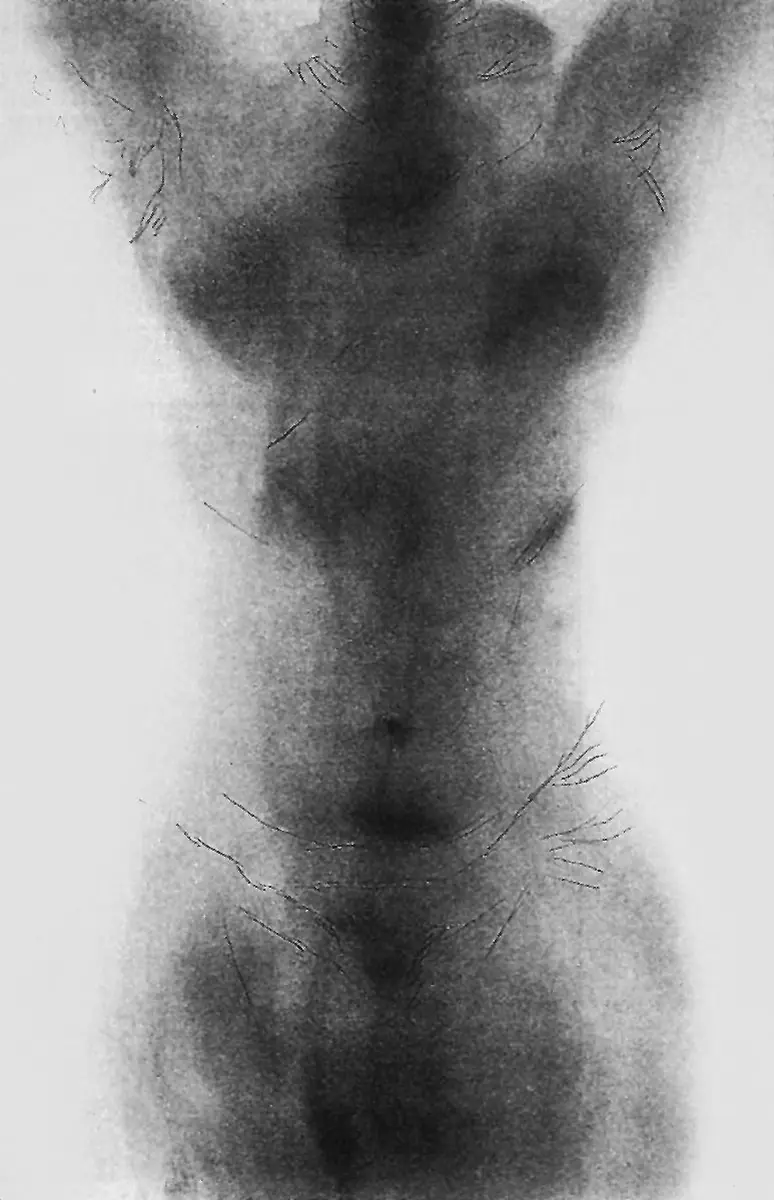
In the two rooms adjacent to the hall there was a series of drawings in various formats, all on paper. The first room included a series titled Accumulation, Surfaces, and Appearances. The first title referred to the processes used in its finish; the second alluded to a series of drawings which are simply surfaces done with a roller in which a vertical and uniform gesture persists and covers the sheet of paper. These works, with their absence of figure and their attractive finish, could initially be seen as abstract drawings, surfaces that were attractive and aesthetic at the formal level. But the intrusion of the title and the context in which they were set blurred this impression. Just as we pass from the purely formal to the universe of sense, these works do not speak to us about the abstract world but refer back to their essence, their origin, the way in which they were carried out, and which in the final analysis is a response to the gesture and act of drawing.
The same room included a series of drawings with human faces and gestures, titled Appearances. In the third room, there was a series of larger format drawings titled Presences which referred to the presence and absence of the body. Some of the surfaces openly revealed the presence of the body, its traces or fragments, while others were laboriously worked with strokes and frottage. In both rooms, the spectator was confronted with suggestive images whose delicate and sensitive finish both reflected the nature of drawing and provided surfaces that generated enormous sensorial pleasure.
The exhibition was accompanied by two texts written by the artist. The first was a reflection on the space of modern work and the act of drawing. Without wanting to explain my work, wrote the artist, / want this text to provide the spectator with a key that illustrates its intentions. The second text was a fragment of the workshop diary, in which he tells us that a gesture embodies something which is not thought out but which emerges in response to very profound causes.
The reading of the artist’s reflections as well as the careful attention given to his works confirms that behind the gaze there lies an entire world of reflection which is an essential part of the act of drawing—the art of making art.
MARTA RODRÍGUEZ