In Prospect and Perspective: Recent Art from Chile at the San Antonio Museum of Art, curator Beverly Adams presents the work of ten emerging artists who live in Santiago. Many of the conceptual and formal strategies of this new generation of artists have been influenced by the work of Gonzalo Díaz and Eugenio Dittborn, both political conceptualists who came to prominence in Chile in the 1970s during the Pinochet dictatorship.
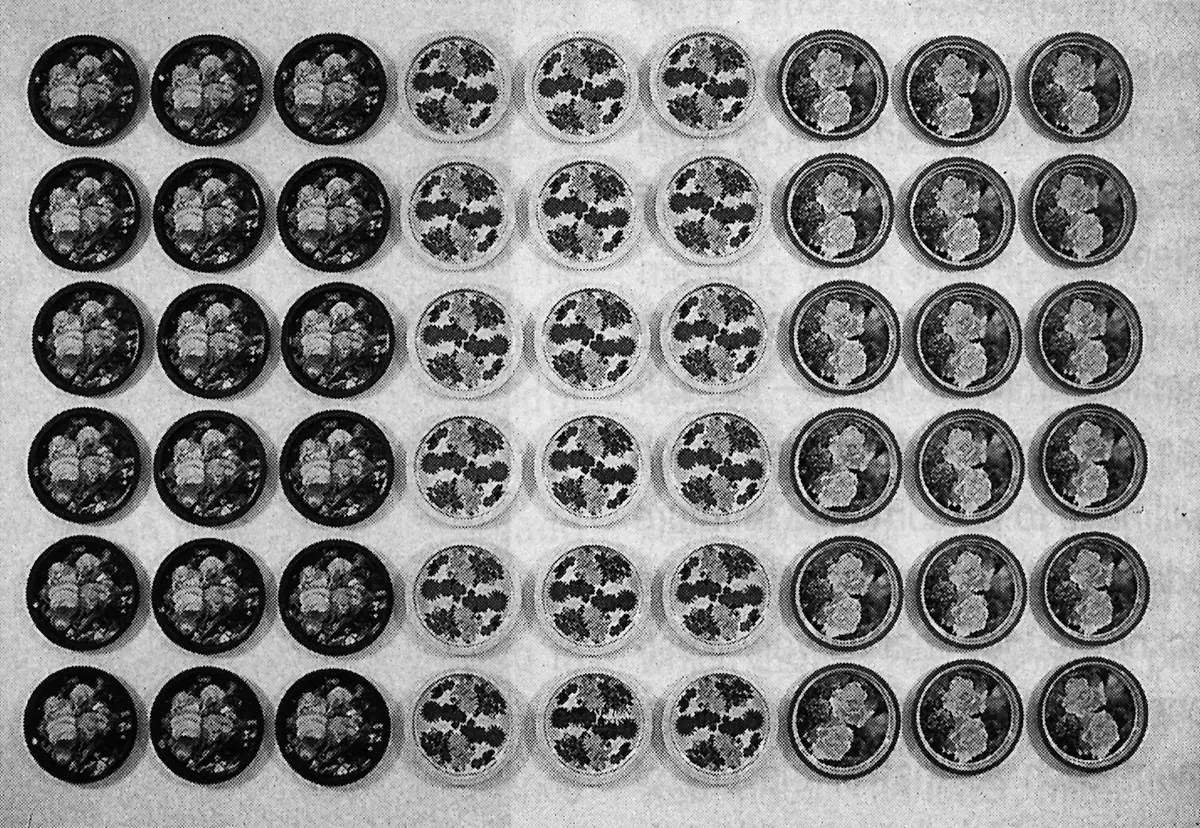
Painting, sculpture, photography, drawing, and printmaking are all represented in the exhibition, often in combination, and large-scale works predominate. Pablo Rivera's boat-sized, elbow-shaped wicker sculpture sits next to Monica Bengoa’s much-larger-than-life close-up photographs of human navels. Mario Navarro's Hi-Fi, the word drawn on the gallery wall in charcoal, is opposite Arturo Duclos' fifty-four tin trays laser-printed with repeated images of flowers.
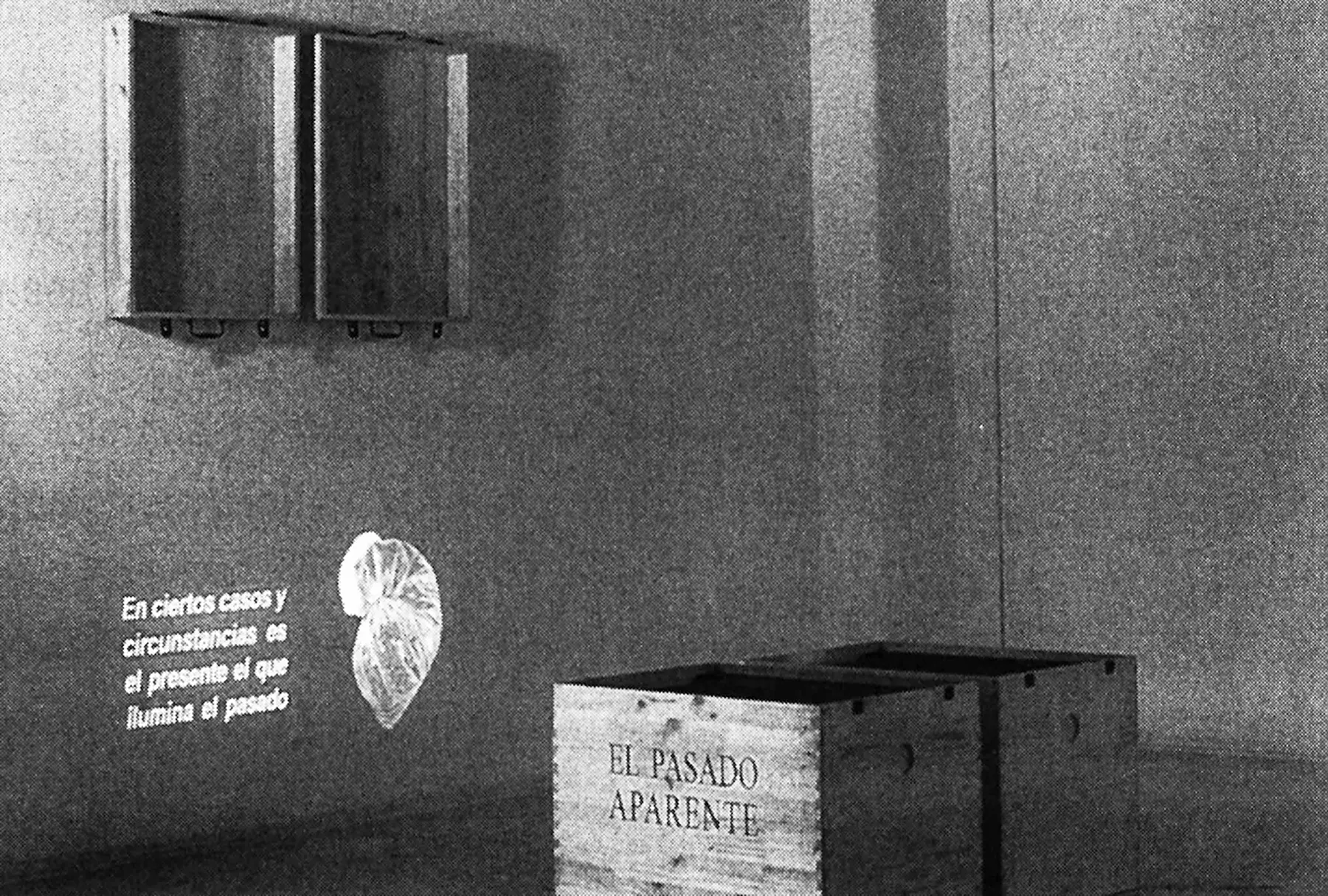
In works by Alicia Villarreal, Nury González, Voluspa Jarpa, and Natalia Babarovic, the object or image is the expression of personal and collective memory. Villarreal's installation, The Apparent Past (1994), consists of two, well-constructed, naturally grained wooden boxes, inside each of which is a slide projector that shines words and objects onto a wall. The projected images-dirt in a plastic bag, a shell, and petrified forms are juxtaposed with phrases such as, "In certain cases and circumstances it is the present that illuminates the past." The juxtapositions suggest a system of cataloged artifacts, like a kind of traveling natural history museum. At times the image is ambiguous and intriguing. Is it a fish or an eye, a sink or an ear, a rock or an animal head?
Nury González's Notional Knots (1996) invokes the women's domestic sphere, where oral histories and memories are kept alive through weaving, spinning, and sewing. The artist embroidered three texts on three monochromatic canvases-one white, one red, and one black. The colors of the canvas and text are symbolic. Sewn-on the white canvas with white thread is an aboriginal weaver's prayer in which she offers ...little white threads from your little sheep. Sewn-on the red canvas with red thread is a metaphorical quote about the act of weaving and the passion between two people. The black canvas, with its instructions for spinning sewn in black thread, is both weaving and technical manual. The layers of fabric —a flowery brocade sewn on a piece of thin cotton, which is attached to a heavy stretched canvas— and the notional knots keep these prayers, stories, and lessons from unraveling.
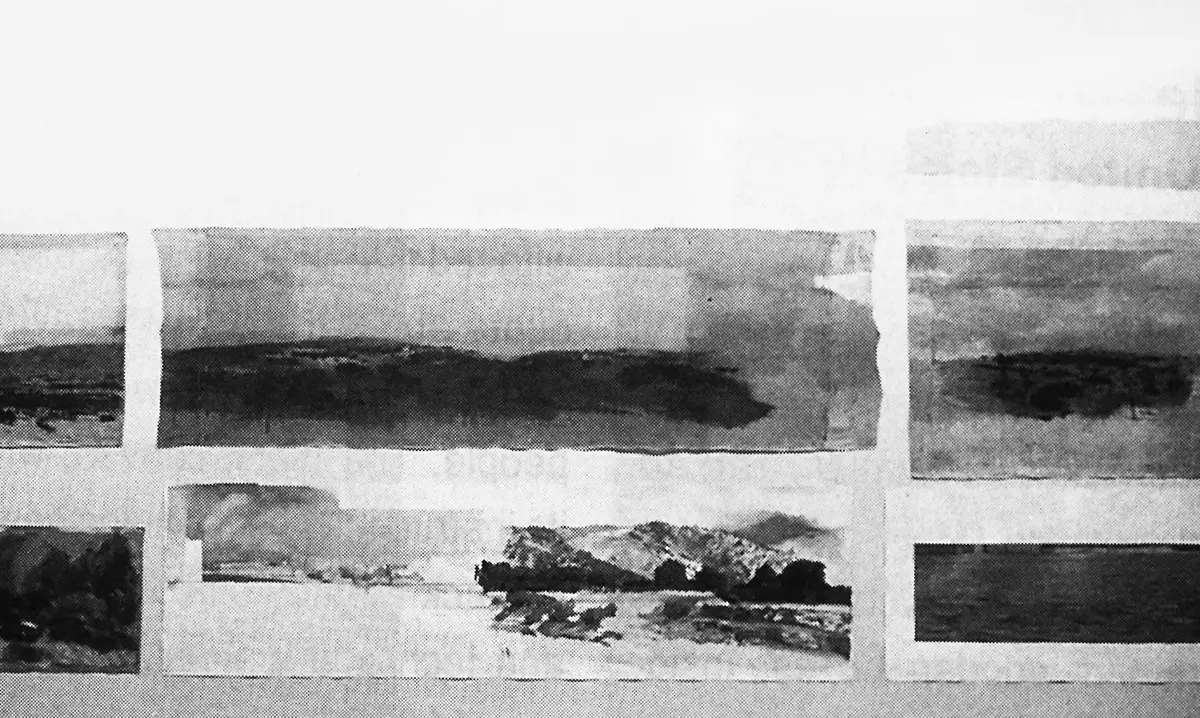
The landscape paintings of Natalia Babarovic and Voluspa Jarpa at once symbolize a loss of memory and the memory of loss. Babarovic's Various Places (1996) show blurry fragments of Chile's countryside, culled from her recollections of car trips to the rural outskirts of Santiago. The sketchy landscapes suggest places where anyone, anywhere, might have traveled and dreamed about later. Jarpa's diptych, No to Place (1997), portrays an abandoned lot a few blocks away from the Government Palace in Santiago. The artist inserts a serigraph of an ornate, gilded frame in the center of the composition, outlining a weed. In the nineteenth century, such a frame would have held a sweeping landscape painting which was then the symbol of the nation's wealth and spirit of optimism.
Some of the artists employ repeated images and objects taken out of context. Pablo Rivera plays with ideas of time and timelessness, and where things are displayed. His Purgatory III (Place/ Displace/Unplaced) (1997) replicates the form of another piece. The prototype for this enormous wicker sculpture is a small, wooden object enclosed —in perpetuity— behind glass in a funerary niche in Santiago's cemetery, which is a museum of sorts. Rivera gives the wooden object new life by recreating its shape in wicker on a large scale and sending it off to the United States.
Rosa Velasco's Launchings II (1996) is a horizontal row of seven mirrored stainless steel disks that are mounted perpendicularly to the wall. Each disk reflects the backside of the next one, and the viewer as well. Sewn to each shiny surface is a lump of red clay, tethered by stitches made from tripwire used to catch rabbits. The haphazard lines of the wire stitches, visible on the backside of each disk, contrast the perfection of the stainless steel circles. The lump of earth tied to the steely disk suggests a patient on an operating table.
There are works in the show that critique Latin American aspirations toward Anglo-Saxon, first-world experience. Mario Navarro's installation, The New Ideal Line (Heaven's Gale) (1997), likens the hopes for economic progress that the Mexican-American NAFTA model created throughout Latin America with the delusional beliefs of the suicidal Heaven's Gate cult in California. A ridiculous-looking dummy dressed in synthetics-red pajamas with feet, white gloves, and peach knit ski mask-lies-face down on a stack of cardboard boxes. At the foot of the anonymous figure is a pair of articulated legs made out of black-painted wooden blocks.
There is much to like about Prospect and Perspective. It has a satisfying diversity of scale, media, theme, and conceptual strategies in a show as small and concise as it is. The artists are as articulate in the text panels as they are in their works, sometimes more. The modest show has its share of surprises, like Rivera's Purgatory III, and the general attention to craftsmanship and materials commonly shared by the artists is likewise gratifying. Even though Adams does not include a theme and context statement in the galleries, her curatorial hand is apparent. The name Prospect and Perspective itself suggests that such a statement might have spoken of the promise of young artists and of the view from their artistic geographies.
CHERYL HARTUP