
Matta: Surrealism and Beyond, was organized by Curtis L. Carter of The Haggerty Museum of Art at Milwaukee’s Marquette Univesity and was co-curated by collector and private dealer Thomas R. Monahan of Chicago.
The exhibition serves two purposes: 1) to provide a brief survey of Roberto Sebastián Matta Echaurren’s prolific oeuvre and 2) to highlight a distinguished private collection that includes some of that artist's most essential themes.
Despite the fact that the exhibition privileges the private collection of its co-curator and principal donor, it is certainly a triumph for the city of Milwaukee to host an exhibit of more than 90 paintings, drawings, etchings, and sculptures previously never shown together. Indeed, there have been very few solo exhibitions by this Chilean master of Surrealism who, at the age of 85, still produces some of the most cherished and sought-after work of this century. Whereas Matta's reputation and fame have long been renowned in refreshing to note that much of the work on loan here comes from Midwestern collections.
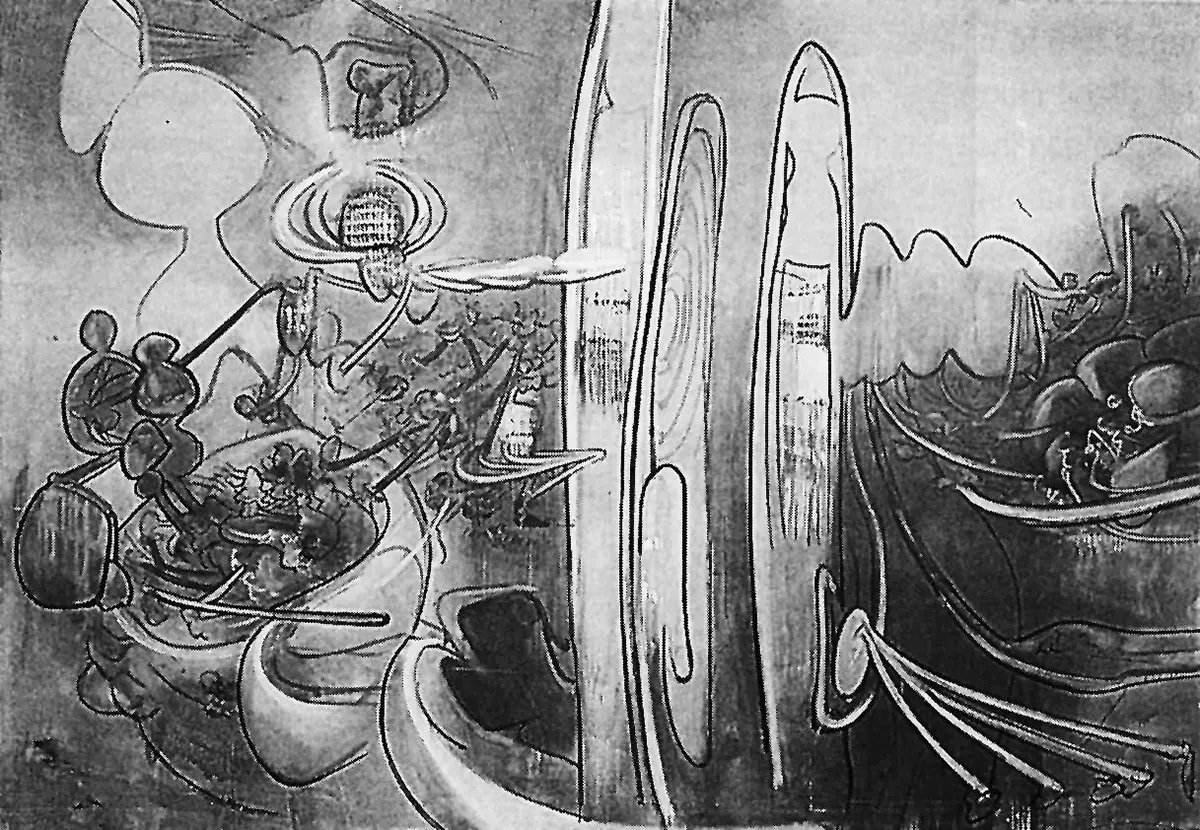
Although many of the works on view don’t necessarily represent Matta's most important works, the often awe-inspiring and alien scenes depicting the depth of Matta's imaginative, if frenetic, mind earn the viewer’s instant respect. Matta’s life has been punctuated by very specific events which allow historians to neatly bundle the various stages of his artistic career.
This exhibition offers a glimpse of each era, beginning with the late 1930s and ending with this decade. Whereas the opening room introduces the viewer to some of the strongest works of the early period, the middle section felt weaker and less cohesive than the work deserves. In contrast, the second-floor room housed a superb series of etchings and aquatints from the 70s and '80s that competes with the quality of Matta's paintings while demonstrating the artist's versatility in conveying his ideas.
Matta’s unique visual language, described in Carter's catalog essay and clearly depicted in the exhibition, began to develop in the late ’30s in a series of paintings known as psychological morphologies. Morphology is Matta's term to express the internal activities of the mind. The show documents how these themes strengthened and evolved with each decade. The work of the early ‘40s enshrouds the soft-edged floating forms with abstract, geometric, and planar shapes, totally devoid of any hint of figuration. Most noteworthy of this style are two paintings from 1943 titled Children’s Fear of Idols and Inscape. By the mid-forties, Matta’s increasing concern with social concerns and the impact of technology on human existence encouraged the introduction of humanoid figures into his arts.
Matta took exile in New York from 1939 to 1948. Matta, along with many European artists who escaped Hitler’s reign, exchanged ideas and influences with his Surrealist friends and enjoyed friendships with the group of young artists who would later be known as the Abstract Expressionists (including Motherwell, Pollock, Gorky, and Baziotes). Upon his return to Europe in 1948, Matta broke ties with the Surrealist to pursue his scientific and humanitarian interests, ideas which the Surrealists opposed. In the fifties, Matta defined his canvas with multiple rectilinear divisions, which create open floorplans of potentially “real" spaces capable of sheltering his biomorphic figures.
While Matta continued to incorporate the multi-layered spaces begun in the ‘50s, the 1960s witnessed a new interest in man's sexual nature, and the artist’s purported own lust for life exploded into his works during the next two decades. It seems that Matta’s work has always been about energy, about man’s dialogue with his inner self and his negotiations with the outer world.
Having influenced the lives and art of so many great artists of this century, Matta floats in this world as a mortal god, smiling upon his cherished followers who await each new body of work as if it will unfold life's deepest secrets. A special talent that has endured throughout Matta’s long career is how he weaves serious themes, such as sexuality, war, politics, and freedom, into wonderfully playful and humorous painted worlds. The vibrant, almost fluorescent, colors, juxtaposed with the darkest hints of the earth’s core, combine to establish a most harmonious sense of space, however surreal and impossibles. Perhaps it is not that Matta's painting skills surpass those of his more hallowed colleagues, but rather that his gift lies in exposing his interpretation of our inner minds and allowing us to enter into his inventive environments.
ILANA VARDY