During the months of July and August, the Centro de Arte Euroamericano presented an exhibition titled Symbolic Waste Materials, the first one-man show by the young Venezuelan artist Alessandro Balteo (Caracas, 1972). It included a number of objects —ranging from photographic recordings of graphic interventions on small blackboards, from 1994 and 1995 to videos, photomontages, photograms, maps, or cartographic objects— which documented Balteo’s short but successful career beginning in 1994. However, it was not an anthological exhibition, which would not, in any case, have had much sense in the case of such a young artist, but rather one based on fragments or pieces resulting from Balteo’s work process, hence their condition as symbolic waste materials. This enabled the visitor to visualize the expansive development of the artist's work and thought processes. However, this initial reading was complemented by another: understanding the exhibition in its entirety as yet another work, which takes us back to the problematic space of contemporary art.
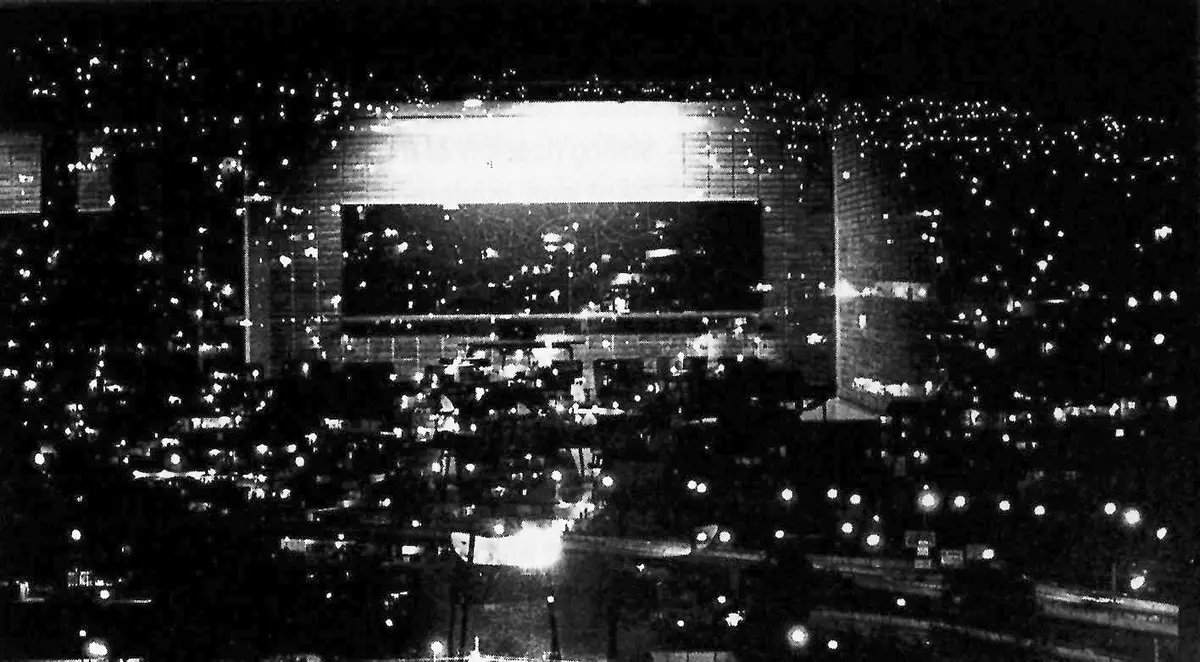
Alessandro Balteo’s work proceeds, in fairly eclectic terms, from the constructive tradition, with his early work involving a study of Gego. However, at the antipodes of abstract art, his work has been permanently linked to reality. And in this sense, art is not for Balteo the projection of an idealized universe of perfect forms. Transformed into visual metaphorical terms, it is rather the sediment, the result in a sense of the manifold interactions generated in reality, a reality which paradoxically has become increasingly abstract. For Balteo it would be impossible to attempt a project able to depict all the accidents of time and space. Stripped of the weight of this impossible representation, the universe of his work becomes a system of relations, intricate cartography of its possibilities, and networks that seek to catch fragments of meaning. To quote the artist, "the work becomes transformed into a fantastic reflection of the real structures which saturate the spaces invaded by ideas, language, history, the relationships between objects and persons." But from this kind of field of operations, of graphic interactions in space, the artist insists on returning to reality, the inexhaustible source of his inter-actions, refusing to separate himself from that reality, using the work of art as a sensitive tool of knowledge in the exploration of his environment. Some of the works in this exhibition reflect this process: a photomontage (1994-1997), a key piece in the show, superimposes on the texture of a small blackboard the nocturnal image of a marginalized district of Caracas as reflected in the vitreous surface of a window: the social fabric becomes interwoven with the symbolic one. The result, in a sense, is a kind of hallucinating, cosmic cartography. The photomontage is a key work since it clearly fuses a conception of the work understood as an abstract system of relations and an unusual interest in reality and its social, anthropological, and cultural aspects. The tricks played by chance and the encounters of desire, amongst other motivations, create these structures, which far from being rigorously rational or programmatic, acquire spontaneous and unpredictable contours. Their relentless generator is the social factor. In another room, a set of photograms presenting various series of graphic structures was decided on an organic, even aquatic kind. Against a black background, the expressive white lines conferred unusual qualities on Balteo's work, a work which usually has a more intellectual kind of sensibility, oriented to neo-conceptual investigations. But Balteo does not merely want to record what he perceives in reality; he also wants to exert some kind of effect on what he sees. Thus he has been conceiving —from the end of 1995— a pyramid object which he calls ESQUINO (the inseparable companion of the comer). It is a kind of Aleph, in the manner of Borges, as well as a little Trojan Horse. Placed in the top part of any room it fits perfectly in its orthogonal vertex. As an Aleph, it acquires powers of a contemplative kind, supposedly creating visual sensations, thoughts, and feelings, an accumulation of relations; as Trojan Horse, it becomes transformed into a bold tool for extracting information from reality, in this case, the reality of the art market and its visceral incandescence. Each client must fill in the blanks in a contract established with the artist. This gives rise, on the basis of the ESQUINO, to a system of relations that minutely unfolds over a map of Caracas, overflowing the space of museum rooms, galleries, teaching centers, etc., places in which this research project has been carried out. This exhibition included only fragments of this cartography. The destiny of each ESQUINO sold is literally imprinted here. And it is through maps and contracts that we can visualize, amongst other things, how sectors of the city circulate through artistic circuits, what their occupations are, etc. The artistic matter moves towards other areas; the dividing lines between art and science begin to move and connections begin to take on geo-social and anthropological connotations. Balteo manages to ensure that this social factor emerges —in itself and in an impersonal manner— and in so doing, paradoxically depicts the artist himself, projected over the irregular cartography of Caracas. The abstract system of relations perceived by Balteo in a fantastic manner, floating in a kind of immanence between persons and things, descends in the form of geological sediments and objectively crystallizes over the urban topography. The specific web of the art circuit is superimposed on the map and interwoven with it. The collective element, which therefore leaves its mark, generates a process of identification with the concept of territory. This is a kind of conceptual drawing on geographical maps, not as a result of the artist’s subjectivity, but as the fragmented consequence of the interaction of the work with its environment. The proposal of this exhibition, in the manner of a simulacrum, could even be perceived in the interplay of the various displacements in scale, like a tiny point in the unfolding of this formidable network of relations.
ELISEO SIERRA