Fernando Prats (Santiago de Chile, b. 1967) recently presented an extraordinary exhibition in the Church of the Divine Providence. It was extraordinary for many reasons: the quality of the aesthetic undertaking, the subject matter, and the atmosphere of the setting.
After three years of studying design, this young artist went to Barcelona, where he pursued his training and began his professional career five years ago. He has already received significant recognition in Spanish competitions, and in January 1998 will return to the Catalan capital to prepare a doctorate on the subject of the displacement of artistic languages. Barcelona would appear to be an ideal place for an artist interested in the expressions of sacred art. The city offers not only a wealth of history but all the intensity of contemporary artistic life. Prats, a confirmed Catholic, has given himself a difficult challenge. His objective is to renew with contemporary languages, aspects of the iconography of the Christian tradition. Several works by outstanding contemporary artists refer to the subject of the sacred, but very few treat it as an exclusive and central field of their aesthetic project.
The basic theme of Prats’ installation was taken from passages in the passion and death of Christ as related to the texts of the Evangelists and extracts from St. John of the Cross. Death gives life. The mystery of redemption. Hence the title of the exhibition, Anastasis— resurrection, rising up. The artist recalls how aesthetic forms have served the Christian church both as an element of indoctrination and as an emotional means of affecting human sensibility. The images of Western religious art are explicitly designed to teach and move the spectator. In Prats’ endeavor, there is something of the iconoclastic crusade, an attempt to obliterate the most repetitive aspects of traditional iconography to allow the essence to predominate over appearance. In Chile's profoundly religious and conservative social environment, it was only the express authorization (and sponsorship) of Monsignor Carlos Oviedo, the Cardinal Archbishop of the city, that made it possible to undertake this project.
The Church of the Divine Providence is a neo-classical building dating from the end of the last century. It has a rectangular nave and a flat roof. The eight side chapels, which are not very deep, do not disrupt the unified space of the building. It was here that Prats carried out his intervention. In two of the chapels, he made use of the existing installations: the baptismal font and a confessional box. Let us review the details.
On the right, the concepts were focused on the idea of the tomb and redemption through sacrifice, Anastasis proper, and the wound of the lance in the dead body of the crucified figure. On the left, the emphasis was on the theme of the word as a means of redemption. Prats used basic, unaltered materials which paid homage to Joseph Beuys: smoke evoking the universal memory of sacrifice, virgin wax, rolled, unleavened bread for making the host, wood, and olive oil. There was a clear intent to restore the origin of things, of going back to dark sources to the point of non-recognition in the traditional imagery of the Catholic church. There were two doctrinals at the entrance to the church which provided a theoretical framework for the exhibition. They contained texts, sketches, maquettes, and a reproduction of the Isenheim altarpiece.
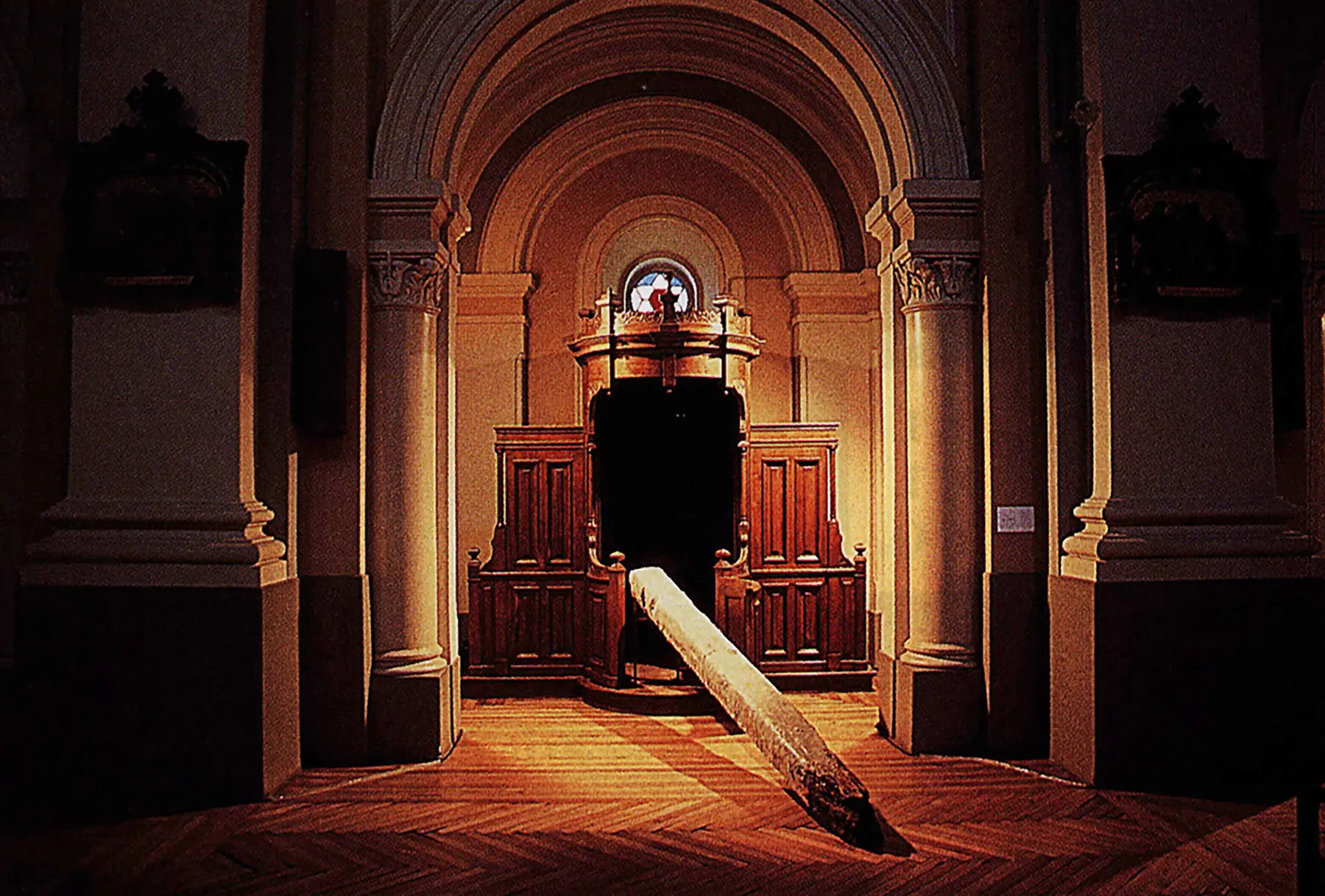
The installation referring to the tomb, the first on the right side as seen from the entrance, was the most literal. A mortuary casket was made with a dressing soaked in oil and hardened. It was broken open. Inside, the rolled unleavened bread became a morphological allusion to the spinal medulla. Placed directly on the wooden floor, it enhanced astonishingly the chapel void. The following space was structured on the basis of the confessional, a wooden box with the traditional design of a central cabin for the priest and a side prie dieu for the penitent. From the central open space, a heavy beam emerged in diagonal form, one end rotting and the other covered with wax. The piece of wood implied a two-fold reading: as support of sacrifice and its evocation through what remains of the devotional candles. A confessional is a place of penitence, as well as of confession in the sense of the proclamation of a belief.
In the next chapel, the anastasis was materialized in a white, radiant structure, based on uncut host wafers mounted on a neutral platform. The language and textural support were minimalist—a white wall the irregular top part of which was a paraphrase of the pictorial space of the Crucifixion of Grünewald. It was slightly angled in the side chapel. Prats had initially proposed it for the space of the main altar, on a larger scale, where the miraculous dimension of the idea of the Resurrection would have emerged more clearly.
The theme of the wound in the side of the crucified figure was subsequently resolved on a large smoked glass screen with a drawing scratched on the black surface, like graffiti. The artist presented a graphic expression of fine, repeated lines as well as texts—or fragments of texts—as significant elements in the installation.
On the left side of the church, the symmetrical chapels established a conceptual dialogue with the walls on the right-hand side. The theme of the tomb was offset by the intervened baptismal font. The confessional chapel was complemented by another which was closed off by a rush mat lattice that recalled the meditative passages of the sacred word and the enclosure of certain spaces during the liturgy. Against the anastasis, was an altarpiece wall with blackened sheets of paper with the drawing of the crucifix, and against the theme of the lance, a structure which referred to the descent.
On the marble baptismal font (a curious illustrative piece with the figures of a child and a devil at the foot of the pedestal), Prats placed another wax receptacle for holy water. The discourse emphasized the space of the baptismal chapel vis à vis the opposite chapel, highlighting the duality between life and death. Then there appeared the rush mat wall—the word passed through a screen that was opaque but not watertight.
In the next space, on the support of blackened sheets ordered in a way that reflected the uncut wafers of the host of the anastasis, there appeared the lines evoking the Crucified figure and the words uttered on the Cross. This Crucifixion, made of smoke on an ephemeral base, was as astonishing as the celebrated Grünewald altarpiece.
The chapel which concluded the sequence on the left side presented the descent from the cross. A volumetric structure made with blackened paper hung loosely from a dark upper space. The light played a primordial role here by falling on the black smoke and virtually transforming the paper into an object. The recourses used by the artist, with maximum economy, achieved an extraordinary semantic density.
It was not necessary to share a specific belief to engage in an aesthetic dialogue with these works. Prats’ work was made from a world at the edge of any representation or figurative evocation. The language was pure, the result of a profound artistic investigation, which enabled the artist to negotiate the historical distance between the artistic and the sacred, recovering what might be seen as one of the essential characteristics of art at its remote origins—its sacredness as an expression with which transcends man himself.
MARÍA ELVIRA IRIARTE
Doctor in the History of Art, University of Paris, La Sorbonne. Lives in Chile.