Yet another biennial. The First Biennial of Angels was an attempt to bring together some of the most outstanding projects in contemporary Mexican art. Presented at the Ibero-American University in Puebla, one hundred kilometers from the Mexican capital, the Biennial attracted a large number of participants from the region as well as other invited artists. This last group was made up of artists of varying stature and working styles, but the presence of some of the most important contemporary Mexican artists gave a singular dimension to the activities at the Biennial.
The first version —a sort of dry run in journalistic terms— did suffer from some deficiencies which will have to be corrected in future editions. However, it must also be acknowledged that its very existence was important in an environment such as that of the city of Puebla, which has traditionally been rather reluctant to take up the more contemporary expressions of the visual arts.
Puebla is a historically conservative city and identified by many as a bastion of the Roman Catholic clergy. This fact naturally caused apprehension amongst the organizers, but any fears were gradually assuaged over the preparation period of more than a year and a half by the enthusiastic reception of the university milieu and the artgoing public. Far from placing any restrictions on artistic expressions at the Biennial, the directors of the Ibero-American University opened up their premises and, in collaboration with the curator, Miguel Ángel Corona, and the general coordinator, Aurora Berlanga, as well as the local and invited artists, worked together to explore avenues which until then had been blocked.
Despite the broad diversity of means of artistic expression present in the event, possibly one of the most solid areas was that of photography. Unlike painting or sculpture, and even installations or object art, the photographic section included works that offered a more abundant range of elements for the treatment of the theme of the angels. Without underestimating the iconographical value of angels, we are here confronted with a kind of spectacle which implicitly involves the idea of variations on a theme, rather than one which allows free rein to be given to artistic creativity on various topics.
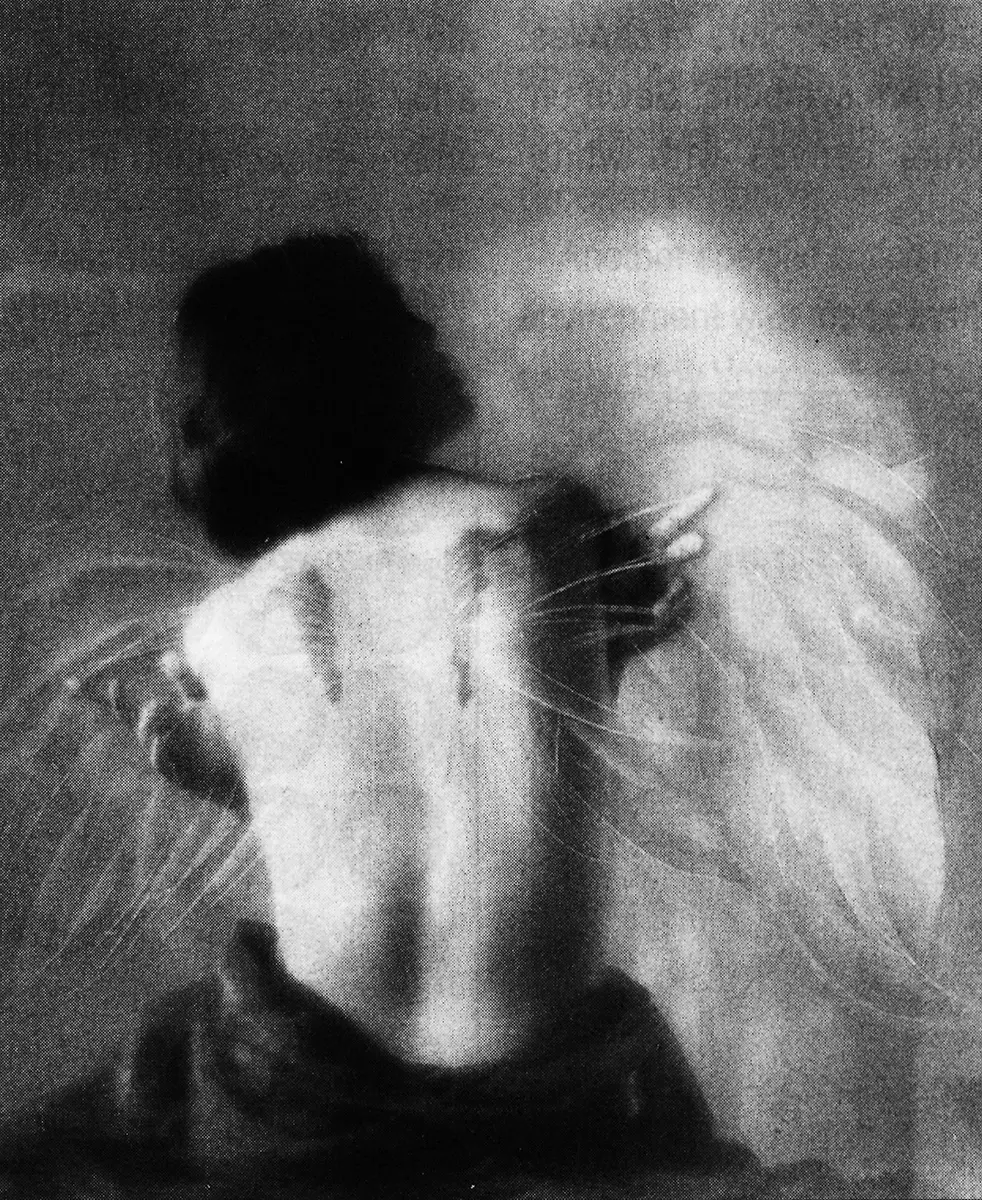
The Photography Prize went to Mónica Bello, for her work titled Short Passage on the Earth. A woman with her back turned has on her skin what might be the scars of wings that are no longer there. Her evocation appears, through the intervention of the photograph, to be a kind of transparency in the foreground and a cloud in the background. The hands of this former angel, with fingers outstretched, also evoke the form of wings which have disappeared.
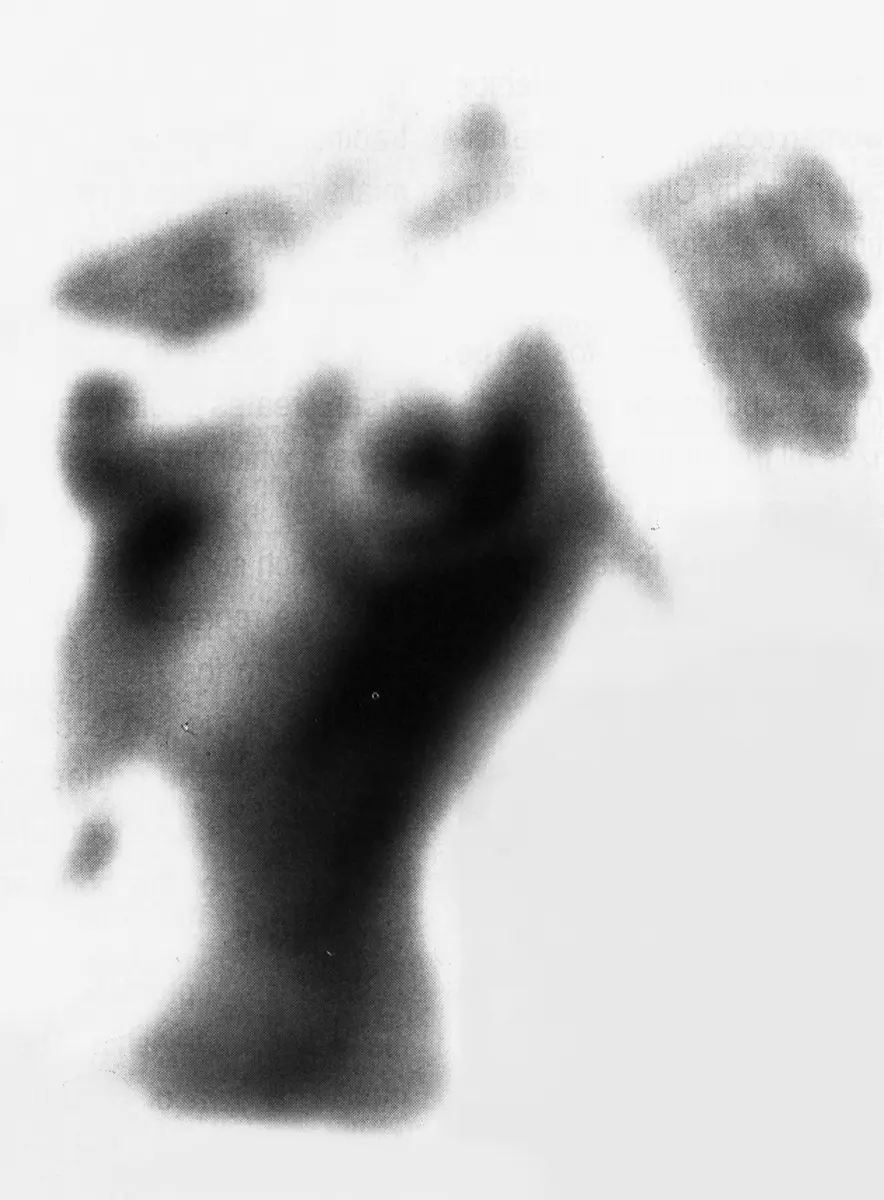
Another image selected by the jury was Aggelos by Elizabeth Castro Regia, who was awarded an honorable mention. Her diffuse photograph showed the torso of a woman and, at her back—and so as not to break the referential sequence of wings as almost the only and evident attribute of angels— something similar to wings, but perhaps a bit too small in relation to the body and which, one imagined, would soar in celestial flight.
Juan Carlos Ladrón de Guevara presented a series titled Resplendence in Gestation, which included, in a similar guise to the previous example, an angel —a woman whose wings, under her body, appeared to be recumbent like the woman herself. Although the conceptual work in these photographs was successful, the images failed at the production level, proposing models whose life seemed to evolve within a restricted visual space and with flat lighting which did not enhance the final result.
Almost the opposite could be said of Shot by Tabatha Pardo Flores, who successfully fused her use of perspective, background, color, and concept into a really amusing piece. An angel, already on earth, makes a sign to the heaven from which it has come and to which, of course, it will not return. Fallen Angels by Vladimir Chávez, also made use of obscene signs. He showed a caricature of a former President of Mexico, Carlos Salinas de Gortari (in fact a model wearing one of the thousands of such masks on sale in the streets of Mexico City), making a gesture with his arms—a gesture which has acquired a new meaning in this country following its recent used by politicians in office.
The work by Raúl Pérez Sánchez titled Angel Dust, was undoubtedly another work with considerable humor and critical force, as well as great topicality, and was justly awarded the prize of Advento A.C., which is chaired by the artist Raymundo Sesma. A work by Pérez Sánchez, a young artist who was participating in his first biennial (and, as he himself said, for the first time in the world of art), showed the face of the Mexican drug trafficker Amado Carrillo, who recently died during liposuction surgery, according to official sources. Carrillo’s nickname was The Lord of the Heavens since he transported drugs by air cargo.
The piece consisted of a wooden box of the kind used for an old manual meat grinder. But inside, the artist had placed white feathers. Where the ground meat would normally emerge, there was white powder instead, a finely ground kind of talcum powder. At the rear, against the photograph of Amado Carrillo, an inverted sign could be read the right way around by using a mirror placed on the upper part. The text read: "The Lord of the Heavens." The inclusion in the Biennial of this work, which had no artistic pretensions and which was complete within itself, broke with all our expectations about these kinds of figures and went to the heart of political and religious criticism, as well as to the heart of the iconographical treatment of angels—in one fell swoop.
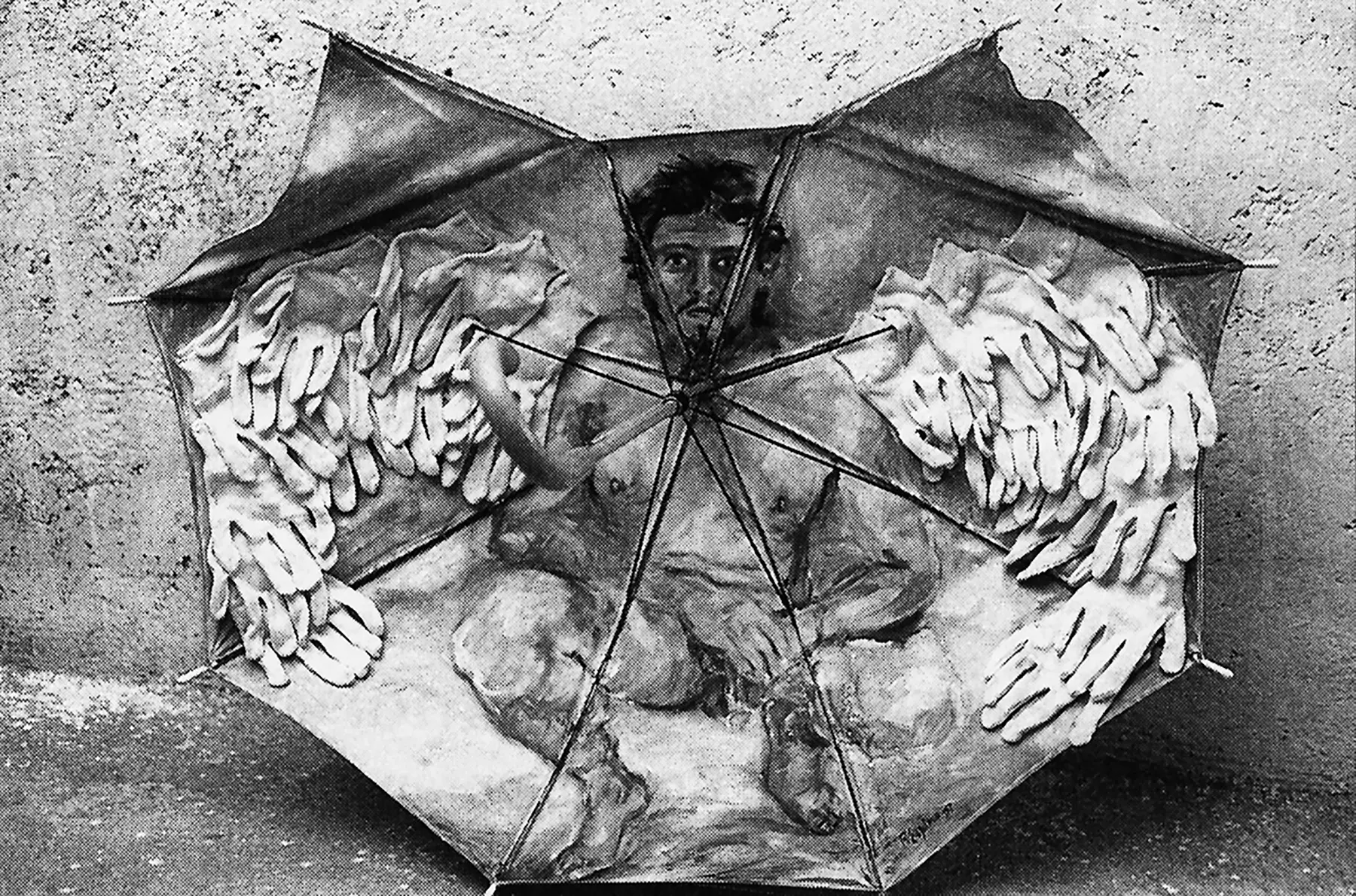
The work by René Espino titled My Guardian Angel ever ready to lend me a hand, was another work that combined humor and wit. In addition to the angelic meaning that such figures might have in the hands of a creator, here we could see a real guardian angel watching, as most of us believe, over our lives. The piece consisted of an umbrella inside of which Espino had painted a portrait of himself crouching down and with wings. The latter, made with white gloves the fingers of which spread open through the law of gravity at the moment when the umbrella is over our head, made the work one of the most original in the show and won the Object Art Prize.
The First Biennial of Angels also included a number of performances, lectures, round tables, and film and video presentations. Given its characteristics and geographical location, it seems destined to become a major event within a few years. The amount of the prizes should be increased in each section (this time they were 3,000 pesos, approximately $370 US). The more direct participation of well-established contemporary artists should be encouraged and there should be a more rigorous selection of participants, without of course veering off course from a journey that should be pursued, filling a void whose existence was already inexcusable.
SANTIAGO ESPINOSA DE LOS MONTEROS