In the past few months, New Yorkers have been given an unusual opportunity to reassess, or even familiarize themselves with, the work and influence of Joaquin Torres-García. This revisitation was initiated by recent displays of Torres-García's own work, and it has been furthered by the recent exhibition of the art of Julio Alpuy at the Sidney Mishkin Gallery of Baruch College.
Journeys of Julio Alpuy is the first major exhibition in many years of art by Alpuy, who was a student and later teacher at El Taller Torres-García. The 45 paintings and sculptures from 1943 to 1996 are arranged chronologically, which in the case of Alpuy, reveals a definite evolution. Alpuy's early paintings show a very strong tie to Torres-García, which also means that they exhibit the sometimes uneasy marriage of Picasso and Mondrian filtered through a vernacular figuration. For example, his Café of 1946 uses the faceted outlining of analytic cubism set within a regular gridded structure colored in red, white, blue, and ochre to depict geometric humans drinking at tables Almost from the start, however, Alpuy shows a penchant for stronger colors than his teacher, and he also has a less disciplined rigor in his paintings which actually tends to serve his art well.
After Torres-García’s death, Alpuy’s art loosened up even more. He also began to travel extensively. Subsequent paintings sometimes lose their overriding grid altogether, and in the 80s he begins to exhibit a personal figurative style based on his own variations of stock archetypal images, including mother-and-child groups, men in nature, and cosmic spiral motifs.
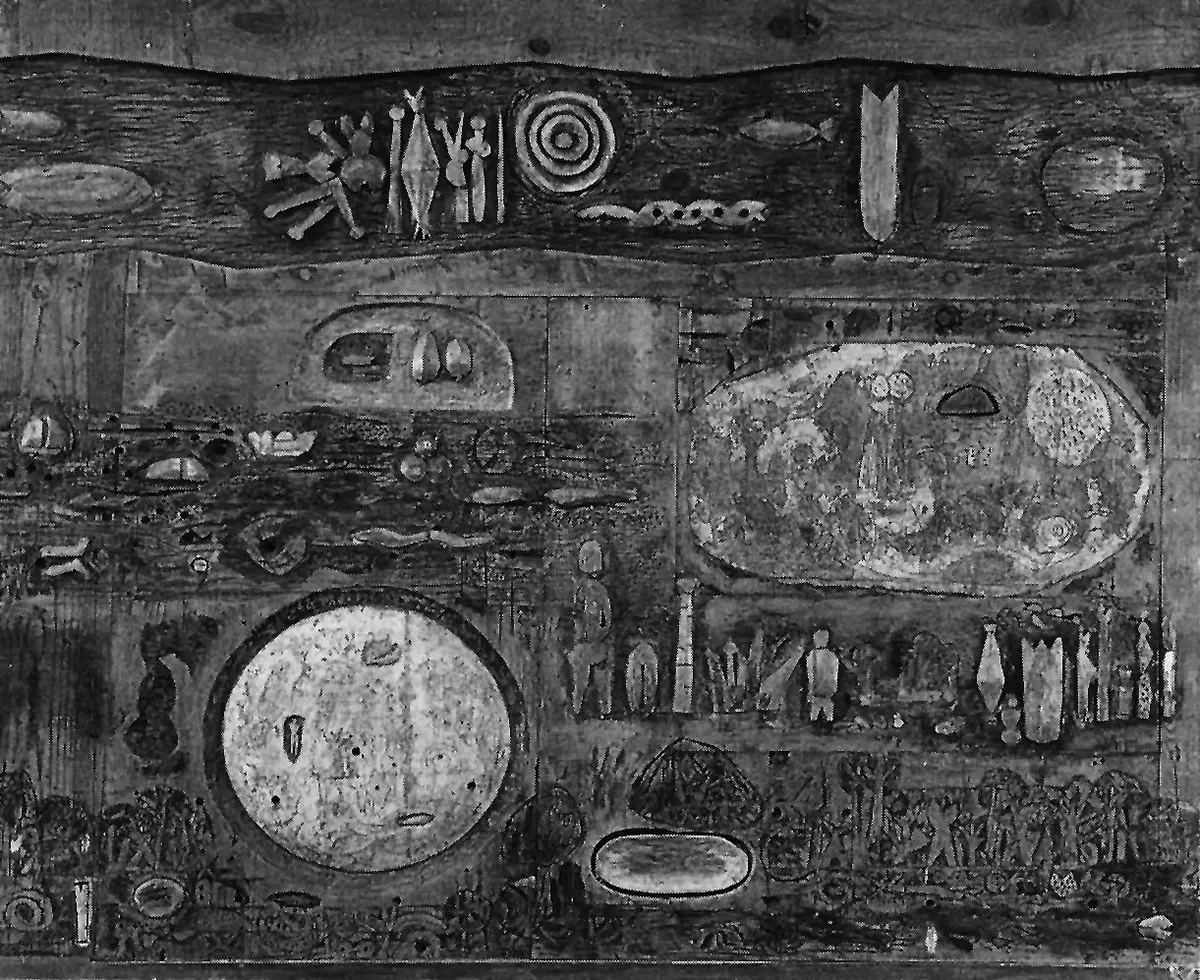
But where Alpuy really distinguishes himself is in his own sculptural projects. He has a facility with wood that Torres- García never demonstrated and can move from slick sophistication to primitivist rawness in the same piece. His reliefs, such as 1964’s Génesis I often take on an almost painterly appearance. His sculptures in the round like Spirit of Life present both simple monumentalized forms and exacting minute details. It is in works such as these that he manages to not merely imitate Torres- García’s example, but rather to learn from it and assimilate it into his own visual language.
JOHN ANGELINE