The rigorous clarity, vitality, and corporeality that has characterized the development of Brazilian art in recent decades, has been the result of a long process of affirming and consolidating artistic attitudes which have always given attention to the relationship with the vital dimension and the application and implementation of an avant-garde concept in a permanent process of questioning and movement. Without a doubt the work of Hélio Oiticica and Lygia Clark has been of pivotal importance in this collective process. Their legacy goes beyond the merely referential and extends beyond their influence within the national frontiers of Brazil. The passage of time has reaffirmed the topicality and continuing relevance of their projects, which were developed in conjunction with the international movements of the period without being submerged by them. This was the privilege of the periphery.
For a number of years, a process has been underway at the international level for the reconsideration and re-assessment of their proposals. One proof of this was their presence at the recent Documenta X in Kassel, although the montage of the works of Lygia Clark did not achieve the kind of clarity and understanding they required. At a very different level, the Antoni Tàpies Foundation in Barcelona recently organized a retrospective exhibition (Belo Horizone 1920 - Río de Janeiro 1988), which attempted to propose an overall reading within the various contexts of each creative period, with participatory spaces being provided for all those works which required the active intervention of the public. Curated by the director Manuel Borja, Nuria Enguita, and Luciano Figueiredo, the show will subsequently travel to other European museums, including the MAC in Marseilles, the Serralves Foundation in Oporto, and the Palais des Beaux-Arts in Brussels, before closing at the Pago Imperial in Río de Janeiro.
The show begins with the geometrical works of a pictorial kind, Superficies Moduladas and Espaços Modulados from the mid-1950s, which were set within the sensibility of the concrete movement and very influenced by the legacy of Mondrian. Subsequently, there emerged concerns that led to the progressive abandoning of normative precepts and a more dynamic kind of practice directly related to more flexible and vital attitudes—although still linked to geometry, as in Bichos (1960), sculptures of articulated surfaces and mobiles, or Trapantes, flexible rubber sculptures which can adopt any position in space (coinciding with their participation in the consolidation of the neo-concrete movement of Río, which was a plastic response to the lack of satisfaction felt by some Río artists at the rigor of the concrete movement in São Paulo during the same period).
From the progressive rupture of the pictorial plane and the break in the quietness of volume, Clark was to follow a path that would take her towards the demise of the artistic object, towards proposals that became increasingly participatory and an experience of creativity in which artistic practice merged with the therapeutic—a process which she pursued until the end of her life.
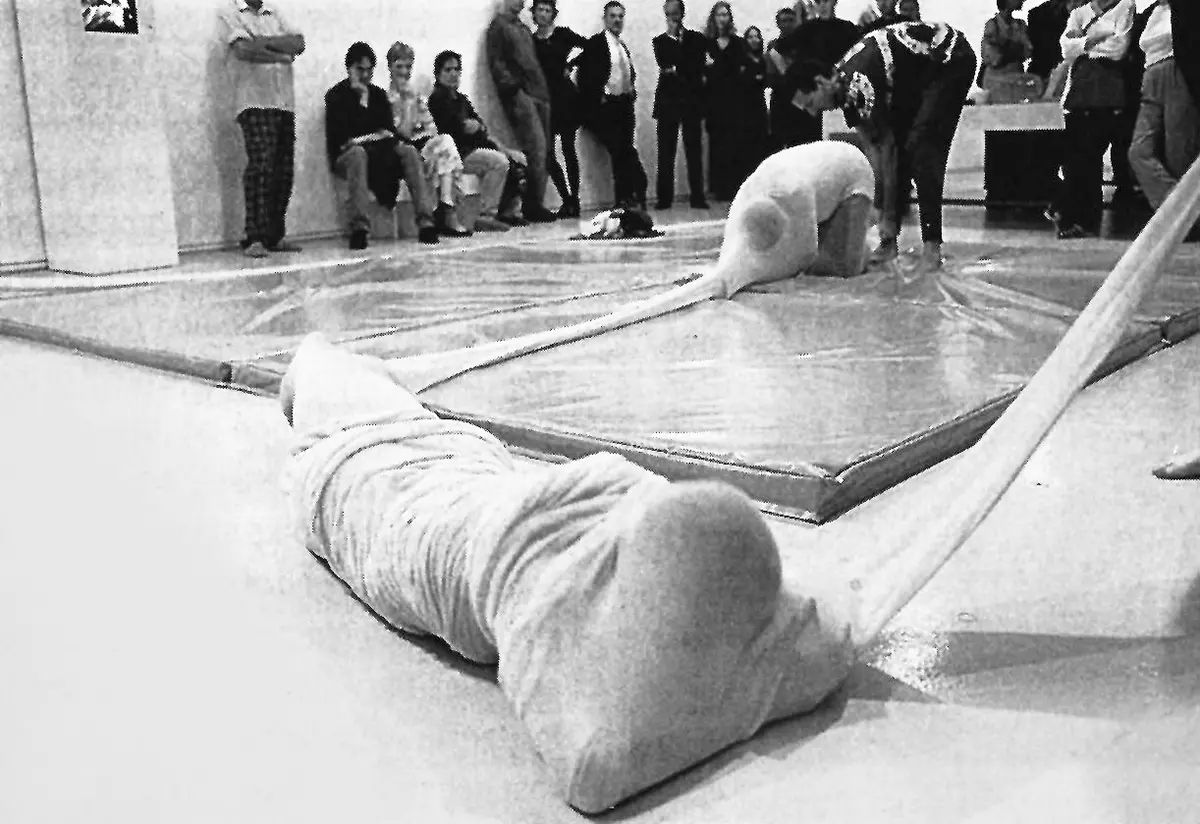
This exhibition reconstructed the environment A casa é o corpo, which was presented at the Venice Biennial in 1968 at the Brazilian Pavilion, and in which spectators passed through narrow spaces of different textures, made with fabrics, lined with rubber balls or filled with inflated balloons, like a perceptive metaphor of the bodily experience of birth. In the same way, visitors could manipulate a replica of a Bicho, and experiment with reconstructions of the Máscaras Sensoriais, the Máscaras Abismo, and the Objetos Relacionais.
In a sense, the basic objective of the exhibition was to take up and explore the challenge posed by the work of Lygia Clark in her rejection of the artistic object, the museum, and purely contemplative level, and her concentration on the interpretative and active aspects of the spectator's body.
Indeed, one of the most radical and revolutionary aspects of Clark's work was the way in which it approached in terms of artistic practice the creation of an increasingly perceptive and experience-based framework for the spectator. In this way, just as her work was directed towards the dissolution of artistic artifacts through the construction of her objects with ordinary everyday materials (from plastic bags filled with air or water to shells, pieces of rope, elastic rubber bands, gloves of different thicknesses, and treated with different textures on the outside reducing the sensitivity of touch, etc.) which eliminated the fetishistic nature of the artistic object, her proposals were an attempt not only to configure a context of perception but to delineate and consolidate the notion of an eminently active subject/ spectator, based on the latter’s sensory experiences and capacity for communication or lack of communication.
Lygia Clark rejected the idea of the god-like artist, preferring to play a role closer to that of mediator between the work and the spectator, transforming the latter into a subject of experiment and in a sense into the author of that same experiment. The work would finally be circumscribed to the experience/experiment (changing and different in each subject) rather than delineated in the objects which permit perception and experimentation, and which are more exactly tools than works in the strict sense of the term.
Despite the apparent formal multiplicity of her work and the linguistic differences between each of her creative stages, her career can be seen as very coherent and compact, starting with painting, then moving towards volume, the object, and its dissolution.
Clark’s influence has been enormous in Brazil, especially among younger generations of artists. On the other hand, in other artistic spheres of Latin America, knowledge about her work- even of a very fragmentary kind—has been slow in developing. After having been ignored by critics at the international level during her lifetime, her work is now beginning to receive worldwide attention, which is leading to a richer and broader understanding of the role played at the perceptive level by artistic research on the body in recent years, as well as revealing once again the precarious and insufficient nature of the partial or partisan critical readings which have dominated art in the present century.
SANTIAGO B. OLMO