This show titled Identity, by the Venezuelan artist Milton Becerra, recently presented at the Museo de Bellas Artes in Caracas, was an ambitious, reasoned, and complex project in which the artist proposed both a compendium of some of his previous work and a renewal of certain concerns and concepts.
Identity was organized according to a criterion that was circular in its spatial design. The nucleus of the great installation consisted of a group of scepters installed in the center of the room in a circle in hexagonal form. Each of these seven scepters guided the spectator in a specific direction, either towards the other installations in the room or towards the infinite, given the conceptual transcendence of the scepters. The work as a whole formed a center of irradiation, in part due to its radial structure, but also because of the spiritual and energy-related powers of quartz, the mineral with which the pieces were made. This concentrated all the powers (economic, political, religious, cultural, etc.) that govern the world.
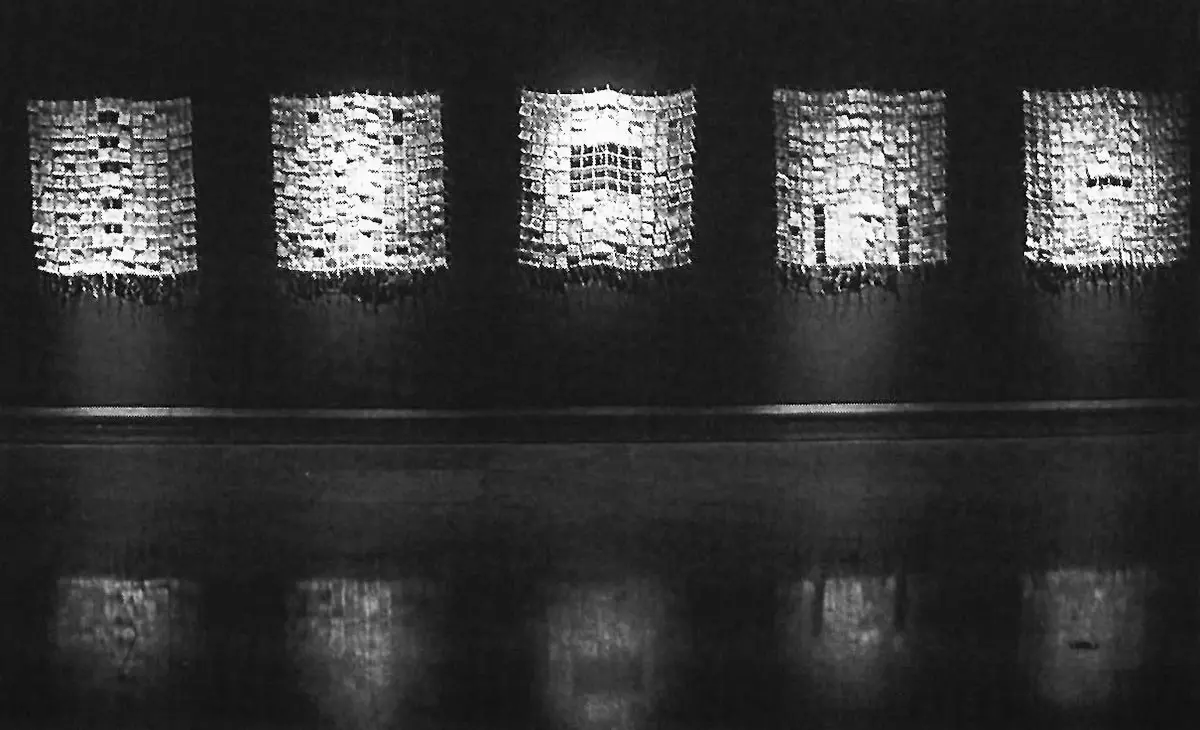
Each irradiation placed the spectator before various situations raised in the other works: My favorite currency, The horizontal window, All or nothing, Bludgeons, Coin scraper, Coffers, and Earthenware Jars. These pieces offered a critique of various aspects of our daily life which depend essentially on the policies established by the centers of power. Thus the devaluation of the Venezuelan currency, the resulting financial disaster, and the repercussions of the country’s economic crisis inspired Becerra in his choice of paper money as his plastic medium. The bills are attached to one another to form tunics (My favorite currency) or a gigantic tapestry (All or nothing). In both installations, the currency continues to be what it truly is —devalued paper— but at the same time, it is a new material rich in texture and plastic potential. The luminous qualities with which the latter piece was endowed (the best lit in the room) significantly enriched its impact, with the reflections on the back wall creating a handsome kind of brick wall or lattice effect.
The light was an essential feature of this show light and dark, reflections and mirage-like effects. The artist played with the spectator's sense of perception, encouraging the spectator to move closer and then away, towards one side or another as he discovered the identity of the works. Becerra takes from his kinetic past the idea of the active glance by the spectator, creating an atmosphere of suggestion and secrets which in turn revealed other aspects curtailed by the mercantile spirit and a loss of principles. The artist emphasized the need for a return to native values and alludes to how these have been debased. There are continuous references to the Liberator and his thoughts, the history of Venezuela, our indigenous ethnic peoples becoming extinct, our pre-Columbian past —in short, the process of mental emptying out and the growth of alienation and futile materialness— all of which appear and disappear in this montage.
At the same time, there is a clear ecological consciousness here of what is happening in the Amazon region. Coin scraper refers to the work tools of our indigenous peoples, except that the presence of a million bolivares in coins piled up on the floor inevitably suggests the thirst for wealth, the unscrupulous exploitation of our soil, and the ecological disaster currently ravaging the Amazon region of the country.
These situations, as well as others that merit more detailed analysis, form part of our own identity. The artist invites us to reflect on our identity, not as a simple concept or search for some formula or label which identifies us, but in terms of a confrontation with the reality from which we are made and from which we cannot detach ourselves.
Since he is above all an artist, Milton Becerra also endeavors to endow his work with sophisticated artistic and aesthetic qualities. There is beauty in the conceptual hardness —and harshness— of these works which, despite all the opposing forces which they contain, manage to convert the museum space —and that of the work of art— into a retreat for spiritual and sacred reflection.
SUSANA BENKO