I am an Other, the recent exhibition by Mónica Castillo, gathers together some of the work which the artist has done since 1995. Her paintings, photographs, and other embroidered and woven pieces comprise a small and select sample, the main themes of which are reflected in the quotation from Rimbaud which serves as the title of the show. In a letter addressed to Paul Demeny, Rimbaud wanted to demarcate the body from the mind in an attempt to explore the depths of the soul and achieve a universal language. The splitting of the persona through a long, immense, and profound dysfunctioning of the senses would enable him to unravel the relationship between the I and the world. Castillo, on the other hand, seems to begin with the surface and explore appearances. She multiplies her self-portraits and the different components of her face to analyze the relationship of the individual with the other, which is frequently oneself. By treating the effigy of her own persona with a cold sense of distance, the artist not only breaks the traditional meaning of the self-portrait genre as a psychological mirror of being but objectifies and conceptualizes this / to which she refers as though it were a third person.
By transforming the subject into an object of contemplation, Castillo proposes a repertory of images that make up personality, as well as the various implications of alterity. In A Self-Portrait like any other (1996), her face which seems to be in search of some identity can be seen with difficulty under a blurred surface of flesh tones. Similarly, in Self-Portrait like another person (1996), her effigy is split and her features transfigured, resulting in two faces with different expressions that nevertheless remain the same.
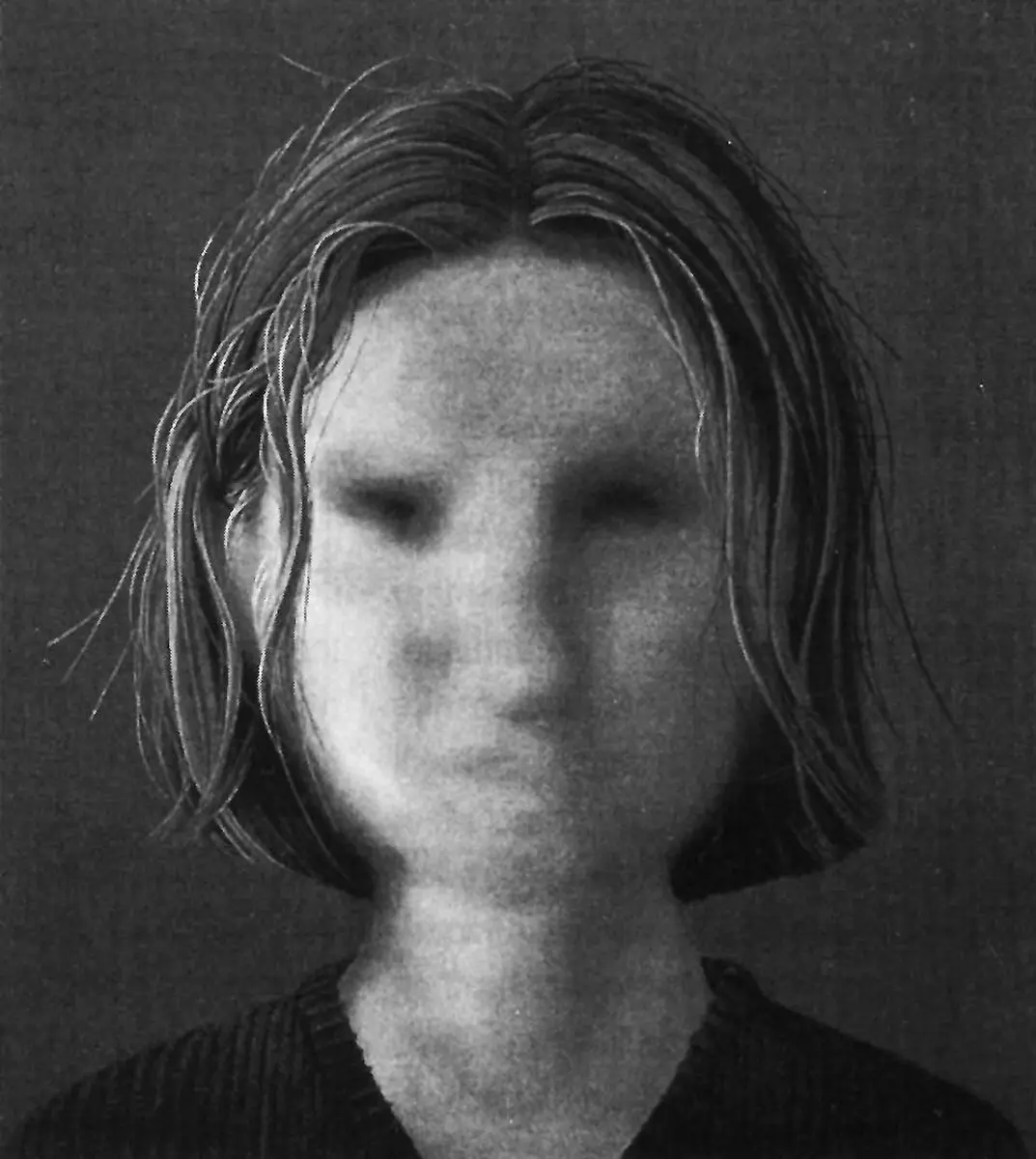
The disintegration of the individual to whom the pictures refer is even more evident in the work titled Self-portrait for assembly (1995-1996), consisting of eight embroidered pieces which, one by one, present the different components of her face—eyes, skin, facial hair, mouth, eyelashes, eyebrows and hair. Castillo invites us to reconstruct her identity, suggesting with a cynicism that the project for each spectator will be appropriate but that none will reflect her true reality. Something similar occurs with Model for self-portrait I and representation and Model for self-portrait 2 (1996-1997), two pieces in worsted fabric which use as their support for the head of a tailor’s dummy. While the first refers to the dates the parts were woven, the second seems to be awaiting its completion, Castillo establishes an interplay between public and private identity which is taken up again in the series of five digitized photographs titled Spoken Self-Portraits (1997). The five faces of the artist reveal minimal variations, which would be imperceptible if the images were presented separately. By multiplying the effigies and presenting them together, Castillo subverts the authenticating character of photography and suggests that there is no real image since, between these images, it is impossible to identify an original. The title of the work refers not only to the inefficiency of words and the problems of communication faced by two subjectivities but to the different faces that life in society obliges us to adopt. In Curriculum (1997), strange pieces of eyes, noses, mouths, and ears carefully lined up on a featureless face once again refer to the fragmented nature of the postmodern subject, whose identity becomes transformed from day today. The surface work carried out by Mónica Castillo in each of her pieces postulates the impossibility of defining any absolute identity, since the latter is constructed according to appearances, and depends on both the image which we wish to project and on the different interpretations made of it.
MAGALÍ ARRIOLA