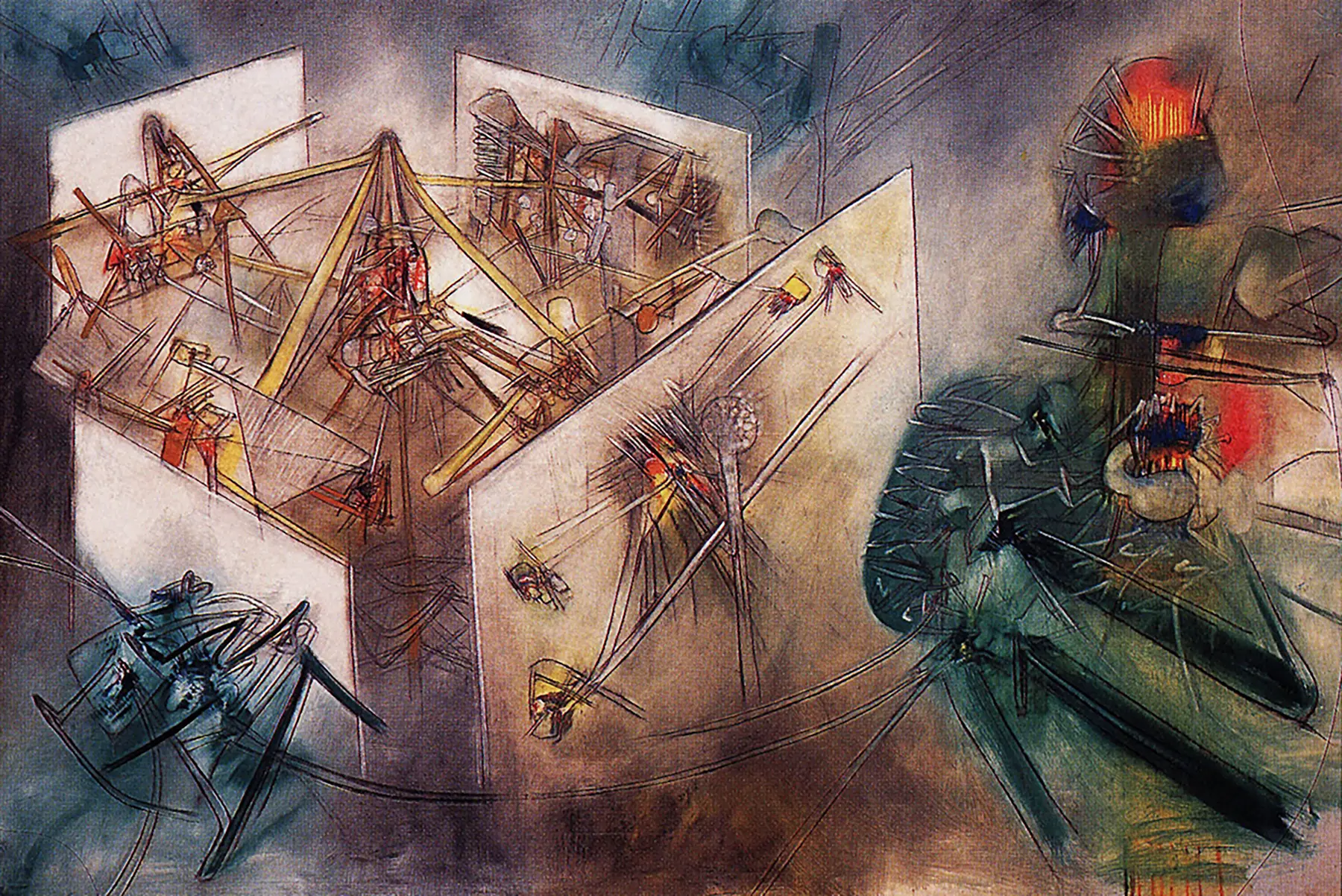
Roberto Matta: Something I had never thought of saying. Musicians have captured the voice of newborns before they speak the language they are destined to speak. To a certain extent, it is like watching the palate as it is being formed and it is the vault of the palate that produces the sounds of voices, that is where accents are generated which tends to be very important for the voice in music. Things like that happen with what people call awareness. That is to say, you are aware but in order for your awareness to grow, you have to make yourself a sort of a box full of images, packages of images which are those you're going to use. Most people are already well-worn images. What I would be interested in would be people who could obtain images for us of less easy moments. For example: what is the form of an orange when it is falling? What is the form of an orange when you are eating it? What is the form of an orange when you are digesting it? What is the form of an orange when you are shitting it? We never talk about these things. We only show the best things. I'm not a painter. Painters in general want to show you something we already know. They say they're going to show it to you with art, better than it is, and I don't believe in that. Instead, what is needed are newer, more exact images of what is happening when a thing is growing.
Celia S. de Birbragher: I have a great passion for art.
RM: But what is it they call art? I'd like to know what you call art.
CSB: I call what man is capable of producing art.
RM: That's technology. That's what carpenters call it. Often what a carpenter does is a lot better.
CSB: There are carpenters who are artful and others who aren't.
RM: That is to say then, you call the love a person puts into something art.
CSB: I call it art when a person does something and afterward that something he produced can transmit ideas, can transmit images.
RM: But there aren't any ideas. What sort of ideas when they are all illusions?
CSB: Illusions then.
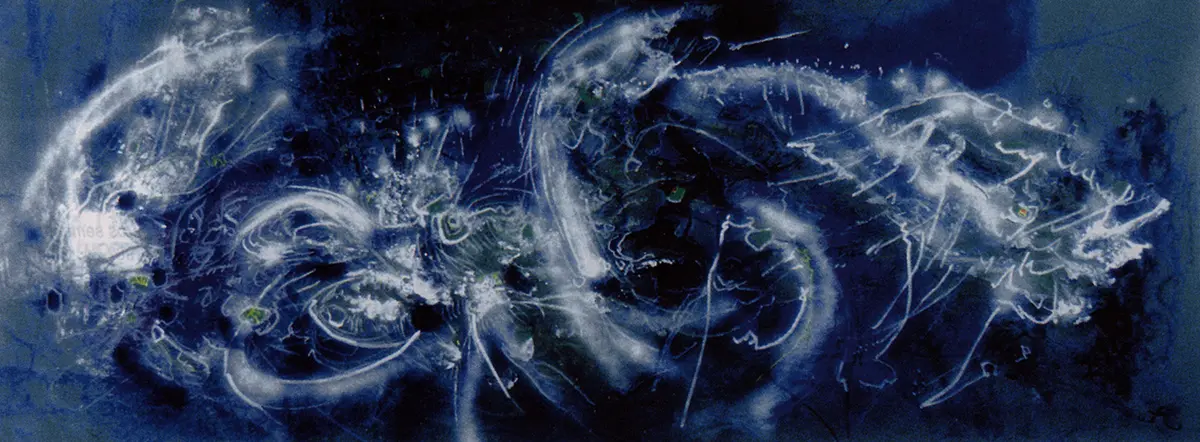
RM: So that is taking up a vocabulary we know nothing about, that is, to be able to speak. When one says time, time is a bone that people call eternity. That is, the infinite, the impossibility of grasping, of growing, of generating things. Growth and the generation of things are so fascinating but we don't have images with which to represent them to ourselves. We are unable to represent the moment in which a thing changes. For example, I like to talk a lot about struss. Struss is the science of power. The science of the human body is anatomy; it's called botany for plants, and zoology for animals. When in human bodies, in living bodies, the sperm touches the egg, wham!, an explosion of acceleration and forms seeking forms begins. No? And from a teeny bit of yogurt at the beginning, this thing in nine months appears like a little kid shitting away. That's the way it all is and it also happens in thought; always changing, always modifying itself, always inventing how the fingers begin, how the fingernails begin, how the blood begins to reach the fingertips. That is what I'm interested in. I don't think we have a way of communicating (about moments,) when things change, when a thing starts to be loved, or when a thing starts to be forgotten. So everything requires another morphology and I like to say that this is all the verb America. I don't mean verb America, I mean verb Oh! South America because the verb America is new, Europe is already technology, hammers and those impossible and absurd [plastic] keys they've invented. That's the way keys are now. It's, like, thinking we don't know anything about how feelings, ambitions, and awareness are generated and they keep on inventing idiocies for everything. It's incredible now that this could be a key. This isn't a key, it's a card. So the key no longer exists. So keys, let it be known, no longer exist; they're cards. So the key is done for, let it be known, what you call art is done for! What you call art was something for opening, for entering into the desire to make, to improve, to make, and be able to say something better. These are all voices from microphones and the telephone. Right? People don't even see each other when they talk.
CSB: So true.
RM: The word art is like the word track. No one leaves tracks anymore because no one walks anywhere by the edge of the ocean in bare feet. I don't think anyone knows who passed by here. I have something very strange. My hand. See how that line is very peculiar? It runs to this finger and I don't know where I'm coming from, where I'm going, what's happening. It's quite strange.
CSB: It's strange. They say that is the lifeline and it's long ...
RM: Yes, that's what they say. But it's strange, it crosses my entire hand.
CSB: It crosses your entire hand. It crosses it (you) completely.
RM: But there's something else that is strange: I was born on the 11th of the 11th month of 11. The 11th of November 1911. It's strange. A friend in France gave me a copy of the newspaper from Paris on November 11, 1911. In that day's editorial the guy speaks of how strange that date is because it is a date on which there are seven ones and just one nine. Fine. This isn't going to happen again, for at least ten thousand years or something like that. Because January 22, 2002, only has five; March 3, 3003, there's going to be four. There's going to be seven on February 22 of 2222. Those are strange coincidences.
CSB: We don't know if the world can take all that, right?
RM: That's right. And the editorial ends by saying that this isn't going to happen again until November 11, 11111. So the issue is perhaps that awareness must obtain something more secret, more genital, beyond the essence of reality and not just appearances. I leave history behind. I leave the knowledge of how to build buildings behind, how to build awareness, an awareness that comes before one dies to be practically universal, and how one is able to grasp realities. But one can't say this in a magazine.
CSB: Don't worry about it. I wanted to ask you another question: What about the joy of painting?
RM: That's the only thing that matters. But not the joy of painting. It's the awareness of growth. The majority of painters I call tubists because they're interested in tubes, palettes, and brushes. It has nothing to do with... that's what happens with fingernails. The primitive arts are important. The guy making primitive art has no art history. He's just trying to grasp a hidden reality.
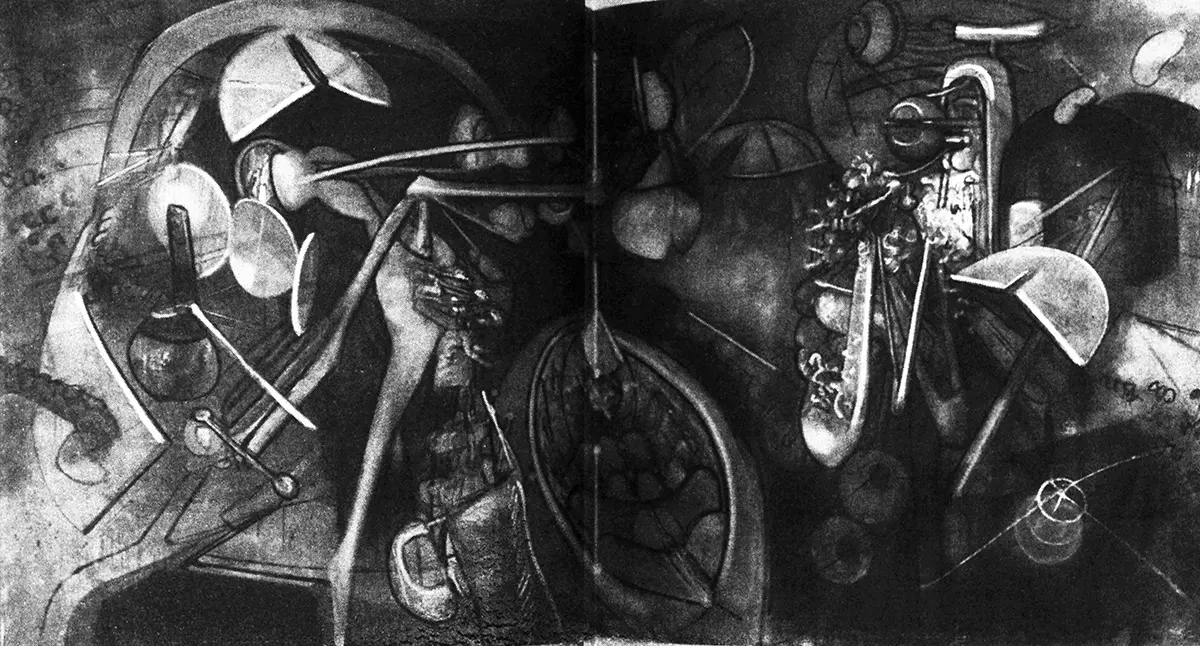
CSB: When I look at your paintings, I sense a kind of game.
RM: You can't do anything else but play games. I play a sort of eternal chess game with myself and that's why I like the name of this city [Miami] because it is mi a mi [me to me], that is to say, it is a Me with a Me. It is the circle from which awareness grows. It is the me that is growing and it tells the me that a sort of me-ism is appearing.
CSB: Drawing.
RM: Drawing is sketching. They are all tracks.
CSB: They are sketches, they are tracks.
RM: Yes, if they are tracks, they are scars, they are scratches. The thing is that in English you can say all of this very well because in English you can say "to be aware." To be aware is to realize there is a thing called life, to realize it, but "to be aware," the word "wear" is how you use your awareness. If you use awareness, desiring more and more life, more and more awareness, and more and more, then you are using what you have already used. But if you use it, you wear it out, you know? And most people don't want to live, they want to be dead. Art is actually poetry, constantly living the reality so that you are wearing your awareness.
CSB: Have you helped young artists?
RM: Never. I haven't helped anyone. I've told them what I believe they want. Because most people believe they want to enter the history of art and be celebrities. That's what they think, but that's not what they want deep down. They want something they don't know they have.
CSB: And if you were to give advice to an artist, what would you tell him?
RM: It depends on who it is. Because first of all, one can't give advice. One can know more or less what things that guy is searching for. Animals have no need for anyone to tell them for they know what they're looking for—they're looking for food, they're eating food to take in energy except that often they eat junk, and then since they eat junk they don't grow, they stay right where they are, chewing. Perhaps what they want is for the painting they're selling to go for a million dollars. Deep down, that isn't what they want but they've entered a sort of championship of who can get to the millions of dollars first. It's a game of imbeciles. The only thing in which I believe, more or less, that I experience, is that since there are a lot of Basque things
in my origins, that is, things from before history, nearly animal things, like some animals, I like to eat roots and origins, where things begin. That's why I believe in the verb America. It is very important because America is now being used very badly. The awareness of what America is, what this land is, this continent—this continent is different from Europe, very different, extraordinary. But it is being used badly. When I say the verb America, I mean we should be aware, that our art was strong. I mean that technology, the way people express themselves in the artisan's sense of words before the Christians arrived. The Spaniards were stupid when they discovered America (the same as they would have been if they had gone to Egypt in the year 4,000 BC.) They found a culture with an extraordinary state of development and a concept of the universe and they destroyed everything in fifty years.
CSB: Absolutely.
RM: When I say the verb America, the verb America is the desire that existed to a certain extent in Italy during the Renaissance to recover that sort of passion, that sort of desire, and then it seems to me that a need for that is going to appear gradually, to try because after five centuries all the immigrants that came here to become Indians are now Indians. That is to say, you're now in direct communication with these leaves, these flowers, these birds, and these strange things that are different from Europe. So, in all that there can appear a sort of language, a language that has no ugliness, that doesn't have anything. At least it's not a game of idiots, that of having one more Cadillac... And then, perhaps, different human relations might appear, more aware of the difference, with fewer fears than in relations nowadays in which whites are terrified of blacks, blacks are terrified of whites and Chinese, and there is a sort of universal fear. We have to let go of all that and get back to Nature, which instills in us at least a natural fear: the fear one has of lightning or the fear one has of viruses or the fear one has of the cold.
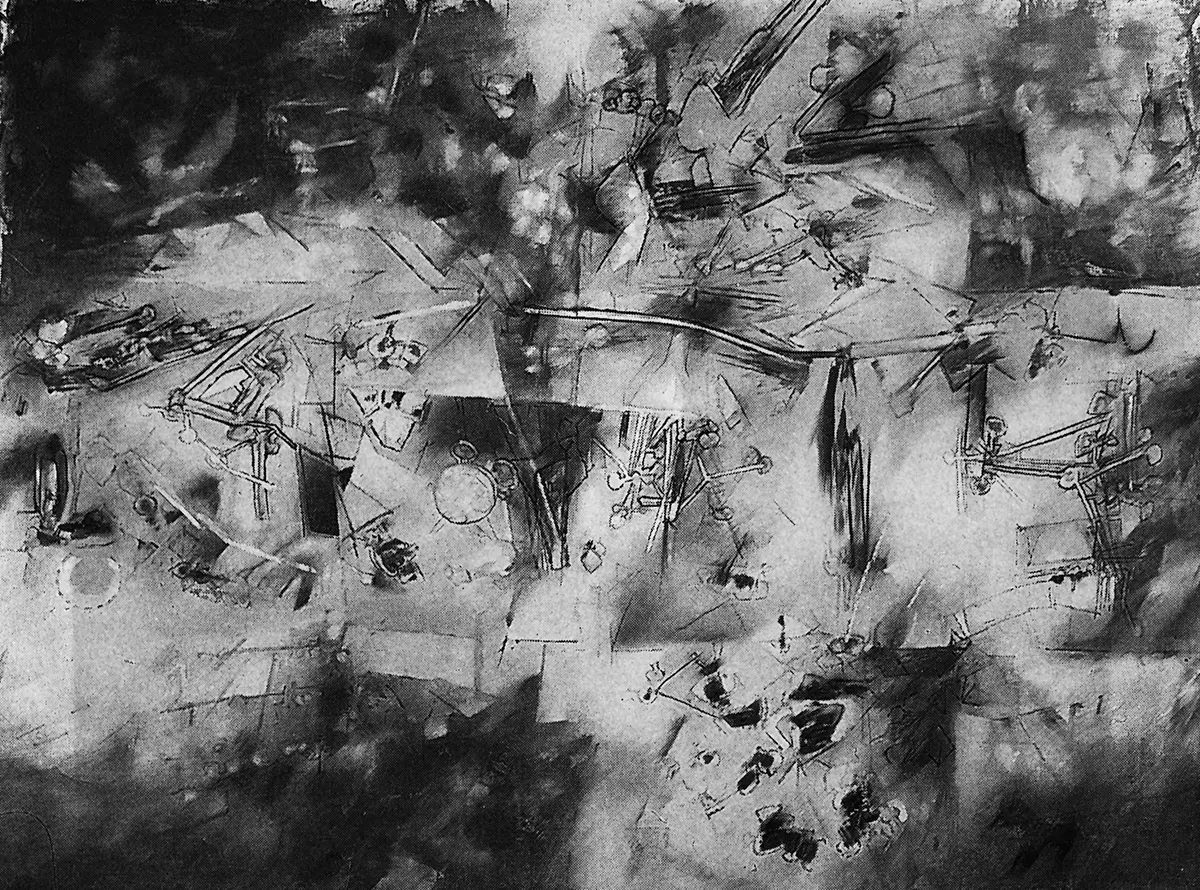
CSB: I find it marvelous to listen to you speak.
RM: Marvelous. Mar-villas, sea-villas. It is a sea of villas, villas—no, you call those things hebillas [buckles]. It's a sea of buckles, it's a sea of closed things. What happens with oral communication is that you are eating something hot, your speech is hot, but when there are machines and records and it gets cold. I don't know if you can still talk about that, because I could upset everyone. Journalists are like priests.
CSB: But I'm not a journalist.
[Diana Lowenstein approaches.]
DL: This woman produces the best publication on Latin American art so that we poor Latin Americans might be informed. It is a private effort on her part.
RM: Informed about foolishness. Foolishness, foolishness. You have to inform yourself about the primitive arts. Telling what they are showing in New York, which is the worst, is what screws them. Instead, if there were information about those strange madmen, those Indian magicians that still exist in the center of Mexico and Guatemala or in Brazil. What the blacks in Brazil are remembering about how people used to speak of the rain. That is information. That is the true history of consciousness. But to tell them that a painting by a man who is copying the comics was sold for one million two hundred thousand dollars, that's the worst. It's worse than drugs. They are not journalists. They're worsenalists. In- femalists. I have kept a great distance from all types of journalism. I've never appeared on television. I've never done things like that. I tell a story because it's true that among the things I've come to learn is information about other lives and other ways in which things might happen. Things happen very differently to a tiger than to a rat. Well, with the
living, things of this sort occur. If you could represent spaces instead of representing space always according to Euclid, with perspectives and all that. If spaces of consciousness were represented—what are the worries of a rat, the dimension of the universe of a rat, and the dimension of the universe of a swallow? That's where we start to touch things that are useful and that is what the verb America must be, not the word art that you use, an art of something that helps one grow, make, something one can have, so everything we are being taught is things to have, not things to make. And there is the trap. For example, we live in these religions. These guys who teach have invented another concept for capitalizing and they try to do so, to be good so you have money and investments after death, like Swiss banks. But what eternity I don't know. You're dead. Death isn't an eternity. At heart, it's as if culture wanted to screw us rather than help us. No? That it wanted to get us all muddled. Keep us a little stupid so we would serve them. Take a chicken one day and draw a line with a piece of chalk in front of the chicken and the chicken stays there and doesn't move, doesn't move until something else happens. That is to say, it finds itself in a situation of the infinite unknown and doesn't know how to react. It's hypnotized, let's say. Many of these values circulating around here
are like that. What I predict is that the * magazine will explode, that it will burn up by itself, and that a tiny blue flame will emerge from it. Because for starters, the first thing one must do to build is to destroy. You have to prepare the ground, cut down trees, clear the land . You have to knock down all the weeds.
No one wants to hear the truth. Another very important thing that must be said immediately is that that is why I don't like to talk with worsenalists, you know because if talent exists and you have discovered talent or love, no one should know, it should all take place in secrecy because if it is known everyone wants to screw it and destroy it. If you believe you have a talent you shouldn't talk about it. Maybe it has to be there but try to make use of it, to apply it, for if you don't, you'll screw it up. Amuse la muse, as they say in French. They don't say that in Spanish because amuse is divertir and divertir doesn't rhyme with muse. You have to be constantly seducing the muse. The same holds true for love: if you have love, no one should know about it. And that is the great secret of adultery.
No one should know, for as soon as one person knows, it's screwed. That is keeping the flame of being. That is poetry but it's called art and it is already starting to become artifice, starting to become artifice and trap.
CELIA SREDNI DE BIRBRAGHER
Director and Editor of Arte en Colombia / ArtNexus.