The United Nations High Commission for Refugees (UNHCR) recently presented at the Espacios Cálidos Gallery an exhibition of work by the celebrated Brazilian photographer Sebastião Salgado, titled The Refugees of Our Time, under the auspices of the Ateneo de Caracas —the headquarters of the above-mentioned Gallery— and the Ministry of Foreign Affairs of Venezuela. The show, inaugurated on 24 September, lasted for two months. A total of 48 works, of a documentary kind, in black and white, reflected part of an ambitious project which Salgado started in 1994 focusing on the brutal situation of migrations violently imposed on large human groups, for religious, ideological, or racial reasons, a project which will keep the artist busy up to the year 2000. These images, which belong to the first period, between 1994 and 1995, show refugees and internally displaced persons of the former Yugoslavia (Bosnia, Serbia, Croatia), Hong Kong, and the African countries of Rwanda, Mozambique, Soudan, Tanzania, Zaire, Burundi, and Malawi. Fleeing oppression, ill-treatment, and death, these afflicted human groups are forced to move from one place to another, from one country to another. Men, women, and children wander through different regions of the planet, although they are not alone since they are always accompanied by their wretchedness. And sometimes by Salgado.
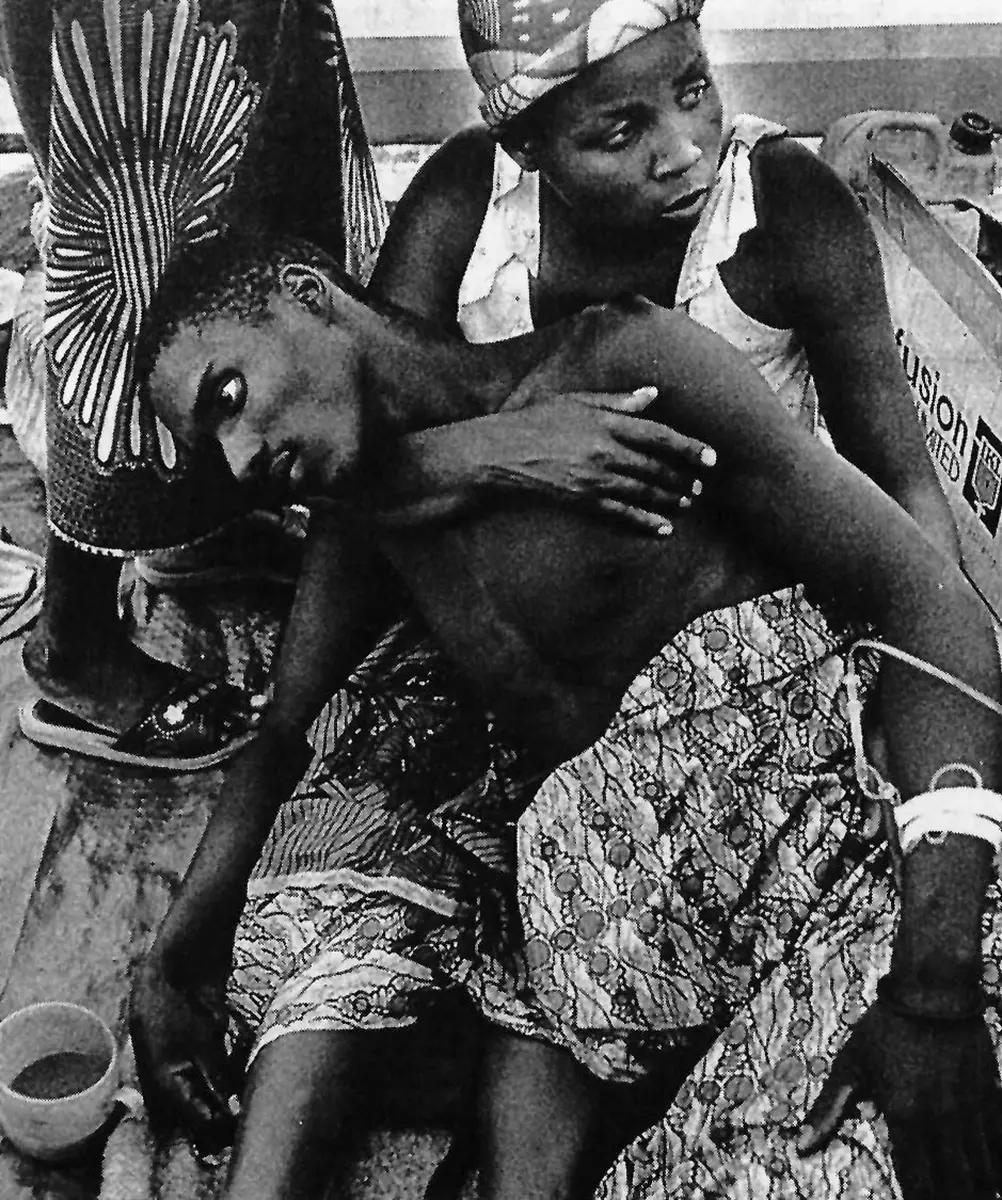
Along with their surroundings, and their landscape, they are transformed into the raw material for Salgado’s exceptional pictures. The refugees thus become the dramatic actors of their own representation. And contrary to the generally received opinion, the impeccable formal beauty of these works is precisely their greatest misfortune. Rather than a critical vision, rather than an incisive reflection, these images create an instantaneous kind of sentimentalism, the superficial melodramatic effect of emotion. And like a bubble, this feeling disappears rapidly. It is not therefore a sharp and piercing look that deconstructs reality and reveals, in a critical manner, the political and economic factors, the social and cultural factors which underlie the existence which currently faces millions of refugees, with their particular historical specificities. Neither is Salgado much interested in giving his photographs a sense of the violence, roughness, rage, despair, discomfort, and pain suffered by the people he photographs since such ignoble feelings would detract from the mystical and carefully prepared dignity to which he aspires for them. His sophisticated and at the same time conventional formal scaffolding prevents him from resolving —in a sensitive, intelligent, and contemporary manner— the contradictions of the reality which he photographs. Perhaps formal strategies should not be articulated on the basis of such contradictions? Perhaps the decidedly fragmented nature of these human groups, victims of very different kinds of segregation, should not affect these formal strategies, so it should be possible to establish an adequate correlation between such a dismembering of reality and the image which seeks to document it? But Salgado is clearly not interested in such questions. He prefers to use pre-fabricated and old schemas through which he focuses on any kind of reality. And of course, he uses them with exceptional virtuosity —like any self-respecting academic. For example, many of the settings selected by Salgado resemble exuberant film locations, where the elements of reality are completely diluted by the exquisite rhythmical treatment given to light and shadow, with a fabulous range of greys that activates the displacements in tone. In many cases in which landscape appears, the image acquires a grandiloquently epic dimension which forms a counterpoint to the grandiose and epic sky. The social reality, which is barely visible, is what least matters in these pictures. In other cases, the delicate fragmented dispersion of the photographic grain converts the medium into a kind of subtle charcoal and even a diffuse sort of watercolor. The elements of reality, transfigured into the distance and ghostly silhouettes, have disappeared. What has happened to the documentary dimension of this project? And what about space? Should not a sociological and emotional space as complex as that of refugees be visualized through a formal strategy that examines the problems of such space in reflective terms? On the other hand, we must content ourselves —or delight ourselves— with a visual rhetorics which conventionally organize surfaces, with a misty spatial continuity that has eliminated accidents, and sterilized the reality of any agent which runs counter to the formal purity of the images, sealing the possible fissures which would suppurate social suffering and its causes. The figures and situations are placed in a kind of limbo, a mythical, atemporal time, beyond good and evil, since it is evil, from Salgado's perspective, which consecrates them. When he draws close to them, he captures them in such a way that they seem to be posing docilely and even acting for him, and for us. In the face of such raw reality, the formal frame leads to distraction on our part, focusing our attention instead on the exotic quality of the prints of the fabrics which partially cover his African refugees, transforming the print into the motif which structures the sinuous composition. Or in an impressively precious use of the recourse of light, transfiguring men and women into the figures of a baroque painting full of sharp contrasts...in light. Human tragedy thus becomes an infamous spectacle: the aestheticizing and therefore masking image created by Salgado would seem to be skilfully designed for consumption and for enjoyment by Western complicity and opulence, within the conservative limits of the politically correct. Perhaps for this reason some people have claimed that Sebastião Salgado has become the Avedon of human wretchedness.
ELISEO SIERRA