
In Buenos Aires, toward the middle of the seventies, on the same historical horizon on which has arisen diverse artistic forms derived from North American pop—the happening, the environment, and French Nouveau Réalisme—there appears a line whose tendency might be called "political art." There can be no doubt that it shares proximity with Marcuse (less read than he is transformed into an object for consumption) and his Great Refusal: "protesting that which is." It is the time of the revolution and art must participate in the transformation of society. For some time, Bony, Jacoby, Suárez, Renzi, and certain others were working toward this end.
Located on "art's other face," —according to Restany's felicitous phrase—, these artists constructed their languages on the transgression of the traditional genres. They all formed part of a generation that was equally opposed to the preeminence of the object, stable supports, and the supremacy of perception. The installation, the environment, action events, and the intersections of art and writing were their dominant strategies. It was a certain tendency in art whose concept was quite diverse, ranging from Kosuth's linguistic and tautological conceptualism to the work of the group Art & Language.
In this context, the new conditions of support are important, opening the consciousness of the spectator to an exterior problematic in tune with the socio-political reality. An early example of this route is the presentation by the Argentinean David Lamelas at the Venice Biennial of 1968—a teletype that offered the public, in real-time, the news coming out of Vietnam. As Marcuse would say, the work of art, to constitute itself as such, requires a process of "aestheticization of contents."
This period of time is difficult to understand without taking into consideration the place that private patronage acquires in the form of sponsorship by the DiTella Foundation as well as the orientation provided by its Center for Visual Arts, directed by the critic Jorge Romero Brest. In 1963, following the opening of the Center with its large exhibition hall on Florida Street (in the heart of the city, very near to the art galleries and the Department of Philosophy and Letters of the University of Buenos Aires), it was commonly thought, as the magazine Primera Plana signaled, that "the modem world [was now] within everyone's grasp."
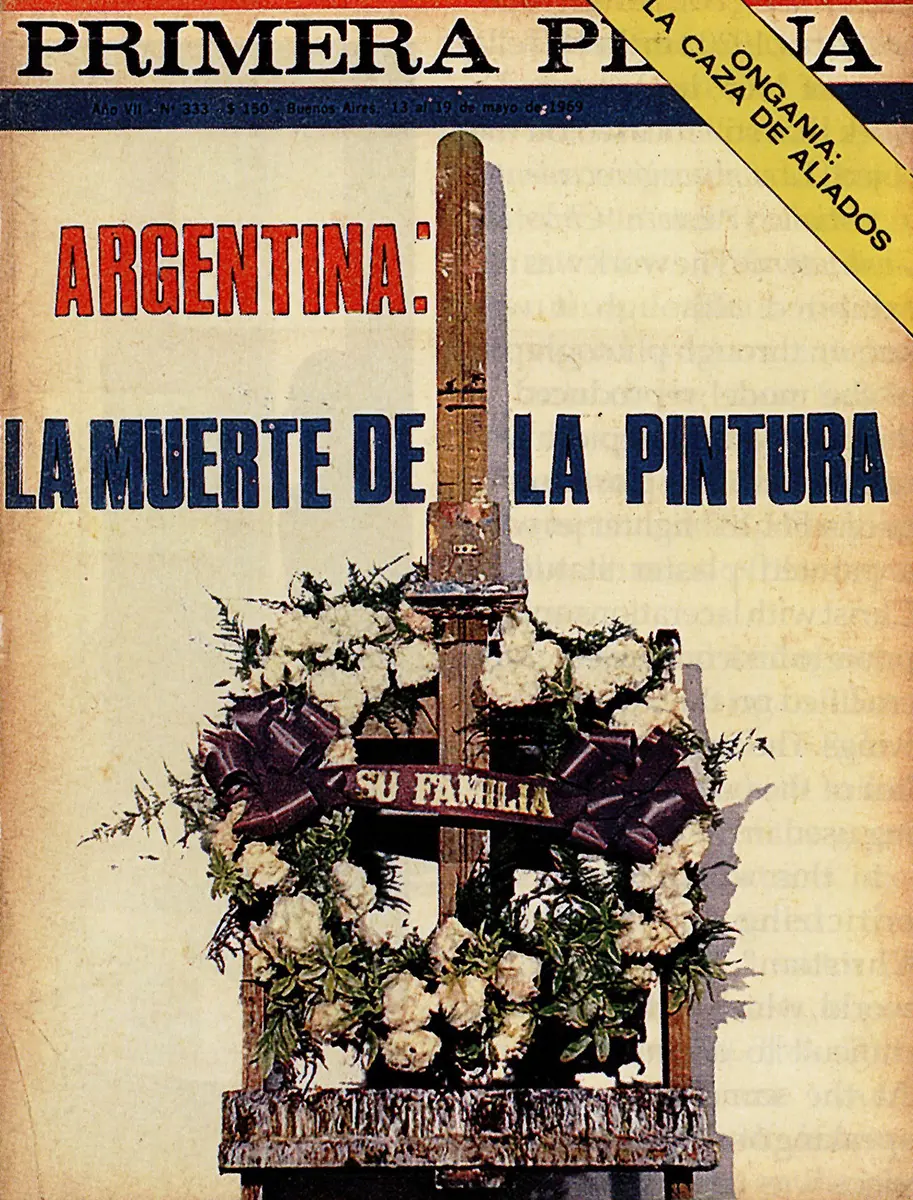
These were the years of the constitutional presidency of Frondizi, of the creed of economic development, and the distant Cuban revolution. Numerous changes of various kinds were visible. Quite evident were the transformations occurring in mass media, particularly in the popular weekly news magazines like Primera Plana and Confirmado. These periodicals published, in a modernized style, the political projects, economic issues, and "innovations" in national and international art. This fact remains relevant, for during a number of years the art of the avant-garde was followed by those magazines that assigned them a transcendence —as well as a frivolous quality— that previous tendencies had not enjoyed.
But very quickly another very different period began in the country: that initiated by the coup d'etat in June 1966, baptized with the pretentious title of The Argentinean Revolution. The constitutional government of the moderate Arturo Umberto Illia, (Radical Civic Union of the People) was replaced by a military commander with an authoritarian style: the lieutenant-general Onganía. This regime persecuted ideologies considered corrosive to the hierarchy. It sought the "spiritual cohesion" that would come from the common welfare and the acceptance by each person of his appropriate place. Interior and educational politics were put on a tight ideological leash.
Within this process, the year 1968 takes on a special meaning: on the one hand, the Priests' Movement for the Third World, the rural guerrilla group in Taco Ralo (Tucumán), a workers' union, the CGT of the Argentineans (combatant), on the other, the explosion of events of May in Paris (an explosion of words) with repercussions throughout the Western world. At the start of 1969, the escalation of terrorist and guerrilla activities becomes evident in Argentina. On April 5th, the Armed Forces of Liberation launched the first action of urban guerrilla warfare when they attacked the military camp of the 1st Aristocratic Regiment of Motorized Patricios Infantry.
The country was seized with violence. The turbulent events at the University of Corrientes, occurring in the middle of 1969, spread to Rosario and Córdoba. In the latter, the worker's march —the famous Cordobazo (as it was called in memory of the Bogotazo of 1948)— advanced upon the center of the city. Discontented students and workers entrenched themselves in the "Clínicas" neighborhood and turned the situation into chaos. Order was reestablished by the next day. Fourteen people had died.
The Cordobazo put an end to the military government's plans of stabilization and hastened the fall of Onganía in 1970. On that horizon of political radicalization, the DiTella Institute fell prey to attacks from the left and the right. In certain sequences from the film La hora de los hornos (The Time of the Ovens) by Solanas y Getino, one can foresee the critique of populist Peronism that opposed, in a simplistic fashion, what was national against imperialism. Romero Brest appears in one sequence surrounded by several pop artists with flowers behind their ears, fashionable clothing, psychedelic lights, and rock music.
The date coincides with a generalized international climate in the world of avant-garde art. Contemporaneous with the student revolts in Paris and the rallies of artists and students at the Venice Biennial, the Council for the Liquidation and Surmounting of Art was declared in Brussels: "Art died long ago… The revolutionary artist doesn't exist. All that is lost in a partial protest partakes of the Old World. It is not a question of making protest art but rather, of protesting art... The only human creativity possible: is the revolutionary/ struggle of the proletariat."
The work of art was losing its modernist character to become a sort of manifestation of vague boundaries where aesthetics mixed with the social world. The creators were suspecting that in the traditional media they had been sterilized. "The fact that an artist chooses a flat space instead of a sculptural space or that of a theatrical space," wrote Jacoby, "are totalizing concepts that don't reside in the 'content' of what is being said but in the medium chosen to say it." With a concept that recognizes McLuhan's theses, he was affirming that the means of mass media had been analyzed in that sense. These forms of media had become myths that eventually became commonplace and, as occurs with all myths, no one questioned their validity. The discussions provoked by television don't exist regarding dance, painting, or theater. These are accepted acritically. For that reason, Jacoby concludes, innovation in the field of art is attempted by changing 'contents' when the problem is: certain media or others.
The question of "the death of art" circulates in the thinking of artists and theoreticians. But what is now declared, instead of "death" is the idea of transhistorical "permanence." This causes a perception of the rupture of boundaries—the arts no longer aspire to purity, they implicate themselves with fashion and use as well as with social revolutions. Alain Jouffroy writes in 1968, "It is impossible today to separate culture from revolution given that revolution itself has been turned into the only form of culture to which man must head to escape the mutilation of specialized knowledge and to frustrate the various dictatorships of consumer society...".1
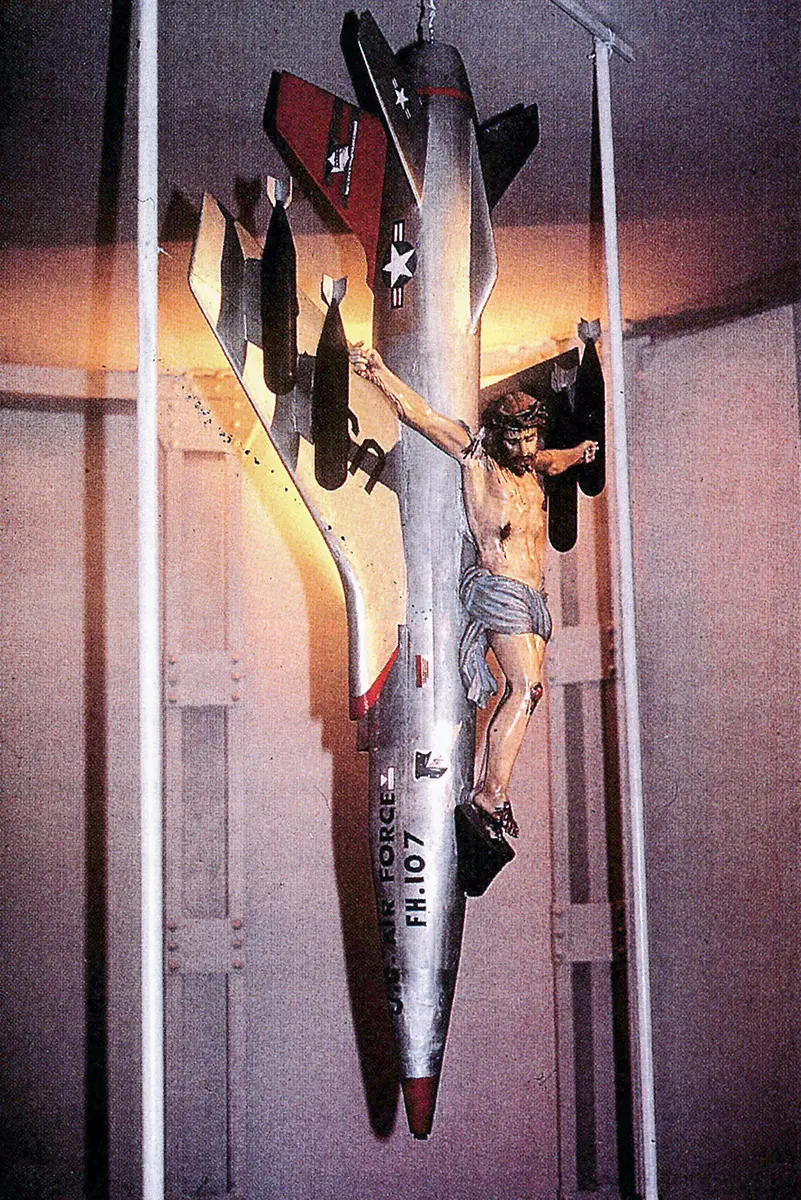
A pioneer in these manifestos of political art was León Ferrari (Buenos Aires, 1920). In the DiTella Prize of 1965, he presented a work that still focused on the object: La civilización occidental y cristiana (Western, Christian Civilization). The work was not exhibited although it was known through photographs of the model reproduced in the catalog. The piece was comprised of the plastic replica of an FH 107 fighter jet with a painted plaster statue of Christ with lacerations appropriate to his iconographic type crucified on the fuselage and wings. The airplane was a replica of the ones that were being used in the Vietnam War.
In this work, Ferrari was criticizing the "Western, Christian" religion of the world, which at that time was difficult to do in Argentina. At the same time, he was speaking of a terrible war. The piece was removed from the exhibition by order of Romero Brest who based his decision on the possibility that it might offend the religious sensibility of the Institute's personnel.
The action-events
In 1968, the process of politicization of the arts abruptly accelerated with action events. When Romero Brest offered to lecture at the Association of Friends of the Arts of Rosario —the second largest city in the country— five young artists interrupted him. Before a hundred people, one of them announced, "Ladies and gentlemen, we would like you to know that this is a raid on Romero Brest's lecture and that in his place, we are going to do the talking, though it is for a short time only, for we consider that words do not constitute a lasting witness. We are here because all of you amid coming into contact with our works of art as if you were afraid they might disturb your lives..."
The action was carried out on August 20th by Renzi and other artists from Rosario. The invasion was accompanied by blackouts and salutes to Che Guevara.
At the inauguration of the 1968 Braque Prize organized by the French embassy, when the architect Samuel Oliver, director of the National Museum of Fine Arts, began his speech, the artist Margarita Paksa interrupted him with an action-event. She was responding in this fashion to the attempt by the embassy to censure "any manifestation of solidarity with the events of May in Paris," as was stated implicitly in the rules of the competition. Afterward, several artists hurled eggs and distributed flyers signed "The Anti-Imperialist Front of Culture Workers." Several of them were detained by police. The CGT of the Argentineans put their lawyers at the disposal of those arrested, who remained under detention for nine days.
In May of 1968, Eduardo Ruano made a presentation at the Ver y Estimar Prize (Museum of Modern Art of Buenos Aires) of a replica of the glass case at the Lincoln Library of the Information Services of the United States. Inside it was displayed an enormous poster featuring an image of Kennedy mounting a sawhorse. On the day of the inauguration, the artist himself, completing the work, destroyed the glass case with a rock. The police intervened shortly afterward to remove the portrait.
In the show Experiencias 68 at the DiTella Institute, several artists presented proposals of a political nature, intentionally provocative. Bony (Posadas, Misiones, 1941) showed La familia obrera (The Working Class Family) a performance comprised of three people placed on a pedestal formed by two platforms placed at different heights. The man was placed on the higher platform; on the lower one, at the feet of the had of the family, were his wife and their son. The artist hung a sign above the platform with the personal information of his characters: Luis Ricardo Rodríguez, a die-maker by profession, collects twice what he earns in his work by standing in this exhibition with his wife and their son during the show.
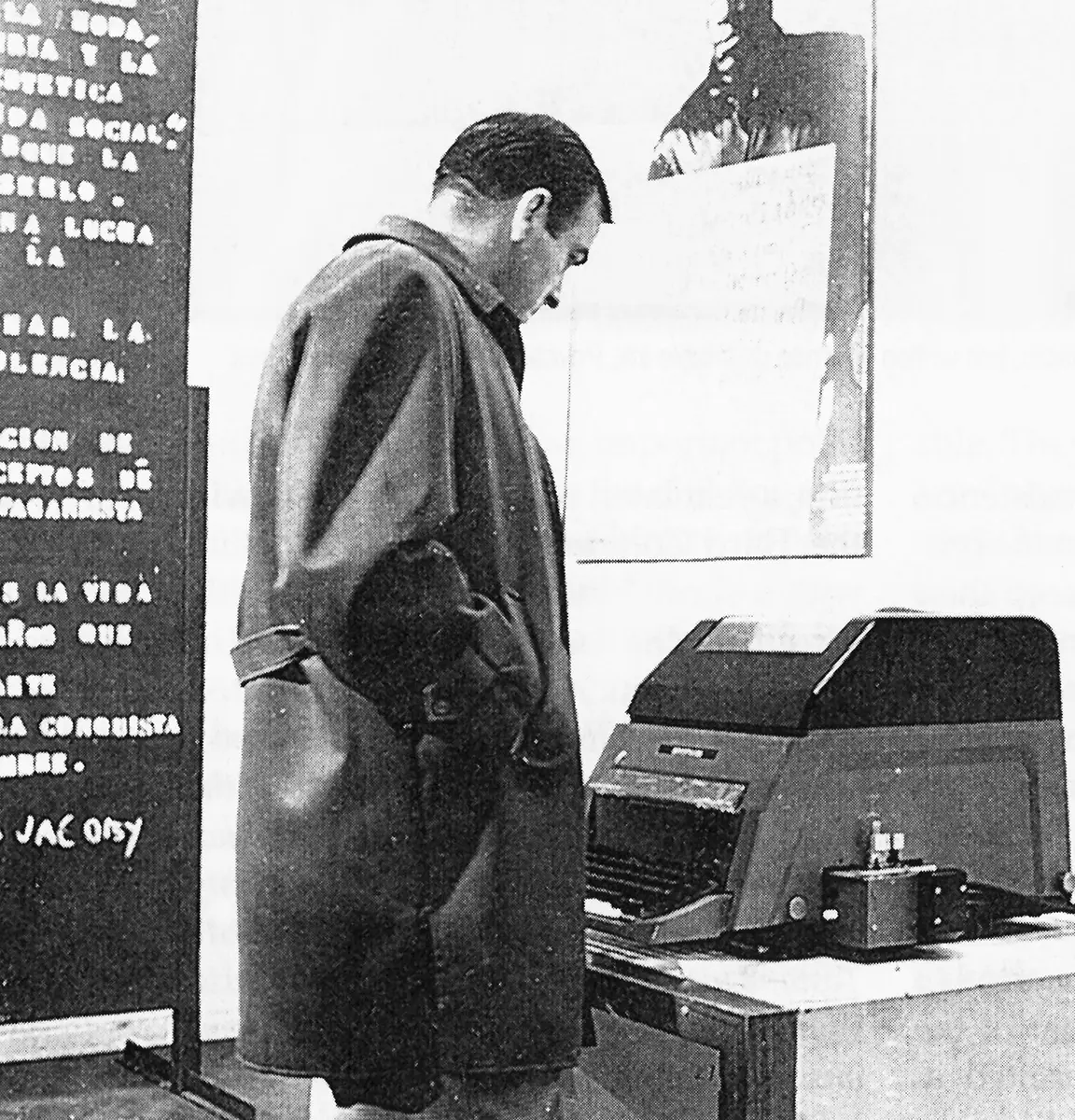
Heading in the same direction, Roberto Jacoby (Buenos Aires, 1944) was proposing as a work of art this text: "This message is addressed to the diminished group of creators ...To those who methodically seek, through Di Tella, to take the ‘bath of culture,’ to the public at large... The future of art is not linked to the creation of works but to the definition of new concepts of life... 'Art' has no importance: it is a life that counts."2
Pablo Suárez (Buenos Aires, 1937) had planned to show an office of information and critiques of the remaining "experiences" as well as of other artistic activities in Buenos Aires.3 But at the last moment decided not to exhibit, according to his statement, "due to a moral impossibility." On that occasion, he distributed 1,000 copies of an open letter —addressed to Romero Brest— which was handed out at the door to the Institute by several "newsboys" and by the artist. In a footnote under the signature, pointing out the ambiguity of his attitude, converted into a "participation" of a political nature, he added: This refusal is a work of art for the Di Tella Institute. I believe it clearly shows my conflict when faced with the invitation, and thus 1 believe I have fulfilled my commitment.
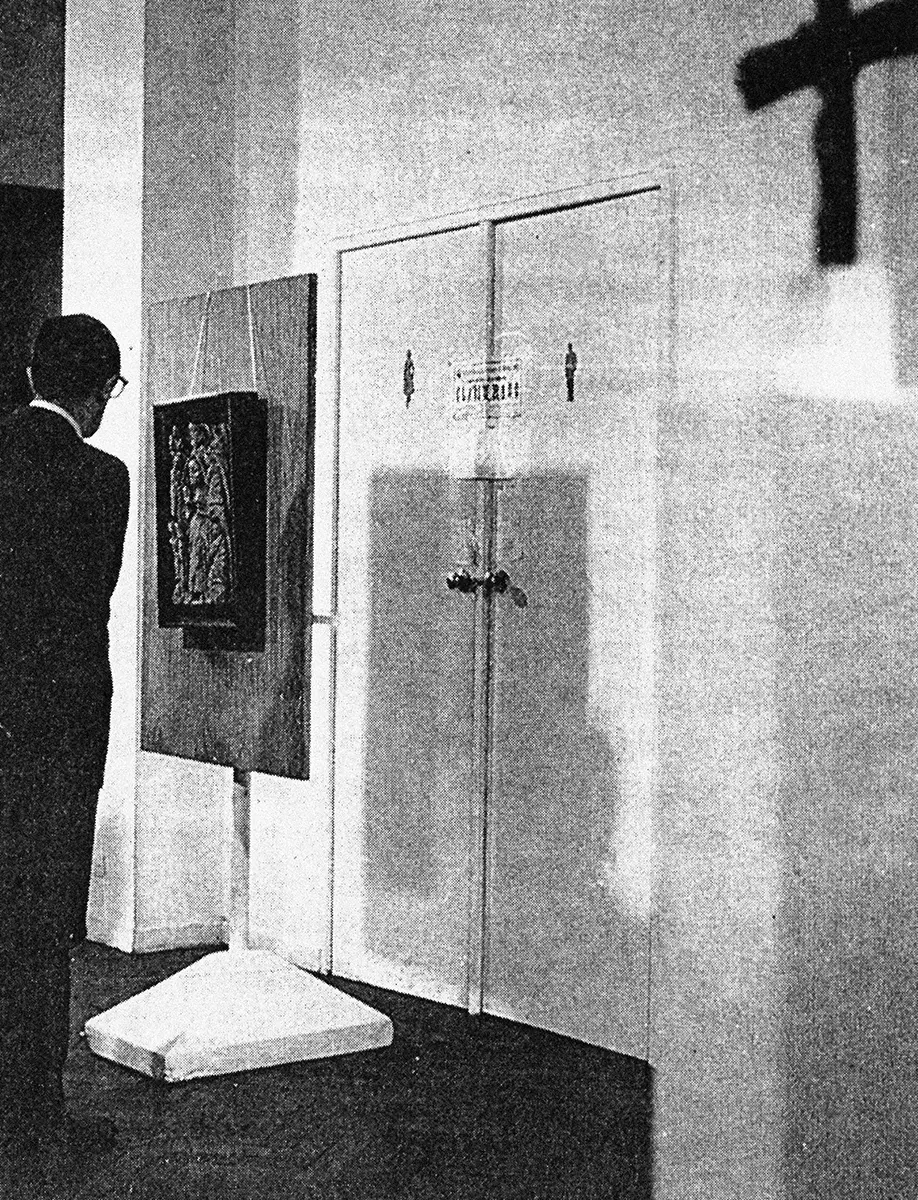
Roberto Plate (Buenos Aires, 1940) presented work with the title El baño (The Bathroom). The installation showed a simulated coed public bathroom with a door that bore the typical silhouettes of "man" and "woman." Inside, there were no toilets nor any other elements whatsoever. The walls of the room were white and it was the spectators who began to cover them with drawings and phrases of all sorts like those found in public bathrooms. Erotic massages and insults directed at the government of Oganía predominated. By an order emitted by the authorities, the police "closed down" El baño. The reason was the infraction of articles of the Penal Code that regulated punishment for the exhibition of "obscene images or objects" and for offenses to "the dignity or decorum of a public official." In this case, the injured party was the president of the nation.
In the final days of May of 1968, the participating artists in the show at the Institute removed their works from the exhibit as a sign of protest. In the text (the "explosion" of words being evident) they distributed to the public on May 23, they indicated: "With the intervention of the police and the judiciary, one of the works shown in Experiencias 68 at the DiTella Institute has been closed down. Tins are the third time in less than a year that the police have substituted arms and criticism for the criticism of arms, claiming a role that is not theirs—that of practicing aesthetic censorship."
On July 16, the Anti-Imperialist Front of Culture Workers distributed, at the inauguration of the Braque Prize, a manifesto with a similar tone: "We do not accept any sort of economic tutelage that validates the dominant system of oppression in the capitalist world nor do we accept any form of censorship of our works."
Tucumán-Rosario-Buenos Aires
The "operation" Tucumán Burning was organized by several dissidents from the DiTella Institute and by a group of young artists from Rosario, among them, Juan Pablo Renzi (Casilda, Santa Fe province, 1940-Buenos Aires, 1922,) a key figure in the artistic-ideological crisis of the sixties and seventies. Toward the middle of 1968, they sketched out the strategies for initiating a political-cultural program based on "an ethical, aesthetic, and ideological consideration of the possible realization of an entirely new work of art".4 They sought to bear witness to their break with the "bourgeois consumers of culture," defining artistic production as a collective action directed toward the popular masses and whose main purpose was to deepen social struggles and stimulate the people.
The group, in line with the plan for the political struggle which the CGT of the Argentineans was developing, began a propaganda campaign regarding the social conditions of the Tucuman province following the shutting down of the sugar refineries. In a manifesto by the group of Avant-garde Visual Artists from the Commission of Artistic Action, they indicated their forms of action. "We as artists should contribute to the creation of a true grassroots network of information and communication that opposes the media network of the system. In this process, we will discover and decide upon the most efficient forms of media: clandestine movies, posters and flyers, pamphlets, records and recorded tapes, songs and slogans, the theater of agitation, the new forms of action, and propaganda. They will be works that the regime will find difficult to repress for they will be based in the people. . . Art is everything that mobilizes and agitates. Art is that which radically denies this way of life and says: let us do something to change it."5
The exhibit was held in Rosario and later in Buenos Aires, in the CGT building. This last show was shut down shortly after its inauguration due to pressures exerted by the government and the police. In those packed spaces were presented all kinds of testimonies collected in interviews with teachers, union leaders, unemployed workers, inhabitants of the cane fields, films, photographs, organigrams, and sociological questionnaires portraying the situation of the province.
In the exhibit a large sign displayed a slogan, "Free the Patriots of Taco Ralo." This poster which called the members of the guerrilla group "patriots" explicitly revealed the adherence of a sector of avant-garde artists to political violence. This signifies —as Marcuse would say— a sort of self-destruction of art, given that its forms and contents are "never those of direct action. They are never anything but language, image, the tone of a world that is not—or not yet—in existence".6
In this period, many artists—linked to distinct approaches, ranging from the most frivolous to the most committed— abandon the practice of art: Renzi, Suárez, Bony, and Paksa, to name a few who return to it later, in large part by way of painting.
Labyrinths and Shot-Out Windows
The ramifications indicated in the expressions of political art signal the existence of two separate periods: 1965-1969 and 1970-1998. On the one hand, the cycle of those who acted in the spirit of anti-art, lays no claim to a lasting existence. Perhaps lacking any programmatic proposal, these artists wanted to keep their experiences from being turned into "monuments" by a social system. These were the times in which one could say that the most beautiful sculpture in the world is a paving stone, a sturdy paving stone flying through the air toward the head of a policeman.7
On the other hand, the initial period of the Group of Thirteen, was that of the hegemony of structuralism, printed in profusion by Argentinean and Mexican publishing houses. "Structuralism is in style," Jean Pouillon noted in the presentation of Les Temps Modernes (November 1966), devoted to this theme (a magazine published in Spanish shortly afterward.) In 1967, Octavio Paz gives in to the fashion, publishing Claude Lévi-Strauss y el nuevo festín de Esopo.
Structuralism —notes Vattimo— was among other things the koine of the seventies, without this implying the necessary acceptance of its thesis. On the other hand, the philosopher continues, structuralism becomes the theory of decolonization, an attempt to allow other cultures to speak (In 1968, it becomes the theoretical arm of the Left).8
In this context, in 1971, with the sponsorship of the Center for Arts and Communication, the Group of Thirteen is created in Buenos Aires. Its first presentation, a year later, was the participation in the Third Coltejer Biennial of Medellín, with a show bearing the excessive title Toward an Outline of Latin American Art. The Italian critic, Gillo Dorfles indicated in the Corriere Della Sera: "I find one aspect alone to be significant in this Biennial... the presence of an abundant group of conceptual Argentinean artists. These artists (among then, noteworthy names such as Clorindo Testa, Luis F. Benedit, Juan Pablo Renzi, Carlos Ginzburg, Juan Carlos Romero) demonstrate that through the contribution of varied techniques and procedures —which range from the now academic concrete poetry to the most contemporary experience of visual poetry, from the ecological vision to statistical documentation— it is possible to virtually produce a document of political denunciation."9
The artists who compose the group, generally linked to conceptual art, had to act during difficult political moments, including during the military regime that had defeated the government of María Estela Martínez de Perón in March of 1976. No sooner had it installed itself in power than the dictatorship intensified the repression of guerrilla organizations. Toward the end of 1978, these organizations had been practically annihilated. But the operations against subversion had acted outside all rules of law. On notes Noe, that many artists, for a variety of reasons—some of them after being arrested and tortured—but always linked to the fact that they didn't want to live under this regime, leave for other countries. Others, like Franco Venturi, were murdered.10
One of the most renowned members of the Group of Thirteen is Victor Grippo (Junin, Buenos Aires province, 1936.) With his Analogies cycle: La construcción de un horno popular para hacer pan (The Construction of a Public Oven for Making Bread, 1972), Algunos oficios (Certain Trades, l976), and other silent and subtle works, he denounces—without appealing to the legitimizing function of the great récits— the concepts of the world that objectify the hyper-technological world, particularly in Latin America. "Aesthetics and ethics, note the curators of his retrospective show in Birmingham and Brussels (1995), lie at the center of the discourse of this artist who never dissociates art from life."
His experiences with potatoes are, among other issues, a vote for the ancestral culture of the continent. Analogía 1 (Analogy 1,1971), preserved in the National Museum of Fine Arts of Buenos Aires, is made up of forty potatoes, each one placed in a niche and connected via copper and zinc electrodes to a voltmeter that measures their energy output. Without a doubt, from one perspective it is a "potato battery" but attempting a less simple interpretation, is a "conceptual" proposal. Its meaning derives as much from the minimalist nature of the structure of the tubers as to the Quichua (American) origin of the word in Spanish for "potato", its use as a food, and as the energy that can be assimilated into consciousness.
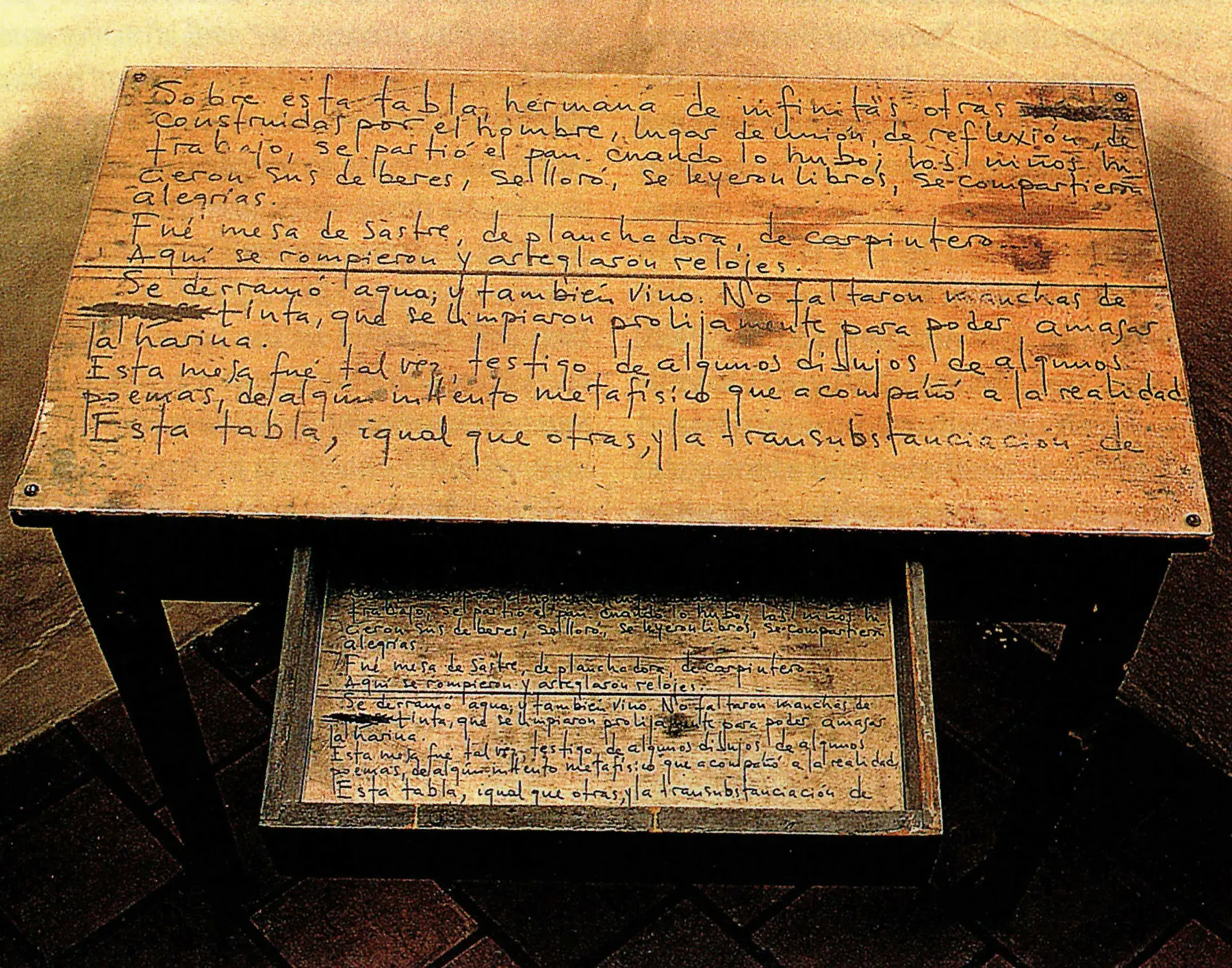
In 1978, Grippo produces one of his paradigmatic works: Tabla (Board). A humble table, worn from use, stained, on whose surface a text is written in spontaneous calligraphy, describing the uses of its own support: "On this board —it reads in ink— the sister of an infinity of others made by man, place of joining together, of reflection, of work, bread was broken when there was any, the children did their chores, tears were shed, books were read, joys were shared. It was a tailor's table, that of a woman ironing, a carpenter's..."
Vida-Muerte-Resurección (Life-Death- Resurrection, 1980) is a typical piece of process-art made up of various solids of lead (cones, cubes, cylinders, triangular prism, square prism.) The assemblage was displayed in a window as a museum object. Certain lead shapes contained beans that, shortly afterward, began to sprout, destroying the rigid geometry of their containers. Nature had conquered rationality. This piece was read, inevitably, as a metaphor for the situation in which the country found itself during the years of military dictatorship.
In all of these cases, these works function in a labyrinthine fashion (the labyrinth being a dominant figure in baroque art), sending one back and forth without allowing an exit to meaning. That is what Jorge Luis Borges wished for in El Aleph: The solution to the mystery is always inferior to the mystery itself. The mystery is connected even to the divine; the solution, to a magician's trick. Grippo is a baroque artist —not in the sense of a morphosyntactic topic but rather, of the crossing of writings, of the intertextual horizon— who places the allegoric function ahead of any immediate resolution.
Benjamin, in his study of baroque drama, notes that "every person, everything, every relationship can signify any other thing." The method of allegory is probably "the indirect route. Presentation as an indirect route." In the same direction, Baudelaire upbraids the "bad glassmaker" who doesn't have colored glass that might allow one to see reality tinted green, yellow, or pink. In the same fashion, Grippo —going beyond the requisite codification of his works in a period of irrational censorship— points with his works less to the pleasures of the solution as to the Borgesian mystery.
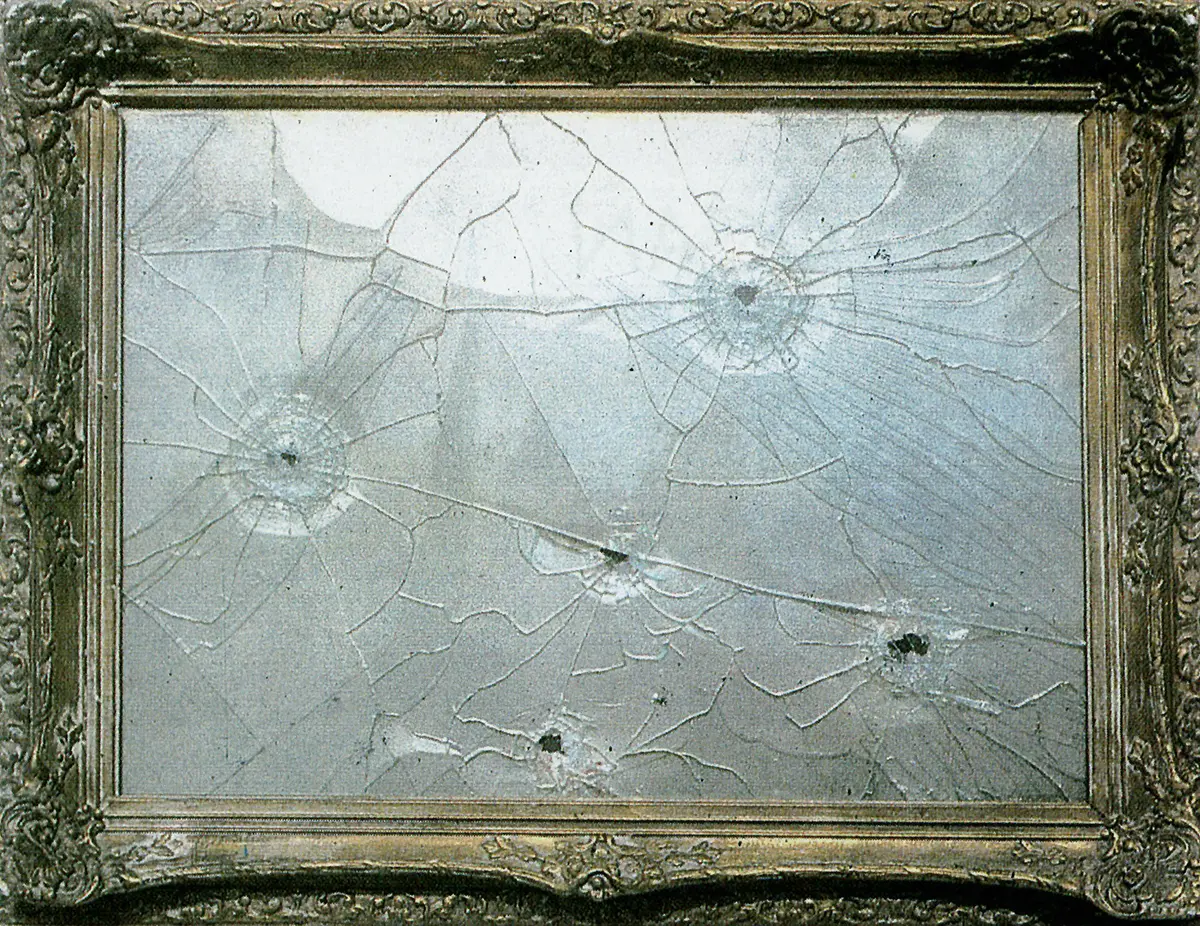
Certainly, the allegorical strategy can be found in other artists who thematize socio-political situations from a large variety of choices. One example, which reintroduces into the baroque rewriting of violence experienced in the past, is the more recent work of Bony. This is evident in his mirrors perforated by bullet holes, hung in cheap, "fashionable" frames, and in his autobiographical photographs, also pierced by gunshots, which refer to suicides or executions (El juicio final—Suicidio I y II [The Final Judgment—Suicide I and II], 1996). In the mimetic, representational direction of these pieces, behind the perforated, shattered panes of glass, we can see the image of the artist himself. But he seems to be neither alive nor dead but rather, quite present with a presence that seems more like an absence.
Binarism vs. Difference
Political radicalism in Argentinean art arose when it was believed that artists and intellectuals had an important political role to play. But in the eighties and nineties, the underlying binary oppositions of those ways of thinking—like colonized/colonizer—were opposed by "multiple, heterogeneous differences." The Derridean critique of binary logic had its consequences.
But even more, as Vattimo indicated, nowadays the philosophy of history that inspired the revolutionary political movements is no longer sustainable. They have fallen not because they are "objectively false" but rather because the social and ideological conditions upon which they were based have disappeared. History can no longer be conceived of as a unitary discourse, nor culture as the realization of a universal model.11
The emancipatory struggles of today are not aimed at the equality of rights, but rather, at the right to difference in lifestyle.
NOTAS
1. Alain Jouffroy, Opus International, "El mundo es de los violentos," June, 1968.
2. Roberto Jacoby, "Mensaje en el DiTella," original typewritten text from the mural shown in Experiencias 68, DiTella Institute archives.
3. DiTella Institute archives.
4. Juan Pablo Renzi, "The Work of Art as a Product of the Consciousness-Ethics/ Consciousness-Aesthetics Relationship" a talk given at the First National Meeting of Avant-garde Art, Rosario, 1968.
5. Manifesto de los Plásticos de Vanguardia de la CGT de los Argentinos, Buenos Aires. November, 1968, Matos Aires, Nos. 1/2, December-March, 1969.
6. Herbert Marcuse, "El futuro del arte", Convivium, No. 26, January-March, 1968, p.79.
7. André Fermigier. "No More Claudel," Art and Contestation, (La Connaissance: Brussels 1969), p.62.
8. Gianni Vattimo, "Hermeneutica: nueva koin," Ética de la interpretación, (Paidos: Buenos Aires, 1992) p.59.
9. Gillo Dorfles, "Se asoma en Sudamdrica - El artista medicante," Corriere della Sera, 7 de May, 1972.
10. Luis Felipe Noé. "Artes Plasticas Argentinas, Sociedad Andnima." Madrid, Cuadernos Hispanoamericanos, No. 517-519, July-September 1993, p. 226.
11. Gianni Vattimo, "Heidegger y la superacidn (Verwindung) de la modernidad," Filosofía, política, religión, Oviedo. Nobel. 1996, pp. 31-79.
JORGE LÓPEZ ANAYA
History of Argentinean Art Professor in the Department of Philosophy and Letters at the University of Buenos Aires. He recently published Historia del arte argentino (Buenos Aires: Emecé, 1997).