
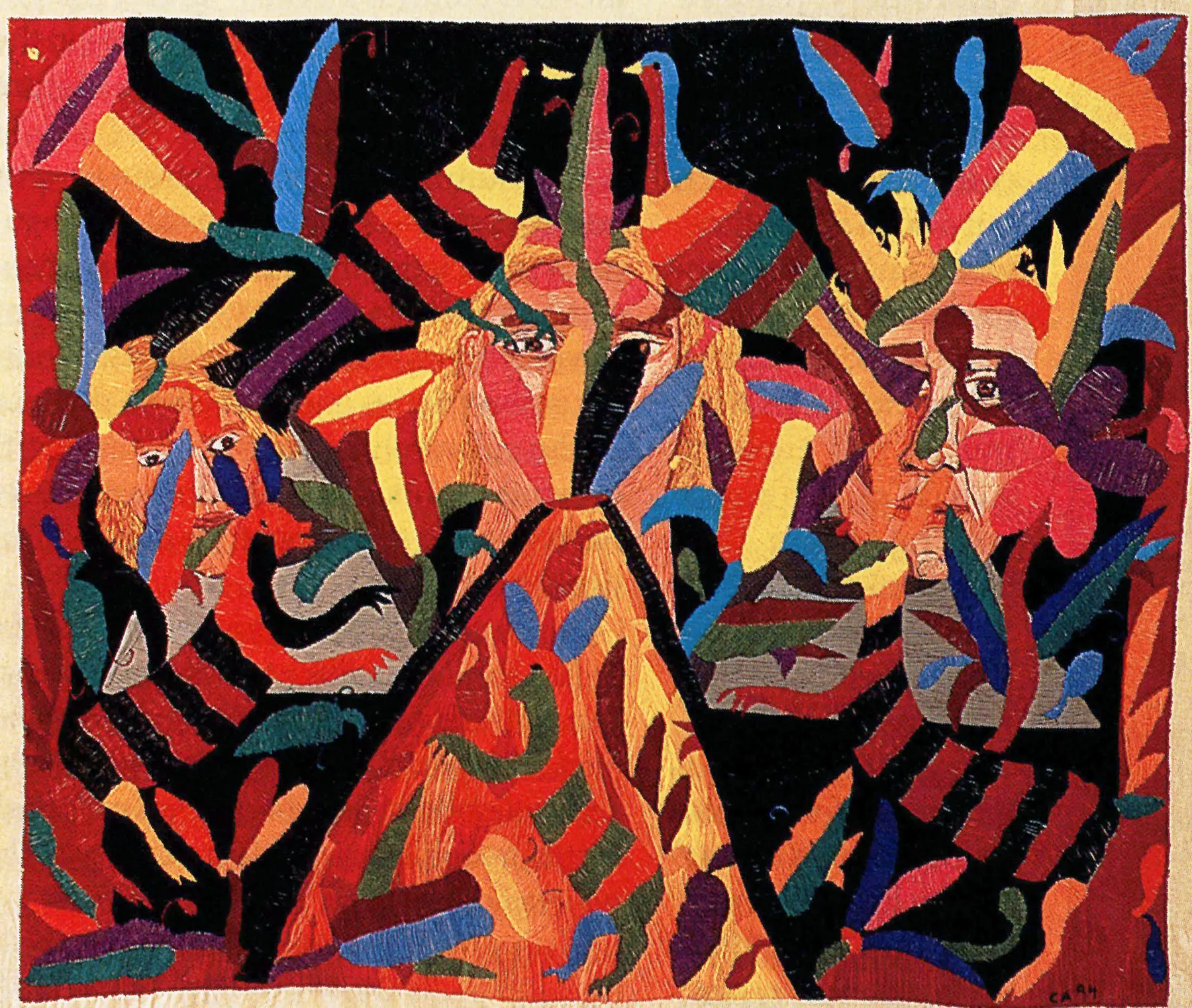
It was Deleuze and Guattari who used the salmon as a metaphor to express the ties between nature and territory. Apparently, going against the current— against Nature?—to the death is for some, the only way to spawn. It is to assume (re)territorializing as a strategy of (re)birth. And they underscored: that every attempt to territorialize refers back to birth (place).
This strenuous history of the salmon opens a peculiar yet effective reading of the needlework of Carlos Arias: delicate constructs in which the polemic ties between Nature and territory reveal the hard cultural background of any figurative strategy.
"To think is to lose the thread." Paul Valéry
In the middle of 1994, within the inner artistic circle of the capital, a rumor began to circulate, thicker with irony than with skepticism, that Carlos Arias (Santiago de Chile, 1964; in Mexico since 1975) was em-broi-der-ing. In light of the ravages of the post-Salinas crisis in the Mexican art scene, nothing seemed more ad hoc—like a painstaking training in personal resistance and in historical abstinence—than the exorcism of embroidery.
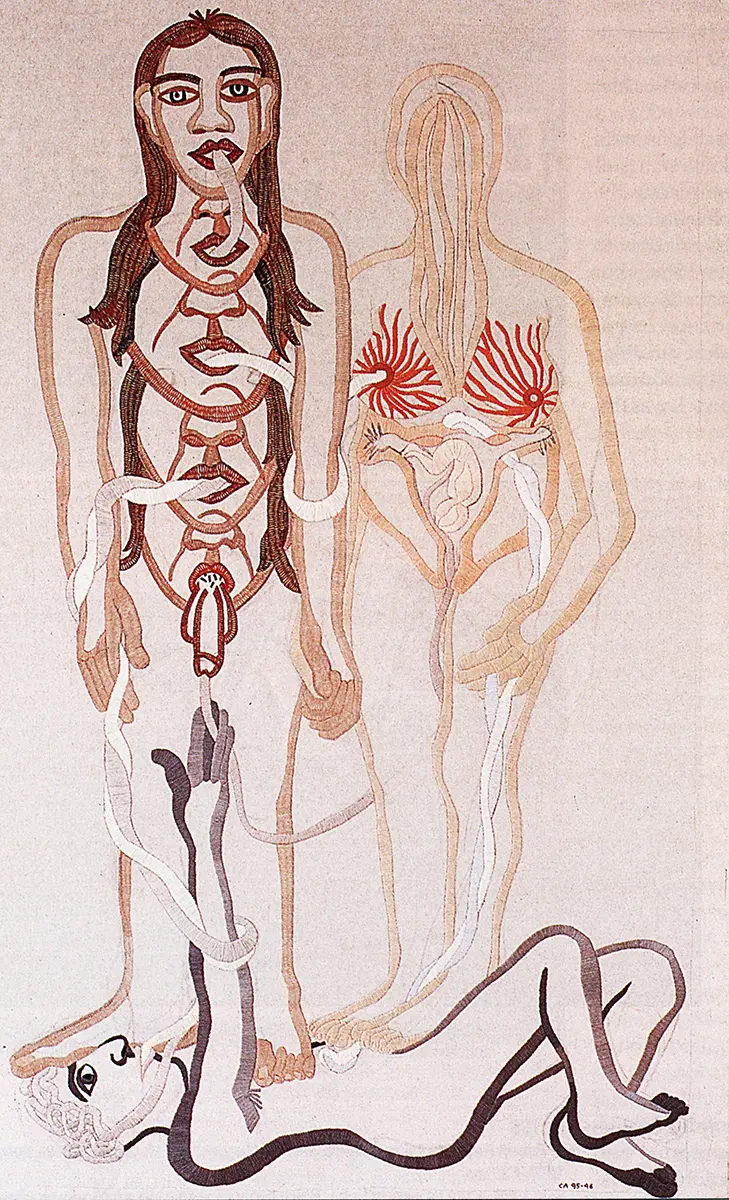
The first embroideries appeared in a collective show that same year and were read as an abrupt turn from his earlier, strictly pictorial work. Indeed, the density of the expressionist canvases, grim and emphatic, realized between 1989 and 1993, transcended his plans.
The new construction being employed turned out to be optimal—in its background as simulacrum and its evident irony—for presenting the same disquisitions that had asphyxiated his painting: the trafficking in identities, access to the mask, the moral weight of appearance, the allegoric perversity of intimate situations, the confessional undercurrent of the self-portrait... Now this "alternative" technique would be imposed as a "soft" discourse, more effective, capable of providing vast conceptual support for the representative dilemma of his reiterated ambiguities.
Even when the embroideries engage in polemics under the idea of the genre—just as critics have located them up to now—we must not forget that Arias' first embroideries were a refined voice in dialogue with the indigenous and popular textiles currently being produced in the states of Mexico, Puebla, Guerrero, and Michoacán; and not only were they situated in a terrain of double marginalization—the female and the indigenous—but furthermore, they exhibited, in the words of the artist, a cultural questioning uncommon in the eroded ideological foundation of Mexican art today. What space do we share with native peoples? What implicates us in that Other? Arias attempted to make explicit this marginality of expression by emphasizing the aesthetic "dissonances" of such patterns of color, composition, and form, and of its silenced symbolic keys. The "refined" voice was a product of embroidering only in the negative spaces of indigenous textiles, that is, building up from the "bottom" in order to complicate the codes of reading in which the Western eye is trained and to give voice and a platform to the cultural distances that decorate modernity in Mexico. In this way, against the grain of their inherited domesticity, the embroideries Three Heads and Red and Black were already transcribing cultural conflicts to consider for a critique of Mexican modernity and the still prevailing paradigms of representation and perception.
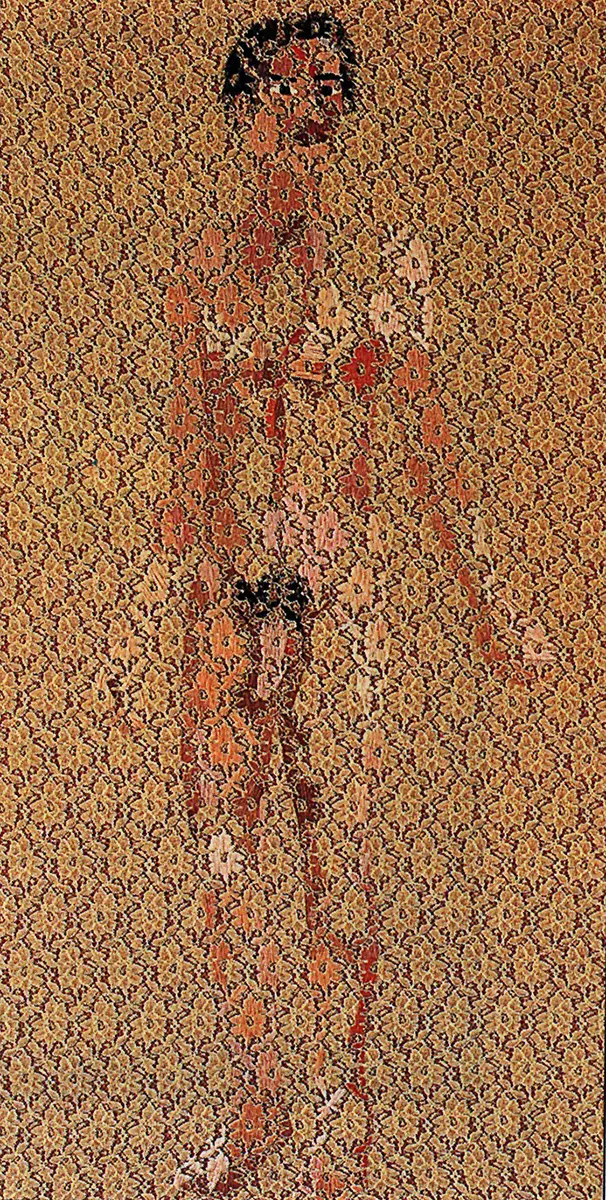
Arias was embroidering upon the forgotten agenda of acculturation. The corruption of the indigenous model was operating paradoxically as a corruption of the Western artistic model and of its aesthetic —as well as ethnic, classist, and racist— segregations under the rubrics of handicrafts and folklore. The new embroideries subverted this ambiguous exercise in ethnic resistance and urban domestication, denouncing the premeditated theft of contents that had been pushed to one side as they were reduced to ornaments. A power play that disguises itself in the category of decorative arts like a dam against other historical silences like that of the female population.
Embroidery, at least in Mexico, marks not only confinement in the domestic sphere, and economic alienation imposed upon women but also, in regards to ethnic artistry, a narrow periphery, perfectly controlled and reduced to a subsistence economy, capable of eroding any act of cultural recognition.
Arias' interaction, like a palimpsest, with the remaining discourse of indigenous embroidery, did not last long. The following embroideries sought the logical path of other arguments, in fact, more closely tied to the transgressive ideas concerning gender and sexual morality that had inspired his paintings.
"Before lunch one Friday a girl went out to play but having to embroider, she couldn't play that day..." Children's song
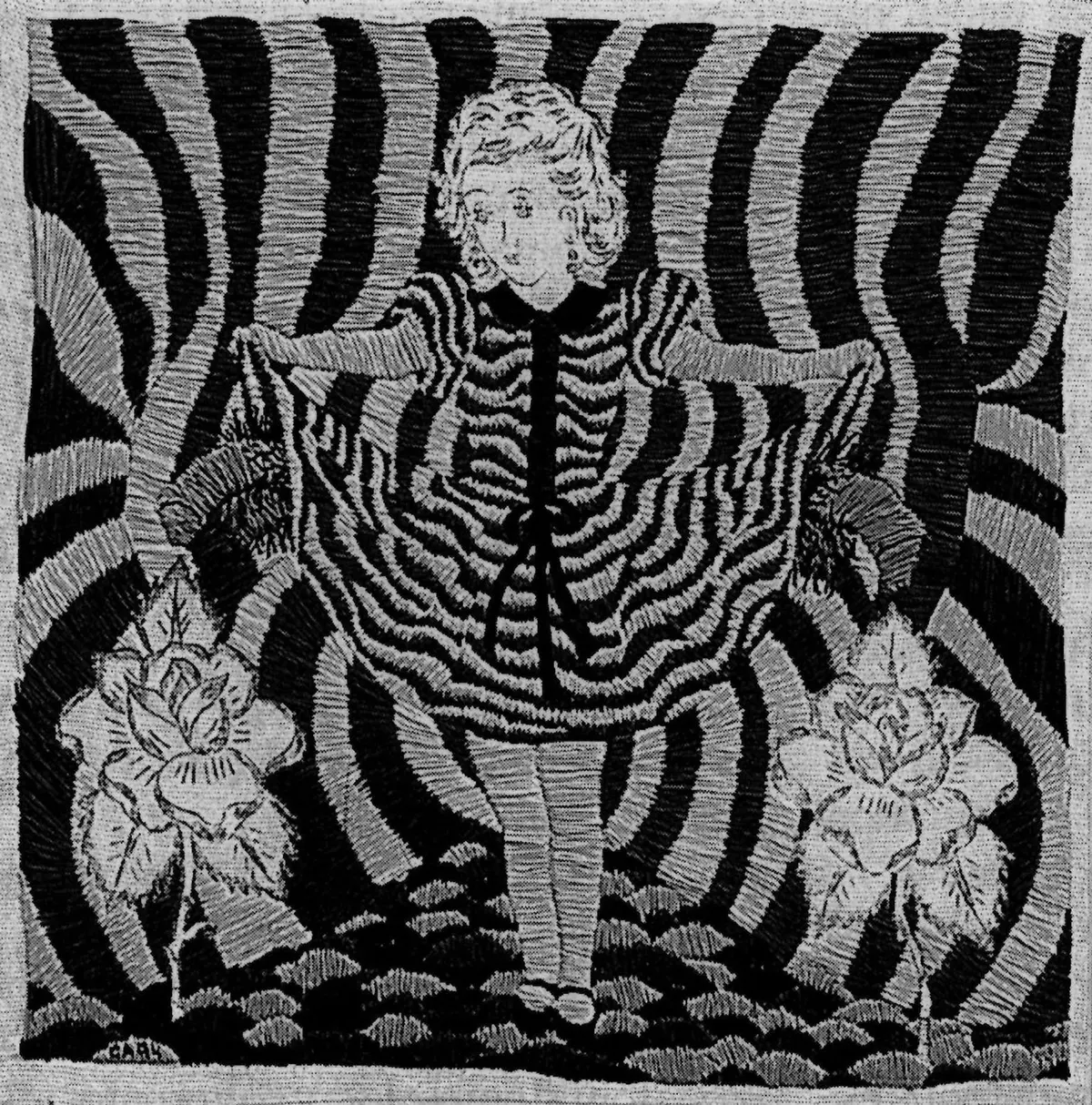
There in the market, engulfed in the commotion of the hawkers' calls, Carlos Arias found embroidery patterns for sale that illustrated in 'innocent' aberration the fictions imposed upon the gynaeceum. Once again, Arias takes on the task of corrupting the imposed model. The themes for sale? Blonde little girls —in a mestizo country— taking walks in short little skirts carrying baskets full of violets under the vitreous gaze of Lewis Carroll. Japanese adolescent girls, wrapped in their kimonos, pose with silk parasols under the pearly shadow of cherry trees in full blossom... Libido and exoticism—Nature and territory-? feed the ghosts of identity, mapping them in that trivialized dislocation. In place of violets, Arias embroiders baskets full of penises —in a variety of forms and colors—, and in place of cherry blossoms are faces and naked bodies; an array of faces distinguished by different races and mixtures or more or less typical positions of penetration, by way of background —our own imaginary background?— for the docile coquetry of that Other, drawn up in her kimono.
Arias returns to languages sanctioned as decorative, drained by cultural —ethnocentric— appropriation, and constructs for them another presence, accursed, capable of annulling that program of duplication imposed by the commercial embroidery pattern. Transgression directed against something which Trinh T. Minh- Ha had already warned against Cultural difference —which also draws borders between the masculine and the feminine— has been deactivated by modem culture, manipulated, and domesticated like a totemic object. Arias deconstructs the inherited feminine as a category of the genre —like an ornamental repertory— and historically stated by the patriarchy through patterns as submissive as these embroidery patterns to create a discourse —a simulacrum of domesticity— in which the feminine is invoked by the cross-dressed artist himself, in an attempt to be understood and recognized as a real, historical subject.
The power of each embroidery realized by Arias rests not only in the perverse (trans)figuration of the commercial pattern but also in all the time, work, and silence represented by his tiny handwork. As objects, the embroideries accumulate this ancestral silence as a form of writing. More than pieces of work, they are read as a macabre game of self-reflection, as solitary work, something that functions as a resource for the maniac dedicated to measuring his isolation.
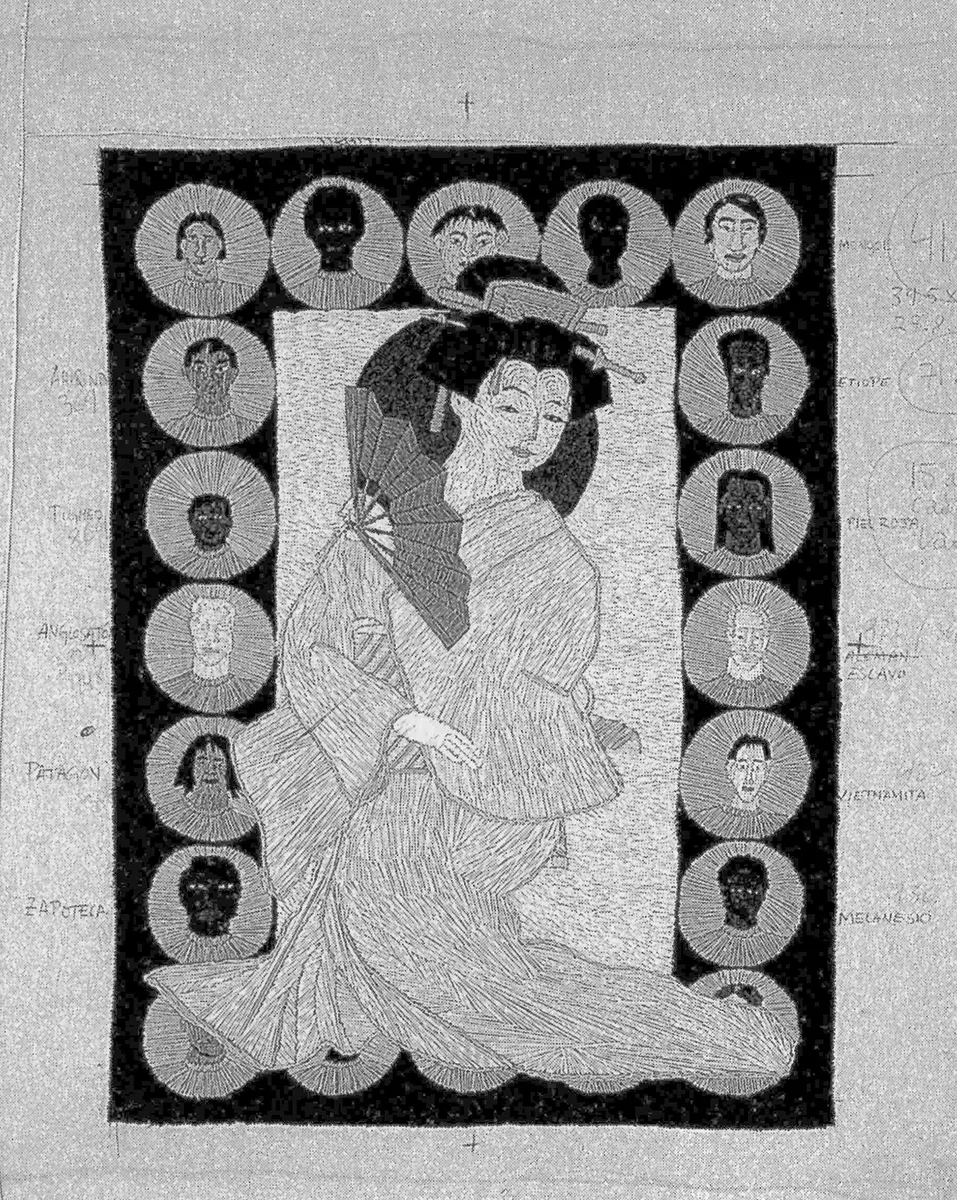
In this way, these embroideries are barely typography. As far as writing goes, embroidery is the conjunctive repetition of Y, a masked ligament, the elegy to a perpetual interval, and the utopic construction of a continuum. To embroider is, in essence, to create borders, to delineate empty spaces In their patience, they resemble that which the ancient Chinese called "wan, the action of caressing a piece of jade in an endless manner in order to polish it, to feel its smoothness, or to accompany a daydream."1 Above and beyond their clear images and muddy arguments, these embroideries with their studied erotic content, proclaim their performance nature by vindicating a territory of subjectivity, an emotional structure whose "silence" is a verdict on the fragility of sexual identities.
Carlos Arias has indicated that his incursion into embroidery functions as well as an intellectual estrangement, a return to the idea of the workshop, to the basic materiality of the creative act. So it is not surprising that these embroideries located in the gallery2 might also become a sardonic allusion to the handcraft of the masterpiece as typified by its opposite: popular, anonymous art from the tradition of the domestic artisan as well as being a memo to the historical Western link between thematic repertories (or ornamental patterns) and tacit silences, between sexual roles and childhood repertories, between embroidering and submission. . . Arias insists on (re)bordering/embroidering that screen —the representation—that blurs and ratifies our cultural inertia —under categories of genre, identity, and statute— in the historical relationships between Nature and territory.
In assuming a feminine strategy —or rather, desire?— he locates existing prejudices in societies in which, for many people, art —and its consequent sensibility—is still "the work of faggots." Thus, his embroideries end up being a defense of the subversive capacity of any "soft" exercise and exalt the old domestic arsenal now used as a dangerous anti-institutional tool.
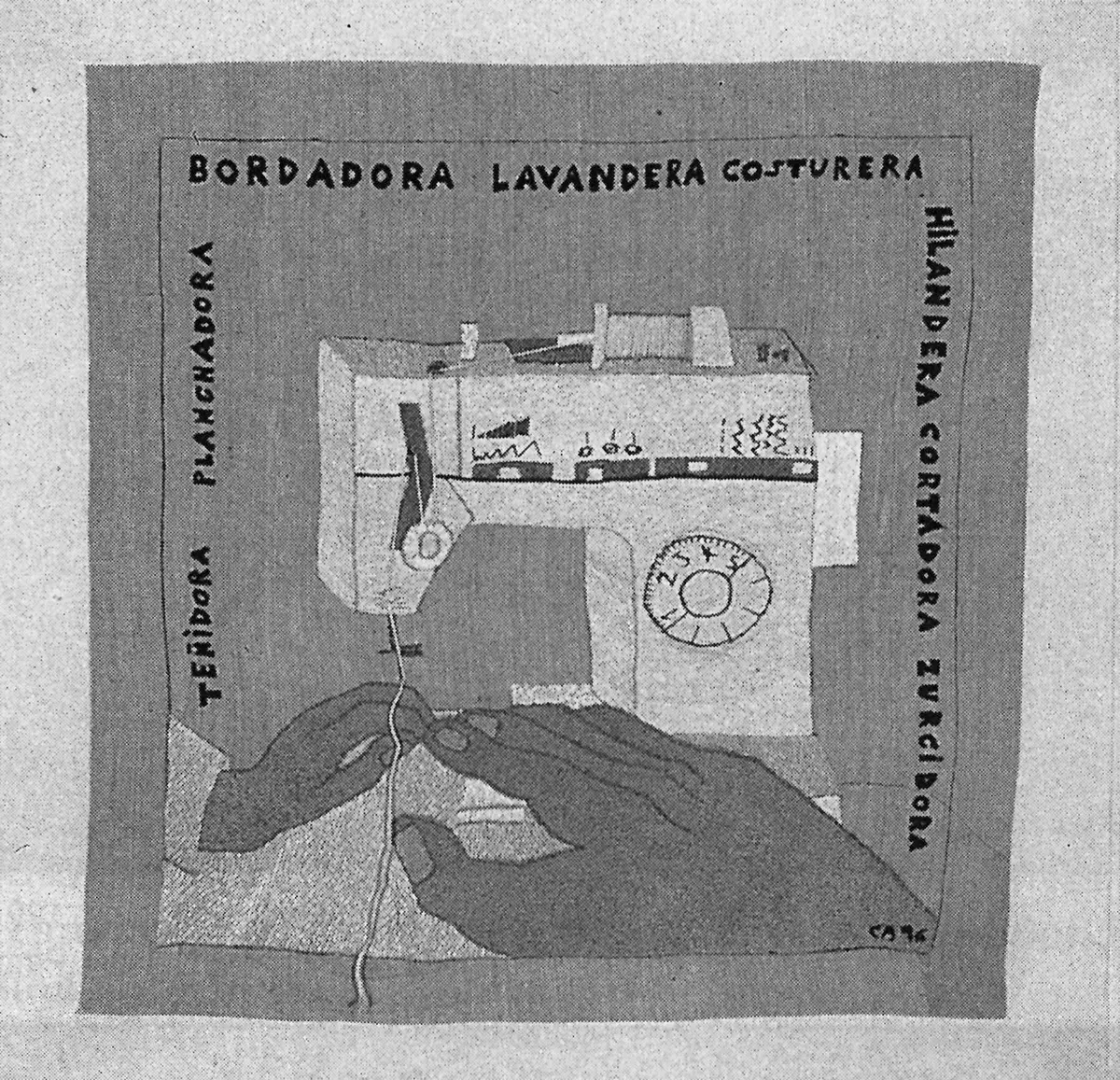
"We should not be surprised then that the Indian should be willing to exchange his most beautiful and elegant clothing, his rarest and hardest-worked cloth for the factory-made blankets and clothing in order to achieve his goal, that of feeling himself to be a member of the national community." Daniel Rubín de la Borbolla. Indigenous America Magazine, 1959.
It is curious that the modem Mexican legacy in its self-satisfied vernacular vocation scarcely retains in actuality a solid critical practice capable of re-situating the manipulation of the popular and indigenous worlds which created its modem spirit and its (overly macho) adaptation to the political interests of cohesion and submission sublimated by the State in the myth of an innocuous and prefabricated cultural and racial hybridization. In Mexico, the conversion of the "decorative" — understood as an indigenous and/or feminine aesthetic pattern— into a fine arts inquiry was attributable to male artists. They would legitimize in high art that paternal reclamation of models considered since colonial times to be ornamental and incorporated into decorative functions. As Kandinsky, Horta, and Matisse did in Europe, so did Diego Rivera, Roberto Montenegro, Adolfo Best, Miguel Covarrubias, and Carlos Merida —to mention only a few3— had the authority in Mexico to make from what had been previously considered merely decorative and exotic, intellectual discourse on form, color, and rhythm.4 For this reason, these embroideries produced by Carlos Arias in Mexico City, restate the modem inertia that still hobbles the Mexican cultural context within the hierarchies of masculinity and veiled colonialism of their precursors.
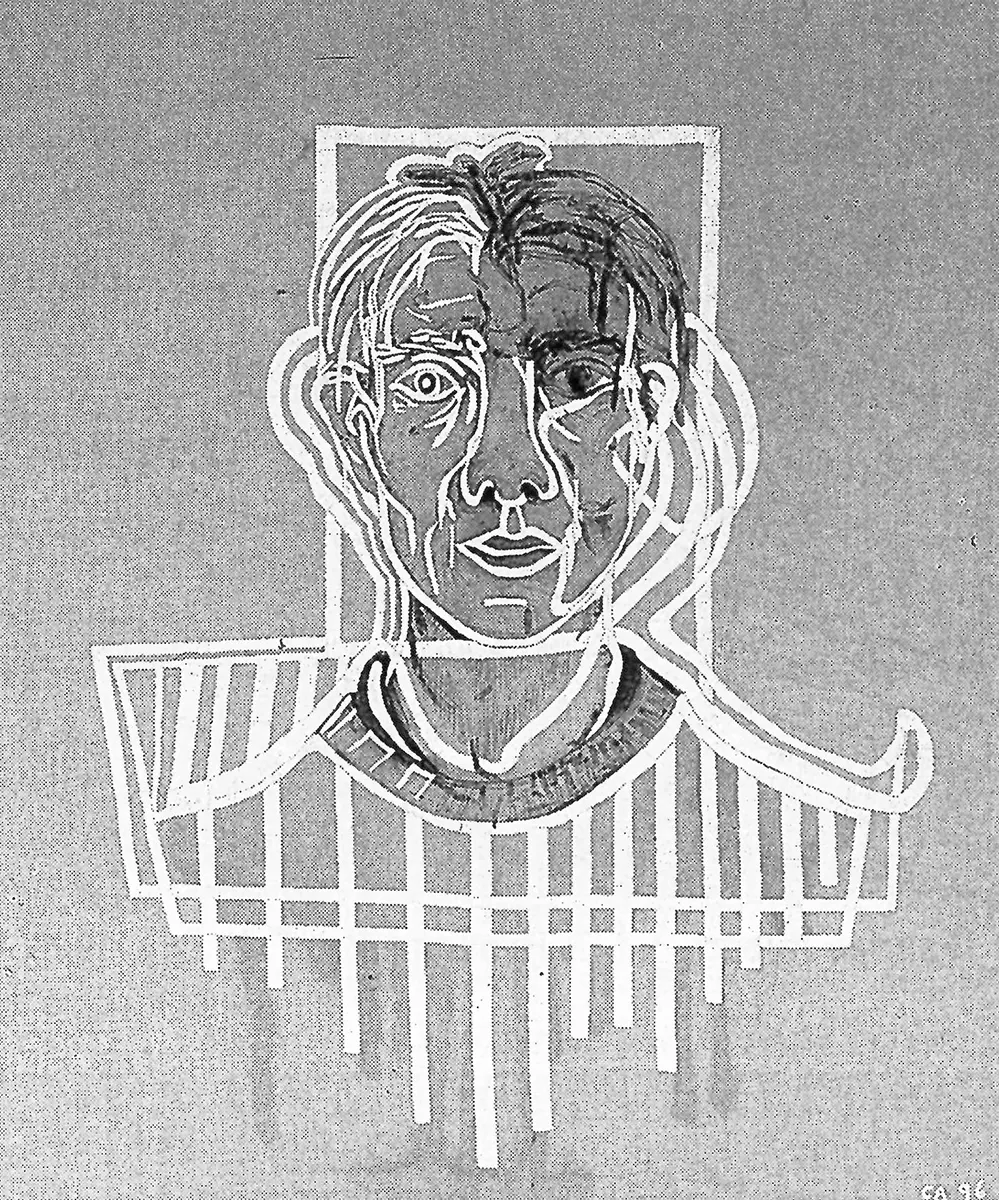
The reaction against minimalism at the end of the seventies and beginning of the eighties, led by female artists in the United States and Europe who vindicated, through the so-called anti-form sculpture,5 a more inclusive and sensorial sensibility, did not gain favor among critics in Mexico as a necessary and reliable antidote to the persistence of a Modernity fossilized in its triumphs. And that, despite the existence of artists like Martha Palau, who worked with textiles, or Maris Bustamente and Helen Escobedo—pioneers in alternative genres like performance or installation who, with no lack of radicalism, knew how to read the macho subtext and the retrograde hierarchies with which the Mexican fine arts were branded since the institutionalization of the Generation of the Split.6
To seek immediate precursors or at least relative correspondences in Mexico to the work of Carlos Arias, one would have to mention the work of Palau and Teresa Serrano who have consciously incorporated feminine and indigenous techniques like applique, embroidery, weaving, and openwork as an alternative discourse, as a conscious appropriation of languages that developed under the shelter of their own segregation as ethnic handicrafts or decoration. One must also mention, as did Raquel Tibol in a review of a collective show in which Arias participated, the practice of the arpilleras, those patchwork pictures were done on burlap by the Chilean women from families with members being held as political prisoners concerning themes of the disappeared during the years of the dictatorship of Pinochet. This last situation marked Carlos Arias' arrival in exile to Mexico when he was still a child.
Above and beyond their cunning and cultural recycling, these embroideries surely serve as a map and geography of some sort of personal mutilation. Behind the powerful erotic charge that thickens their themes is the delicate register of a figurative identity.
So perhaps the laborious story of the salmon is not so strange after all.
NOTES
1. Caillois, Roger, Los juegos y los hombres, Fondo de Cultura Econbmica, Mexico City, 1982: 75.
2. The largest collection of these textiles, composed of 22 embroideries, was exhibited in the Arte Actual Mexicano Gallery in Monterrey in June 1996. In Mexico City, only a few pieces had been exhibited and incorporated in more than four group exhibitions until Arias’ recent exhibition in the OMR Gallery in November 1996 which was reviewed by Magalí Arriola in ArtNexus, January-March 1997.
3. We should recall that it was only a few years ago that Frida Kahlo, Maria Izquierdo, and Olga Costa were considered minor artists whose work was considered lapidada, of little lasting value, as it was decorative, poorly constructed, and of little lasting value.
4. Broude, Norma and Mary Garrard, Feminism and Art History [New York: Harper & Row, 1982) 316-321.
5. Zelevansky, Lynn, Sense, and Sensibility (New York: The Museum of Modern Art, 1995).
6. Formed around 1950, the so-called Generation of the Split was opposed at its beginning to the aesthetic officialism that the Mexican realist school was imposing as the only representative expression of national art. Among the members of this group were Gunther Gerzso, José Luis Cuevas, Alberto Gironella, Pedro Coronel, Vicente Rojo, Vlady, Manuel Felguérez, Lilia Carrillo, Roger Von Gunten, Fernando Garcia Ponce, Amaldo Cohen, and Gilberlo Aceves Navarro.
OSVALDO SÁNCHEZ
Cuban critic and curator. Resident in Mexico D.F..