In 1997 the Museo Nacional de Bellas Artes of Chile presented an anthological exhibition of work by the Chilean painter Ernesto Barreda (1927), marking the fiftieth anniversary of the artist's uninterrupted activity. The show was in line with one of the Museum’s policies of focusing on the work of outstanding contemporary Chilean artists who are permanently present on the national art scene.
This cycle of exhibitions provides an evaluation of an artist’s entire career and has the advantage of offering an overall rather than fragmented view. It enables us to review processes, distinguish periods and thematic options, and look more closely at aesthetic orientations.
There is no doubt that Barreda has maintained a theoretical and practical line of development consistent with figurative pictorial representation. There are no experimental intentions in his work that lead him towards visual proposals other than those of painting, convinced as he is that the two-dimensional support continues to be an appropriate vehicle for what he wants to express.
Barreda has often been identified thematically with the painting of doors and shutters and although this iconography did engage him for a long period in the 1960s and 1970s, it was not the only one. The deserts of the north of Chile, the highlands, and villages also figured among his favorite themes. Even before, in the 1950s, he turned his eye toward marginal spaces, expressing his concern about the wretchedness of people living on the outskirts of the cities and the precarious nature of peasant accommodation.
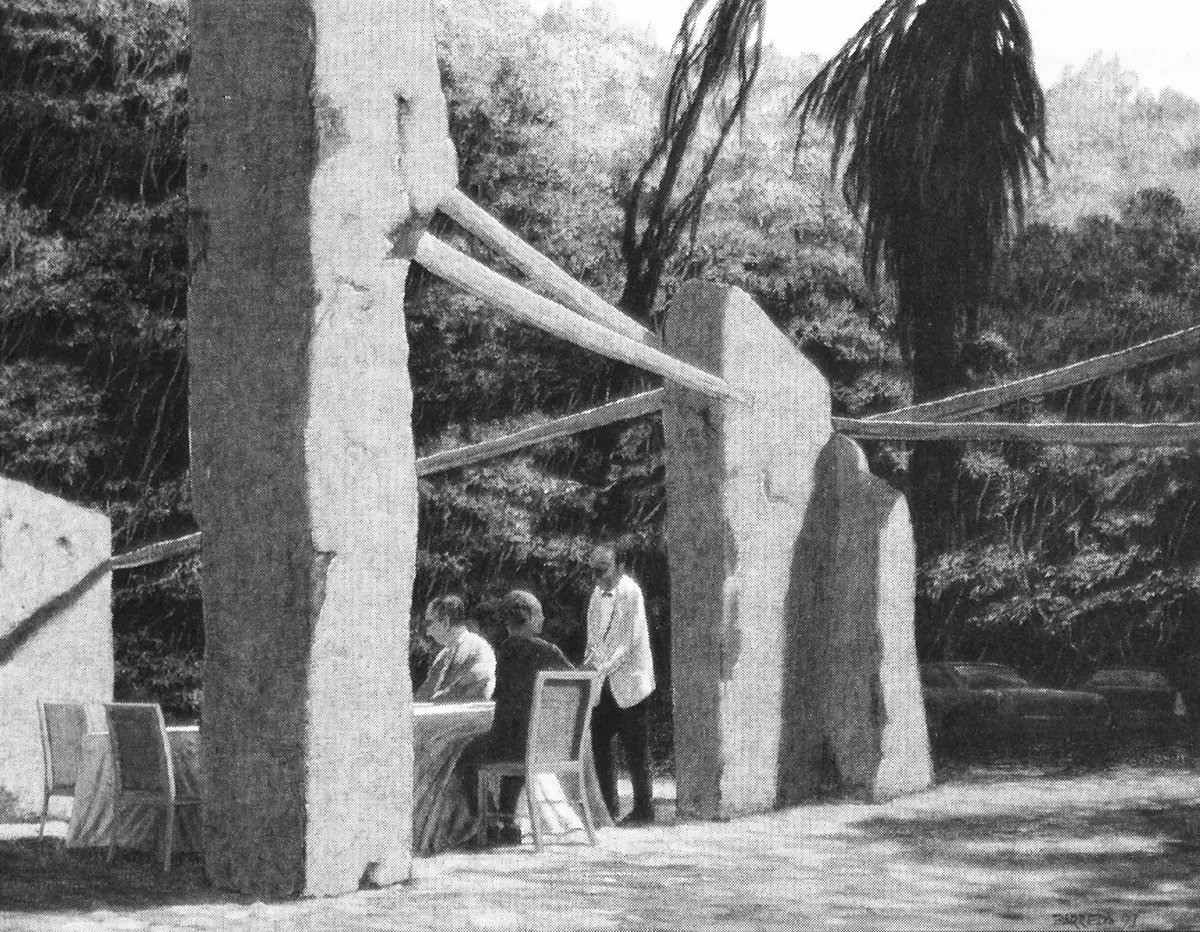
There is a very close link between his activity as a painter and his professional work as an architect. He has repeatedly been attracted to architectural space and its constituent elements: the textures of walls, the treatment of doors and lintels, and his interest in squares and streets and the surrounding vegetation and trees. There is a clear sense of compositional order and rigor, the solid formal structure of perfectly controlled geometrical elements. There is no sense of lightness here, but the weight and density of architectural bodies.
There is in Barreda's work an attraction towards the abandoning of things of the world to their own alterity and decadence; beings and things marked by the deterioration wrought by the passage of time.
It is this floating sense which gives his paintings a high degree of ambiguity. Old doors, crumbling walls, worm-eaten gates, and oxidized icons all conjure up aesthetics of abandonment and even when the palette becomes filled with light-drenched landscapes, the solitude of the world remains.
From the 1980s, a profound and consequent process of analysis led to complete metamorphosis in the artist’s landscape, the result of a sensation of the loss of harmony between nature and man.
An oppressive and suffocating atmosphere marks this new stage in Barreda's work, with the spectator’s gaze being dislocated by the disturbing vision that it offers. The spaces which were previously open are now closed and shut; the lines become twisted; the architecture tumbles down. The human figure appears almost like a caricature, sometimes oppressed, sometimes ironic, always ironic. The reference is to a splendor that no longer exists, a domestic and social decadence that tries to hide in a world of appearances.
MILAN IVELIC