Inside the Matta Room of the Museo Nacional de Bellas Arte, the artist Gonzalo Díaz recently mounted an installation titled United in Glory and Death. As in many of his previous installations, Díaz incorporated into the plan of his work the actual exhibition space—conceived as a storehouse of memory—in order to highlight its areas of fragility. This time the gesture reached its maximum register: Díaz not only exhibited his work in the Museum but exposed the museum itself. The institution itself becomes the object to be shown.
The title of the work, United in Glory and Death, repeats the inscription engraved on the pedestal of a sculpture opposite the museum that illustrates the fall of Icarus. This work, conceived as a tribute to Chilean aviation, was done at the beginning of the century, around the time when the museum itself was established. The artist duplicates the impact of the phrase by reproducing it also in physical terms, with an inscription in neon letters appearing on the top part of the building’s facade. In this way, the words serve as a formal means of linking the exterior with the interior of the exhibition space.
This method of combining and integrating different spheres and levels has been a relatively constant strategy in Díaz's work. His very economic structural gestures have always brought together different worlds and times which otherwise would remain separate from one another. But the phrase is much more than an articulating device. In a parody of its dramatic theatricality, Díaz lights it up with neon. Through this ironic wink or nod that is typical of the artist's sensibility, Díaz makes fun of the grandiloquent pretensions of institutions. In writing the phrase over the front of the building, he is calling attention to the public pose, the cosmetic trick that seeks at all costs to hide the suspicious fragility of the desire for power.
At the national level, Gonzalo Díaz is one of the artists who has been most critical of official cultural policies and, in particular, of the way in which the National Museum has been run. Not only through his work but in interviews published in the press, Díaz has expressed on various occasions his discomfort with the subordination of culture to the interests of the political class. "Culture" is a blanket word that can be used to dress up and therefore hide other intentions. Concepts such as facade, ornamentation, and simulacrum, associated with the idea of power, appear consistently in Díaz's work.
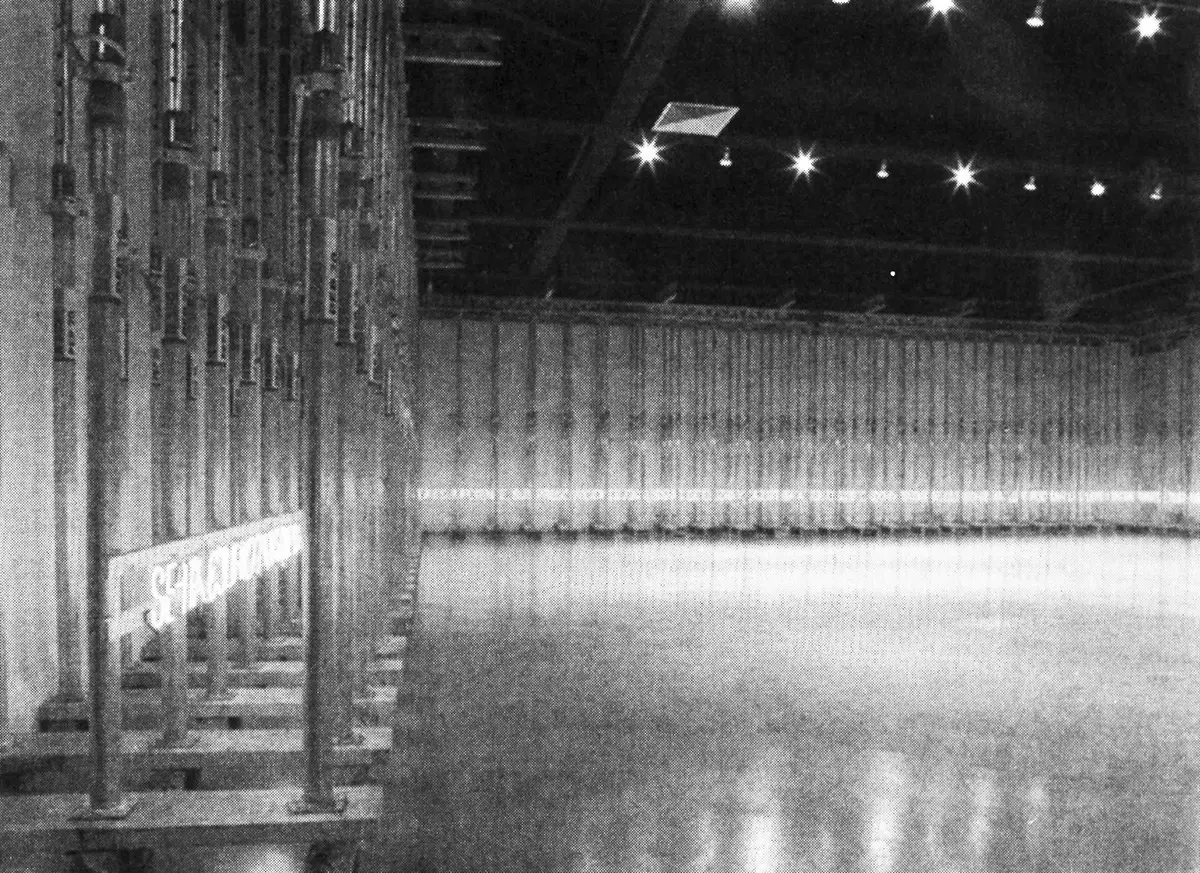
But let us go inside the museum and down the stairs to the basement floor that houses the Matta Room. It is symptomatic that Díaz should have chosen this underground space, which is a metaphor for the comfortably hidden away place which the artist will disrupt with his troublesome lights. It is here that Díaz mounted, in large neon letters, a fragment of the discourse on which the Chilean Civil Code is based. The text covers the interior perimeter of the room and is supported by wedges like those used temporarily for the construction of buildings. Without the support provided by these wedges, everything could come tumbling down. The wedge is therefore a structure that makes possible the construction of any other structure. Once again, Díaz refers back to the idea of foundation, and the fragility which lies hidden within it.
The fragment of discourse written in neon is also a foundation text: it serves to support the Chilean legal institutional system. Its rhetoric and content exert an unusual attraction. The text, which refers to succession rights, establishes a sharp tension between the private and the public, reflecting a dramatic process of fragmentation.
United in Glory and Death strips the monument and exposes its skeleton in a beam of light that pierces through history. Díaz mounts a spectacle of institutional fragility in a work that is technically excellent and visually very clean. The minimal aesthetics manage to reflect basic elements of industrial and technological sensibility, as Díaz reviews the century and establishes a tension between the two aesthetics of language. The first, at the beginning of the century, is characterized by its discursive vociferation, and the second, at the close of the century, is dominated by the spectacle of technology and its economic muteness.
The installation does not demand complicated readings or make recourse to complicated associations. Díaz presents the relationship between the elements which act as referents for his work, without disguising them or passing them off for something else. We might at first see this relationship as a little too explicit, but it is precisely here that the risk and boldness of the enterprise become clear.
Díaz's work is based on the idea of conveyance. He does not use any ingenious tricks and renounces the egotistical pleasure of ambiguity, preferring to reveal a fabric of collective meanings which go beyond any personal obsessions. This process of unmasking obliges him to remain, almost stoically, on the dangerous brink of what is evident without ever falling into the abyss of what is obvious or merely illustrative. Díaz performs this feat in masterly fashion, with his gesture acquiring such clarity and precision that it becomes impossible to forget. Díaz illuminates the history and in the process manages to supplant it. United in Glory and Death will undoubtedly earn its place in the annals of the museum's history.
CATALINA MENA