
It is surprising that the great Haitian artist Hervé Télémaque has not yet had an exhibition in Miami given its large and important Haitian community. In fact, he has not had a solo exhibition in the United States since the 1960s, though he is recognized internationally with exhibitions and participation in major venues from Paris to Havana to São Paulo. He is currently preparing his next retrospective for the Museum of the IVAM (Institut Valencia d’Art Moderne) in Valencia, Spain for the summer of 1998.
Fortunately, the situation of such limited American exposure was rectified— although on a small scale considering the breadth of his accomplishments over the past four decades—with the presentation of this mini-retrospective of his works from the 1980s and 1990s. It was an opportunity to introduce the artist to a new audience, and re-introduce him to old friends, and to the Haitian art aficionados who may have only read his name in the many books of contemporary Haitian artists. (Because of the multi-dimensional and modern context of his art that was developed away from Haiti, he is often described as “not really a Haitian artist.’’ This only confirms the lack of information and error of perception that surrounds the ordinary and accepted definition of "Haitian" art. Télémaque is not an ‘"ordinary" Haitian artist, if there is such a thing. He does not paint palm trees and meticulously detailed landscapes and there is nothing naive or unsophisticated about his work.)
Hervé Télémaque was born in Portau-Prince in 1937, studied at the Art Student's League in New York with Julian Levi from 1957-1960, and then went to Paris in 1961, where he has remained, now as a French citizen and one of the country's most respected artists. In the 1960s, in keeping with the trend toward Pop Art, he used his exceptional drawing skills to develop a popular vocabulary of images in brightly colored compositions that often incorporated words and letters in a layered, fragmented collage-like style. He also constructed assemblages, many of them made from found objects. Over the years the colors and subjects changed with the times, and the imagery became more abstract and serious, while he continued to explore the format and surface variations of collage objects to create wall pieces in three-dimensional relief.
The works in this exhibition from the 1980s and 1990s ranged from mixed media (including coffee grounds and pigment on wood, and nut pigment and coffee grounds on wood), to lithographs, assemblages, and elegant charcoal and graphite drawings on paper. Especially strong was Masaï, 1997, a wall piece assemblage of lacquer and coffee grounds on wood in deep rich natural browns. For all its minimal and abstract sense of design, the object declares a potent sense of presence, a forceful symbolic statement about the African tribe for which it is named. The large collage titled Haitian Corner incorporates fragmented news images, portraits, and words into what must be a source of recollection for an artist so far from his native land. Télémaque still takes advantage of the visual resources accorded the category of Pop Art, now with more juxtapositions and overlapping to attain his authentic style of narration as a dynamic commentary on everyday events.
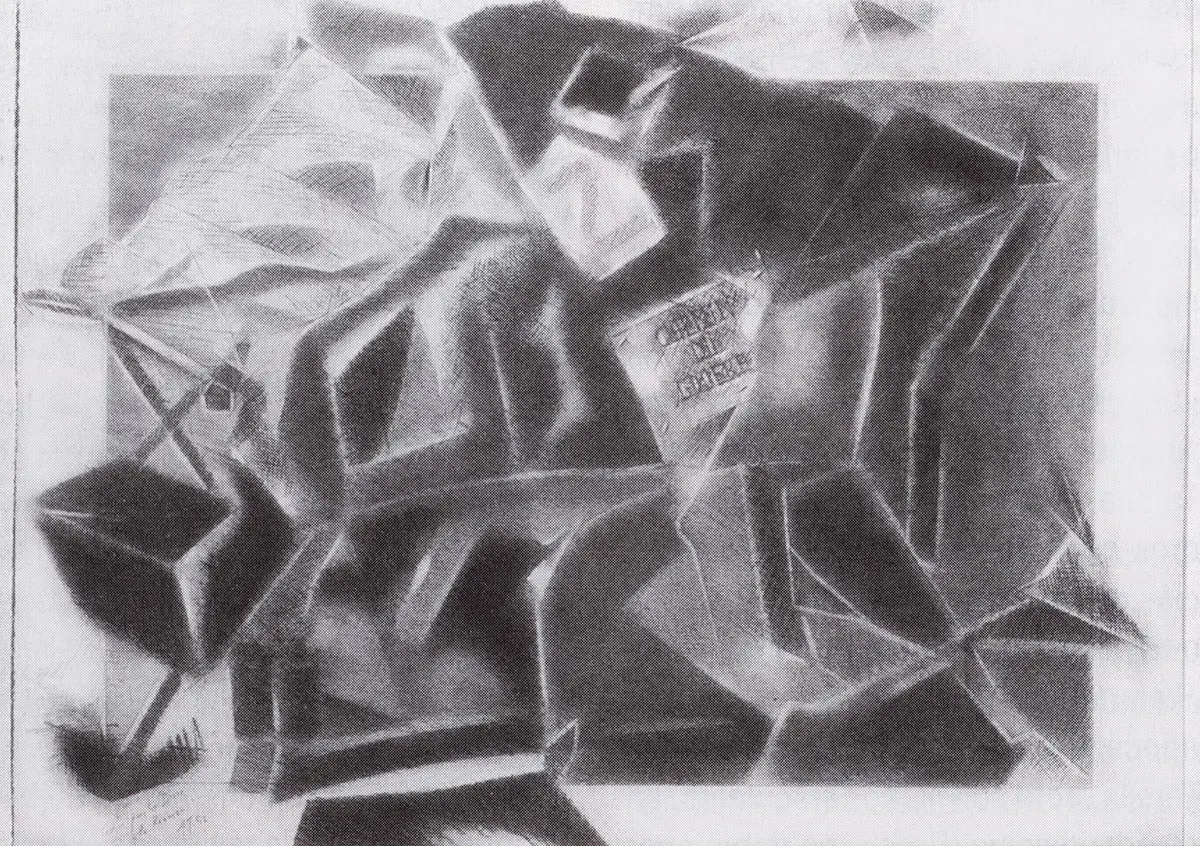
Although he has never moved entirely away from the complex fragmented compositions/assemblages with which he is identified, the works on paper were a highlight of this exhibition. Some were of mixed media and others were done in charcoal. They were all refined and minimal declarations of his keen aesthetic sense, and very contemporary in concept. The success of his complex imagery has always been dependent on an understanding of basic formal elements. As early as 1968, the small work titled Gaine was based on the interplay of line and texture. Nowhere is his command of line, shape, and form better demonstrated than in the recent series of charcoal drawings from the late 1990s. The rich depth of form in Case, 1996, is obtained by rubbing out the depths of the ground charcoal with erasers. With total control of the medium, he moves beyond the merely pictorial of his collages and layered images to explore a new dimension of spatial reality. The monumentality of these drawings attests to a continued investigation of the multitude of possibilities inherent in today's materials and techniques. For Hervé Télémaque, the possibilities are endless.
CAROL DAMIAN