
Humberto Castro belongs to the young generation of Cuban artists who left the island a decade ago to settle in Mexico, Europe, or the United States. His most recent exhibition was held in Paris at the Monde de I'Art Gallery (established in 1991), which focuses on presenting work by non-European artists and in which Latin American artists have had pride of place (with individual shows by Moises Finalé, Yolanda Gutiérrez, Manuel Mendive, Eugenio Olizabal, Carlos Capelán, and Daniel Senise).
Conceived as a mini-retrospective, this exhibition included a number of works (canvases and drawings) done between 1990 and 1997. An expressionist artist involved in the artistic movement of the 1980s—which in Cuba resulted in a social and political critique through iconoclastic forms of expression, Humberto Castro chose Paris despite the isolation that living in the French capital meant for him, keeping him far from his cultural and linguistic community, cut off from a potential public in Latin America.
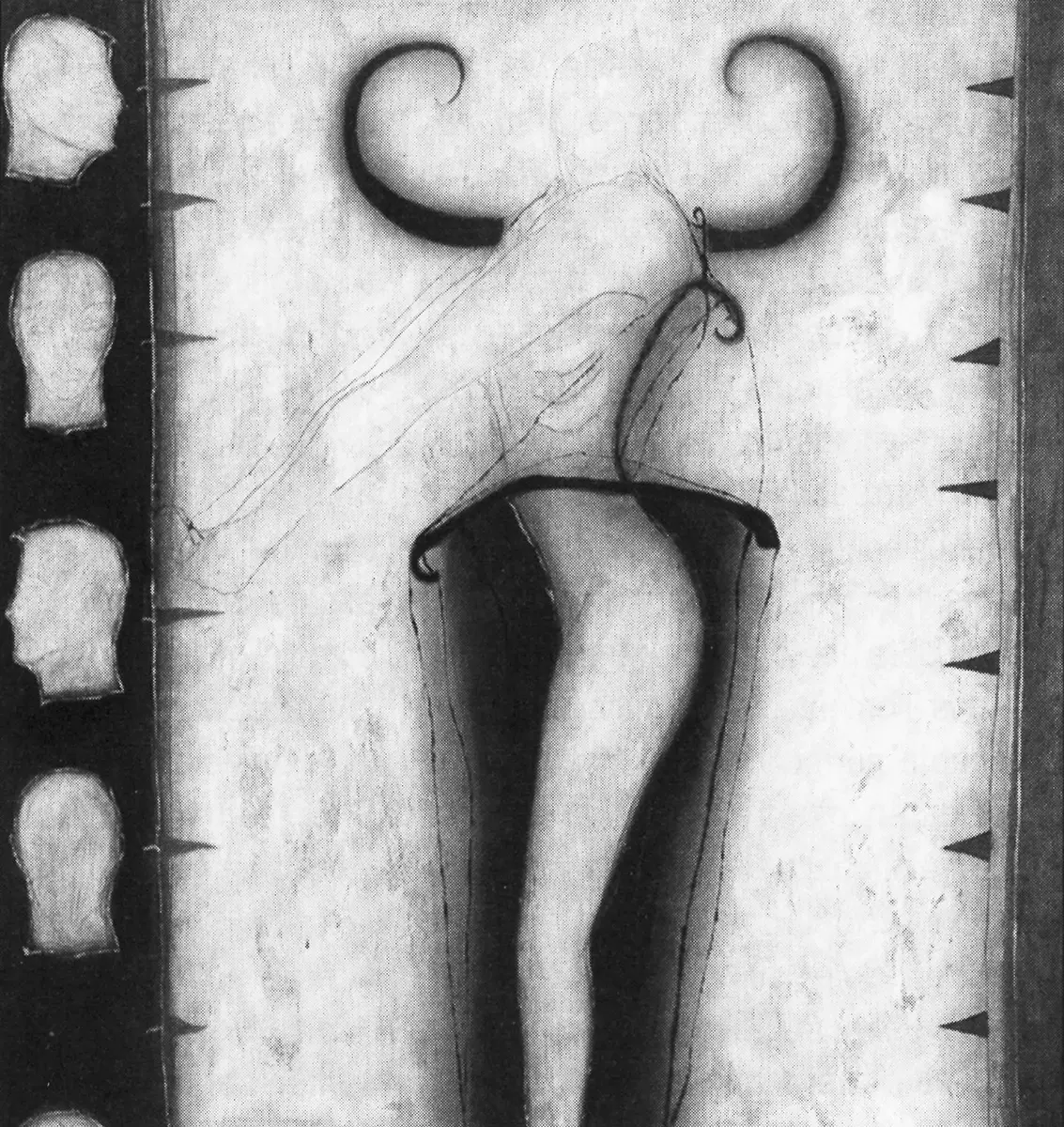
Although the human figure continues to be at the center of his work, as a symbol of both the intimate and universal concerns of the artist, it no longer appears in the expressionist, somewhat aggressive representation that characterized his work at the beginning of the 1990s. There is a softening and a nuancing of form and pictorial values. What is important for the artist now is to give a broader sense of the relationship with the universal, that is the use of metaphor rather than a direct message. The expressionism formerly used in the service of art conceived as a struggle (both literally and figuratively) reflected in the symbology of eternal combat has given way to a more conceptual, though still figurative representation.
In France, the artist believes his work has become intellectualized, through a gradual purification of his forms and images and an overriding process of synthesis. The urgent need to speak out and denounce has been replaced with a sense of distance, a thinking through of ideas through reflection. The mask and the arrow, means of protection and combat in the context of African cross-breeding, have now practically disappeared.
In his most recent canvases, this African dimension, which is also expressed in a range of ochers, dark earth colors, and blacks, has undergone a change in which both the space and the form have become smoother and lost their roughness. The palette has been reduced to a predominant contrast between warm earth colors and cold bluish tones. The work has become more intimate and less directly social, more formal and less referential, and more cultural. In this respect, the artist has for a number of years been inspired by universal themes (Ulysses, Icarus, and the Minotaur), which he has used to express his personal commitment and reflections. These are the philosophical threads that allow him to construct new artistic myths, in which the aesthetic dimension enriches the narrative which must also be communicated. Space is constructed through a message/form dialectic based on humanoid architectures, with the body acting as an allegory of what can be shared by humanity.
Humberto Castro’s pictures reflect a high degree of work on textures and transparencies, in an attempt to enable the spectator to grasp a message which is not immediately perceptible. In his attempt to propose rather than provoke, Humberto Castro has relinquished his "warrior" stance—that he had developed in and for Cuba, preferring the instruments of reflection and seduction more in keeping with his new reality. The combat has become a dance and the artist continues to exorcize what is immediate and at hand in his attempt to reach the timeless (the “essence") through indispensable metaphor.
CHRISTINE FRÉROT