
Malraux saw bullfighting as the contemporary survival of an ancient pagan rite. The Spanish artists Goya and Picasso revisited the bullfighting tradition and the mythical connotations of the ritual, in a series of drawings and prints, including the Minotauromaquia, a group of works by the father of modernism in which a humanized Minotaur executes violent sexual choreography on prostrate female bodies, in a kind of hymn to the power of virility. In this series of exquisite prints, the painter sometimes includes himself spying voyeuristically on the event, sometimes transformed into the bullfighter. Decades later, another Spaniard, the film director Pedro Almodovar, would explore in an almost comic manner the relationship between desire and death in the bullfighting universe in his film Matador.
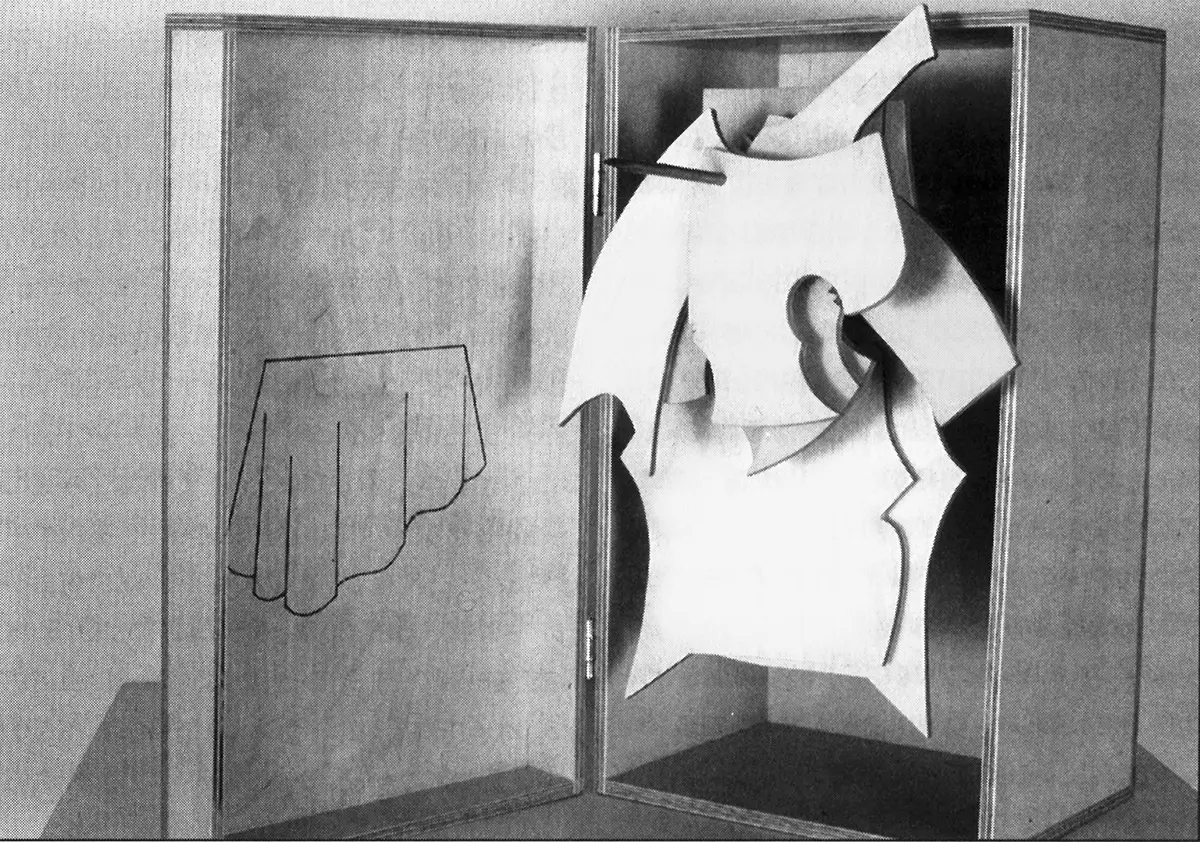
The Venezuelan artist Jose Gabriel Fernández for his part proposes a brief illustrated guide to the bullfight, that is simultaneously a critical tour and an illustration of several readings of the above-mentioned rituals. It does not extend to the furious virility of the bull nor the morbid and risky skills of the bullfighter (who is a kind of henchman), but transposes the codification of desire implied by any ritual —in this case, the costume of the bullfighter— into an allegory which we can characterize as belonging to the art which sees sexuality as problematic if indeed such a category can be defined.
The media used by Fernández to denude a possible model of constructing desire are singularly varied. Delicate watercolors are done in pink tones, two bullfighter costumes, a box in which pieces of the bullfighter costume pattern carefully cut out in wood reorganize the anatomy of the chosen object of desire, a video, and a video projection make up a twofold homosexualization. The objective is to revisit the ritual of the bullfighter’s costume and through this narrative propose another revision: that of the course of art at such varied moments in its evolution as the first period of modernism or the recent proliferation of video projections throughout the last decade (and which seem to have become an almost indispensable part of the vocabulary of the emerging artist). The articulation of this apparently eclectic compendium is achieved through the use of the hole, which the artist causes to circulate amongst the works, now as a direct metaphor, filling it with nails —nailing it down— now as a receptacle for viewing. A spotlight is projected into a dark room, and through the hole we can see hands that run over the bullfighter's costume, buttoning it up and bringing it tight to the flesh, with the same rigorous beauty and economy of gesture that characterizes the varied works in the show. The hole is not only a projection but a multiplicity of black holes in a bullfighter's costume which is meticulously and uniformly perforated. A picture by Man Ray from 1916, which shows a ballerina accompanied by the shadows cast by her body on the stage, is respectfully deconstructed in a series of watercolors, the composition of which is pivoted on a little strategically placed circle, or which are literally riddled with pricks. The bride —and bachelors— of Duchamp, another emblematic altar of the modern tradition of the scarification of the mechanisms of desire, are subtly paid tribute in the above-mentioned meticulous monochrome wooden box.
The frontal and evident nature of the references and allusions to both specific works and tendencies and to a specific orifice of the body results in an elegant efficacy thanks to the studied precision and absence of any intention of parody. The work of this young artist can be seen, in its attitude towards the brutal and deliberate evidence of a declaration of gender, as simultaneously analogous and diametrically opposed to that of the British artist's Gilbert & George, who construct the semantic density of their works through the literalization of the declaration of their sexual preferences. The merit of Jose Gabriel Fernández in his debut in the New York arena is that he borders on kitsch, grimace, and appropriation as simulacrum, but without ever crossing the line. Not even the citation of Almodovar, the use of bolero music in the video, ends up being ironic, but paradoxically melancholic. A brief guide to bullfighting is a piece of machinery that produces cultural nods and winks which are used in the service of exalting a frenzied desire but set within a series of ascetic parameters and formal procedures which are clearly defined and therefore very refined.
NICOLÁS GUAGNINI