Last November the El Museo Gallery presented the recent work of the Colombian artist, Fernando Roldán. Born in Cali in 1955, an architect by profession and a painter by conviction, Luis Fernando Roldán very early on in his life committed himself, seriously and energetically, to the pursuit of the creative act. Thus painting became for him a kind of life force nurtured by various aspects of his everyday life.
Roldán's work has been a process of constant growth and change, which has significantly enriched his creative baggage, linked as it is to an unusual way of perceiving the different elements of his experience. It is for this reason that his work has reflected a constant exploration of not only painting as such, but of life and everything which that implies. His seriousness in assuming this creative role has made Roldán a significant artist at both the national and international levels. He assumes a major place in the panorama of artistic creation in Colombia as we approach the end of the century, a time where the painting seems to occupy a less important role than in the past. Roldán’s work reclaims the transcendental role of painting within the context of Colombian art.
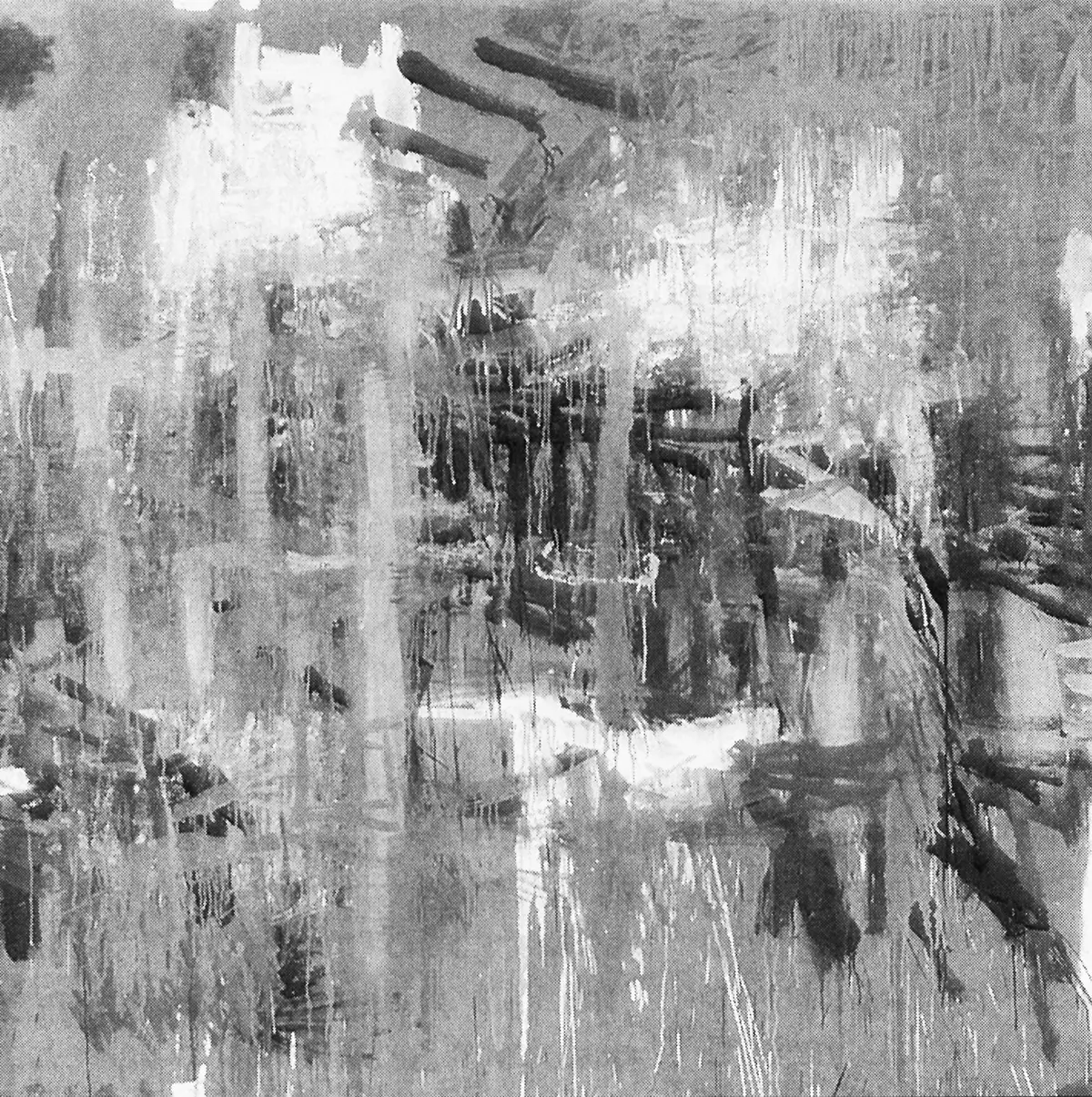
It is interesting in this respect how abstraction becomes an evocative element. His work Calendar, which won the prize at the XXXVI National Salon of Artists, is an evocation of time, its passage, and the different kinds of damages it brings. This is a constant feature of his work, where the combination in the handling of textures and mixed brushstrokes successfully interrupted by the use of the spatula establish communication between the public and the work. In general, the textural work implies a certain kind of commitment, since it transports the spectator towards other important moments in the history of art, such as abstract expressionism and action painting, and in particular the work of the North American artist Jackson Pollock—although Roldán is much more controlled in his technique. His work recalls the gestural movement of Pollock’s hand in painting, the energy used, and the format which such an attitude required, amongst other things. But Roldán goes further back than dripping into the history of art and discovers, as an interesting reference, the pictures of Andres de Santamaria, which when carefully observed, reveal a large number of pictorial layers, one on top of the other, with the handling of color now taken up by Roldán with something approaching nostalgia. To journey through the history of art is, in the final analysis, an evocative experience.
In this recent exhibition, the public was able to see how Roldán continues to experiment with abstraction without moving into geometry or toward the rigidities that it often implies. His abstraction is the result of observation and its subsequent re-interpretation. His work continues to be seen as a series of surfaces on which the artist has worked in different atmospheres and used color in an expressive manner. Each layer reveals the amount of work that has gone into the result appearing on the wall. Through these layers which are based on primary colors rather than black and white, Roldán has created textures that evoke the importance of tactile sensations. He carries out experiments that are novel even though the materials used are traditional and if we look carefully at each picture, we can recreate the actual process of their elaboration since each pictorial layer allows the earlier one to be seen: although it may be the same color, the tonality has changed or has become quite different. Roldán's pictorial work is constantly based on a pencil drawing as something absolutely essential to painting. The language in both cases moves in the same direction and rather than express things in different ways, the one provides support for the other, without any loss of unity in the various elements making up the work. In both cases—painting and drawing—the combination of the colors with the textures and finally with the linework reflects Roldán’s particular way of interiorizing the world and Colombian culture, without lapsing into that noisy and heavy kind of evidence so much in vogue of late. The work can thus be read as a creative act that produces pleasure—a pleasure that results from the opportunity to see things and interpret them through a language that produces pleasure.
Luis Roldán creates pictorial work of great formal and conceptual richness which clearly illustrates the serious path on which he has embarked—and which is clearly distant from the contemporary avant-garde tendencies which deny the fundamental role of painting within art. Roldán sets out to restore the painting to the place from which it should never have been toppled. His pictures are contemporary, reflecting a period through which the country is passing, and bear witness to a reality within the tradition that in Colombia began with the abstraction of Manuel Hernández. They are attractive to the spectator and invite us to engage in a profound act of observation because only such an act can reveal the profound secrets of the painting, and in particular, those contained in each work by Luis Roldán.
MARCELA MEDINA