
What does objectivity consist of? How can a work, whose medium is photography, be seen objectively? Do the works of Luis Molina Pantin recently presented in the Sala Mendoza in Caracas proceed from, approximate, or re-affirm an objective aesthetics?
Without a doubt, the formats, themes, serial nature, and methods of exposure, key elements in an "authorized discourse," are also symptoms of artistic affiliation and pretensions. Molina Pantin is part, not unwittingly, of a dynamic process in photography that from Germany to Canada, from the Low Countries to Chile, has been described in summary terms as the “new objectivity.” From the medusan formalism of the Bechler's (considered pioneers in this respect) to the extreme theatricality of Jeff Wall, from the moving banality of Robert Adam to the landscape stupefaction of Andreas Gursky, from the ironic lucidity of the Swiss duo Fischi and Weiss to the cold Hopperlike pictorialism of Philip Lorca de Corcia, without forgetting the Bostonian School (Morrisroe, Pierson, Goldin) or the new French photography (Laffont, Mouline, Paradeis), the “objective” photography, which is not, in the end, so objective after all, already has more than a quarter-century of faithful followers.
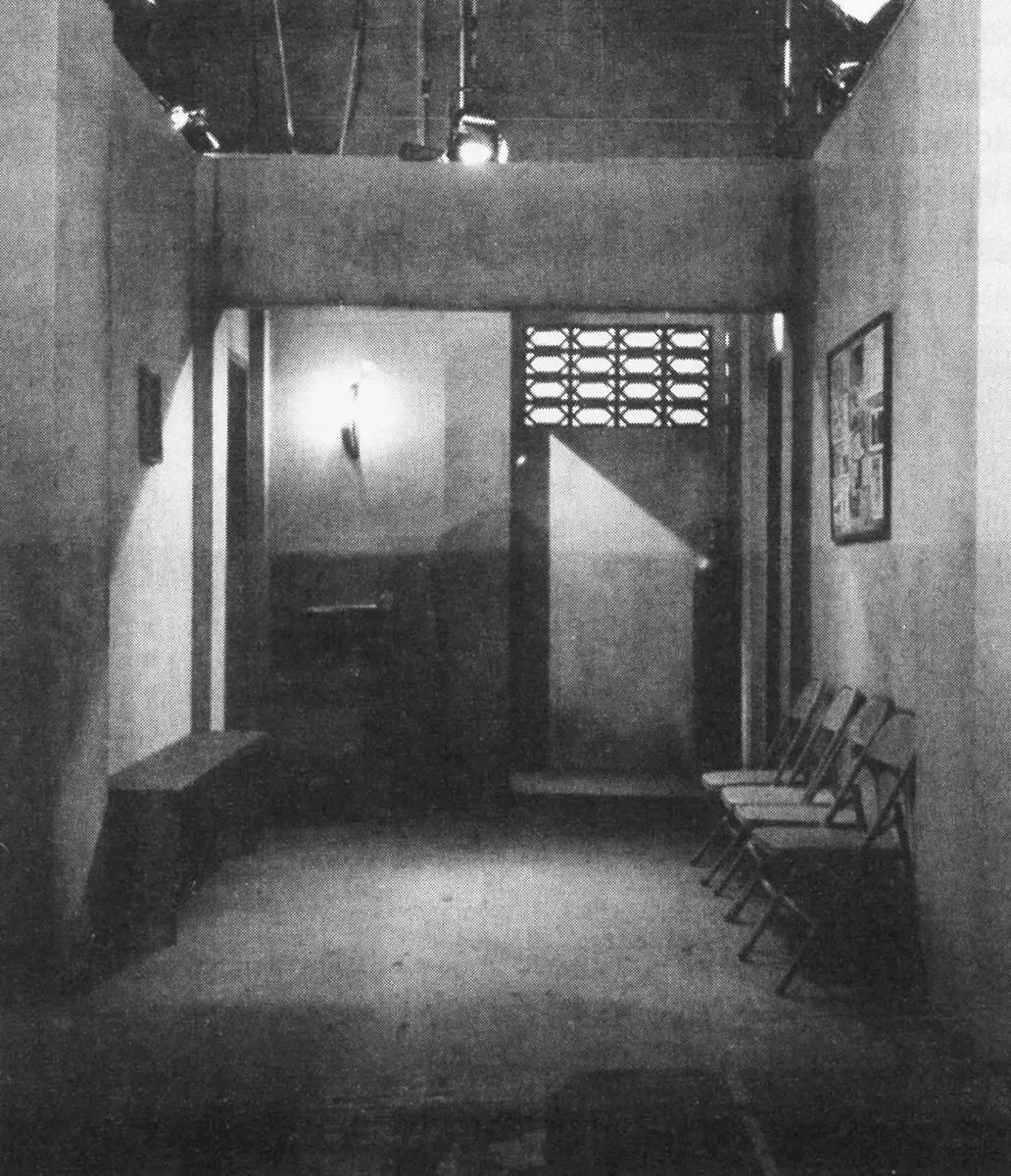
Luis Molina Pantin has been faithful to the fundamental tenets of this aesthetic ambition: to delineate with rigor the artistic practice of photography within the strict possibilities of its “medium” (being only photography and only trying to be photography), to de-aestheticize and unmask impostures of a lyrical, documentary or “everyday” kind which have become the rhetoric of the modern photographic act. There is, however, something which distinguishes him from many of the neo-objective photographers (and which associates him, paradoxically, with the lessons derived from a certain kind of conceptual and political painting, which from Gerhard Richter has its own base in Germany, with artists such as Sigmar Polke)—an interest in capturing not so much the material reality which appears as light on the sensitized support of the photograph, but a repertory of imagistic “stereotypes.” Thus what Molina Pantin’s photography seems to be saying, with the lucidity of an entymologist, is that we see only through certain scenographic “constructs” in which the world, instead of being produced before our eyes, is reproduced. (Rather like— and here the comparison should be read as a kind of honor—the work of Polke constantly “affirms” that our experience of painting cannot today avoid the reproduction machinery of its own historical productions in the form of history textbooks, magazines, postcards, posters, and so on.)
This exhibition, titled Inmobilia, gathered together, through what only seemed to be the coldness of the lens, a series of settings that any ordinary Venezuelan, under the mediated influence of the mass media and television, could recognize as the architecture of emblematic broadcasts, programs, and soap operas that capture the attention of and enthrall our society. The ten very large photographs making up the show revealed the precarious “stitching” of the televised spectacle and—through a few real chinks and cracks-the reality of its artificial machinery. Each was both the “scene” and the “theatrical apparatus.” Inmobilia was, therefore, a repertory of scenes (devoid of humanity) which reproduced in the absence, a selection of human “types”, social “roles” or narrative “stereotypes”, each of which was proportional to a piece of specific television scene. A specter lay hidden behind each of these scenes, the specter-which was absent from the photography but clearly and effectively represented by it-of at least two figures: the character (inhabiting it in the narrative or spectacle-based illusion of the televised program) and the spectator (by looking at the television screen).
Molina Pantin might have decided to compile a repertory of portraits of the human and social "types" of Venezuela, in the manner of the legendary August Sander who worked in Germany before the war. He would have done so, like Sander, by allowing each human type to be also a social "role" and "character" in the scenography of the everyday history of a concept. And indeed, to some extent—by avoiding such an approach—Luis Molina Pantin's series of photographs of television "sets" come strangely close to Sander's example. Except that Molina Pantin does so through the labyrinthine, abysmal mirror of the television reference, and thus through a twofold kind of distancing. As a spectacle-based society, Venezuela today, merely through the mediation of the audiovisual effect, appears as a repertory of meta-characters and double masks— our own (which we always wear, like the figures of the Weimar citizens painted by Sander) and those which are imposed on us through our inexorable investiture as television viewers.
An air of ambiguity blows not in vain throughout these images—what do they say? Perhaps they say something about the power of transparency of television in that it is able to characterize the “typically Venezuelan” better than any eye? Or perhaps they say that by characterizing that type in terms of the artificial and precarious television representation, television in fact projects a simulacrum, a non-truth whose effects are similar to those of the truth? The supposed objectivity of television would thus be trapped and unmasked in the objectivity of photography. But this would mean forgetting that photography too is representation, the visual construction of a world. And repeating perhaps, placing all our bets on photogenic utopia, the early morning illusion of the first theoreticians of photography who affirmed with absolute conviction, like Disderi, the impossibility of representing things photographically, the impossibility in photography of ensuring that things and the world are not perceived as being seen.
LUIS PÉREZ ORAMAS