Over the last few years, the great metropolitan cities of Latin America have become aware, like some of their European counterparts, of the danger posed by the abandoning of their inner-city districts and the increasing gangrene of the degradation of a fragile urban cohesion. The unbridled and anarchic growth of these megalopoli is creating marginalized pockets that threaten a precarious social equilibrium. Like the rehabilitation recently initiated in the historical center of Mexico City, these cities are now focusing on cultural reorganization as a driving force for revitalizing and restructuring their deteriorating or fragmented social and urban fabric.
In a similar spirit, an ambitious cultural infrastructure—public in Brazil and private in Argentina—is now emerging, as seen in Rio and Buenos Aires a few months ago. As the touchstone of this renovation of the old districts that have often been abandoned, these new places of culture should result in the return of the public (and a consuming one at that) in search of quality culture.
At the dawn of the year 2000, Rio’s goal is to become a national and international cultural center. It has set for itself a number of objectives including the fight against a stereotype that accords the cidade maravilhosa no other alternative than it has suffered with for many years: violence and sloth. The old colonial center of the city has been disfigured by the frenzy of "modernist" construction/demolition projects of the 1940s and 1950s, where remodeling was undertaken at any price and without any overall long-term plan for the urban framework. The destruction of old buildings and in particular, those in the old Portuguese part of the city and the construction of flyover highways and skyscrapers, alongside austere office buildings, alternating with those whose ownership has reverted to the State, have all disfigured the appearance and nature of the old center and resulted in the mass exodus of intellectuals and artists.
The Prefecture of Rio is now proposing to redress this situation of urban anarchy and incoherence by the creation of strong cultural focuses linked to the architectural heritage of the historic center. The hope is that this will also enrich the other cultural institutions that already exist within the perimeter of the Praça Cinelandia (Opera, Museu de Belas Artes, etc.). The transformation of the Paço Imperial into a cultural center for theater, performing arts, and exhibitions, and the current renovation of the Casa Franca-Brasil are the most recent changes. Older spaces like the Espaço Cultural dos Correios and the Centro Cultural Banco do Brasil complete the panorama of these new renovations. The vitality of the Lapa district, rescued by actors and musicians —particularly with the Café de la Dança, the Afro-Brazilian movement, and the Amir Haddad alternative theater— has contributed to the collective effort to give the center of Rio its own artistic and cultural life. The galleries which had left for Ipanema, are now returning.
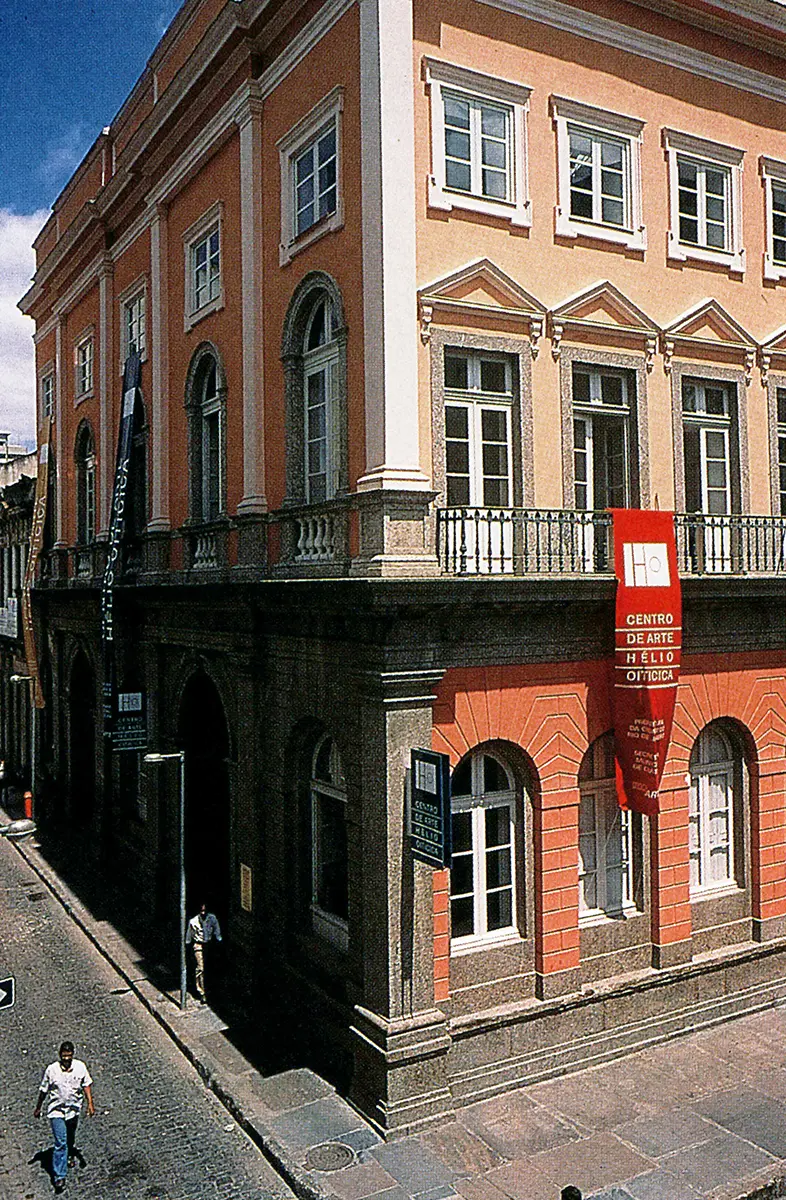
Two events focusing on the dissemination of contemporary art took place last September. One in the historic center of Rio —as a response to the above-mentioned expectations— and the other, held in the city of Niteroi, which faces Rio. The Centro de Arte Hélio Oitica has just opened to the public, near the Praça Tiradente, in the heart of the old town and the Prefecture of Niteroi, with the Fundaçaõ Niteroiense de Arte and the Secretaria Municipal de Cultura, has financed the Museo de Arte Contemporanea de Niteroi (MAC), the most recent project by Oscar Niemeyer.
The Centro de Arte Hélio Oiticica presents the work of the artist on its two floors and a lower story. The center also provides texts, press clippings, and photographs. For Oiticica, who conceived his creative work as something ephemeral and used to perform actions on the street, the enclosure and consecration of the museum seemed like a poor bet. The project involving the creation of a museum space exhibiting works that were, for the most part, conceived for outside presentation and then destined to disappear, implied a conceptual hiatus. On the other hand, the information on the artist and his work was presented in glass cases or through texts hung on the walls—a traditional solution in museographical terms and one which makes contrasts with Oiticica's ludic, provocative, and impertinent spirit. One would have expected to find more imaginative museological solutions in keeping with the recalcitrant, inventive, and disruptive character of the artist’s work. This would have resulted in the creation of a space for social and playful participation, as suggested by Oiticica in his last works as opposed to a static and lifeless remake of a purely derisory kind.
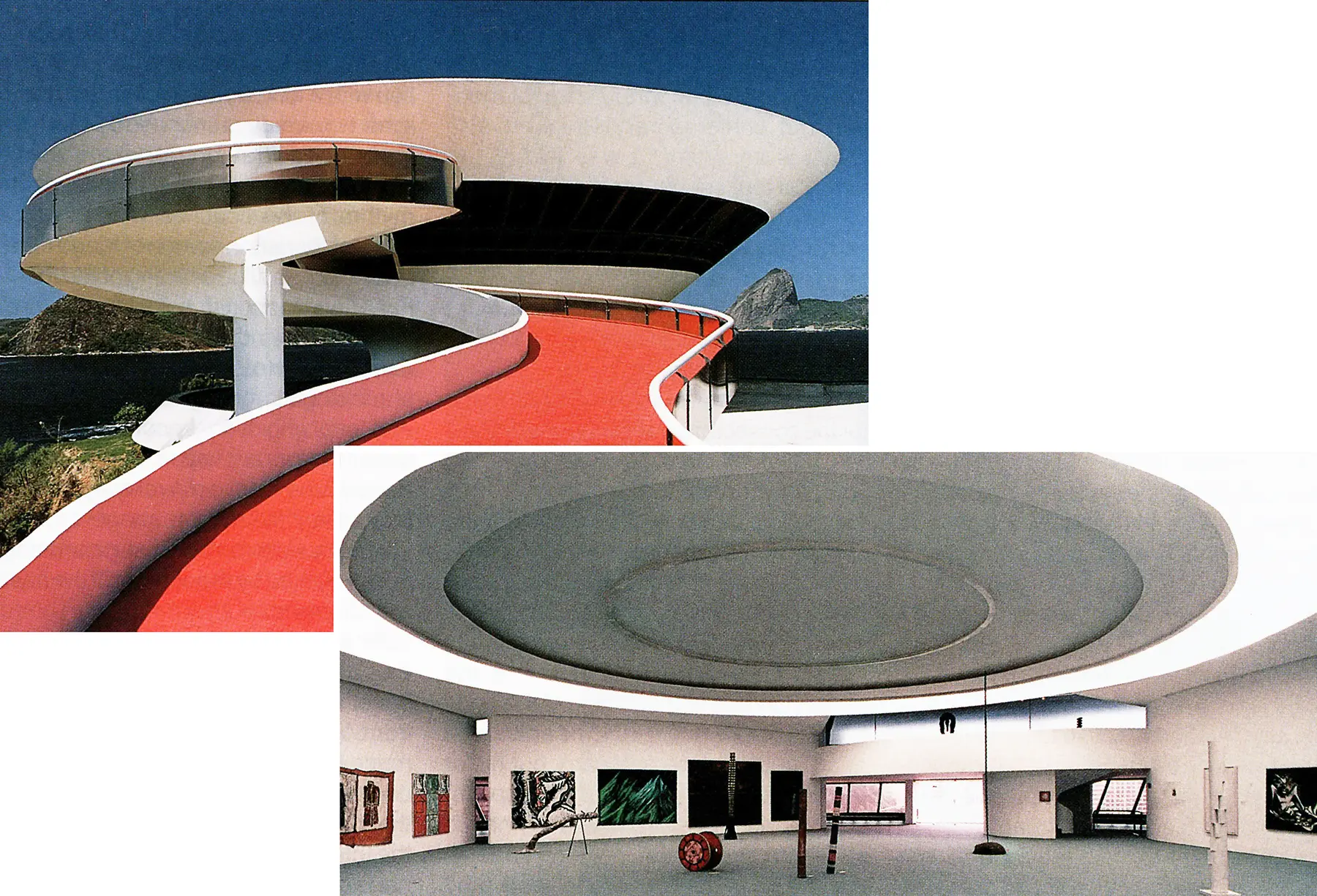
The Museo de Arte Contemporanea of Niteroi is the latest architectural work by Niemeyer. The site and beauty of this immaculate architecture on the prow of a rocky peak overlooking the sea, with Copacabana beach in the distance, combine to make this sculpture museum an astonishing visual and spatial spectacle. A kind of tropical Taj Mahal, the MAC’S ambition is to become a center for the promotion and understanding of modernity and issues concerning contemporary art. Closer to a Buddhist stupa than to a living and modular space, it nevertheless invites critical reflection rather than meditation. The establishment of a new museum of contemporary art in a natural site with a marked physical presence, in a place far from any cultural center, raises the question of its meaning and purpose with regard to the public. If as an exercise in style, form does not compromise content, then it may well meet with the approval of everyone. Internal spaces are only exact, but inverted copies of external form, and for that reason, they do not meet current museographical demands; the flexibility of presentation facilities, the distancing which is indispensable to an appreciation of installations, and the juxtaposition of levels provide diversified views. The reader will remember the sharp criticism in response to Frank Lloyd Wright’s famous spiral ramp of the Guggenheim Museum in New York. But in 1952, museum architecture was still in its infancy and despite its deficiencies, Wright’s work would become the starting point for a new genre.
The situation is very different today when museum architecture has become a fully independent architectural mode that has been substantially developed in many countries.
Three spaces make up the MAC: under the central "bell," is a redistributed circular space. The two corridors encircle the central space below and above. In the first case, a fabric-covered bench does not offer a viable approach to contemporary sculpture. The wall opposite is suitable only for small format pieces. The solution in the upper corridor is scarcely more satisfactory: a pale blue carpet follows the concave form of the floor(enclosed in dark green glass on the lower story) and leads to a source of natural light from a glass-enclosed band placed high up.
If we look at the arrangement of the exhibition spaces, we begin to doubt the existence of prior consultation between the architect and his team with the museum staff, artists, and curators, who are important actors in the organization of contemporary art. The designers, who made no provision for stacks and storage space for artworks in their preliminary plans, later had to construct a special annex for this purpose. There is also the problem of conservation in a place so close to the sea. Given these theoretical and technical weaknesses, one might wonder about the social and cultural purpose of a place where the aesthetic concern with external architecture takes precedence over the demands of collective reception. A museum is no longer a place in the service of artists and art, as it should be. It becomes instead a purely aesthetic object—the current attraction and interest of which are above all due to the aura provided by one of the greatest architects in the world.
More than 90,000 visitors have been registered in the museum in the month and a half since its opening (free admission was restricted in time). Ten percent of the collection of Brazilian art donated to the MAC by the collector Joao Sattamini was on display and its rather anarchical presentation was compounded by restrictions in the distribution of space. Several questions can be asked about the large number of visitors and their real motives for coming to the institution. Why did so many flocks to the museum and its exhibition? For Niemeyer’s name? For the architecture itself? To experience the building’s effect on the landscape? To discover the artists making up the temporary show of modern and contemporary Brazilian art? "What is important," I was told at the MAC, "is that people come to the museum just as they go to the beach—without intimidation. They shouldn’t be afraid of entering a museum." But will they come back, once the secret of the architecture and the museum has been revealed and their curiosity satisfied?
Today, the museum is not only a space for the consecration of contemporary art; it is, above all, an opportunity, limited in time, for an artist to develop his or her aesthetic pursuits, a place enabling the reception of a work to be tested and new projects to be conceived. In the case of this particular museum, the space may well impose on the artist unbearable spatial restrictions, and thus limit the understanding and meaning of the artistic project. If we admit that "the artist must adapt to the space and carry out his or her work in accordance with that space" (MAC), the restrictive spatial demands may compromise the intention underlying the presentation of the work and make the contemporary artist the poor cousin of architecture, or a slave to predominant architectural forms.
The objective of these two spaces is to show contemporary art. There is nothing more open, more fragmented, and evolving than the installations that form the nucleus of the work being produced by young contemporary artists. If the new exhibition spaces want above all to be of service to a silent and underrepresented group, and to meet the expectations of the public, then they should be as neutral and flexible as possible with regard to their interior museographic space. Whether in the case of a museum with fixed spaces, predetermined by the aesthetics of exterior volumes (Niteroi), or a place that reflects a spirit of commemoration or homage in respect to a work that was ephemeral and challenged established culture (Centro de Arte Hélio Oiticica), have not those responsible for these structures in fact worked against the permanent revolution implied by the concept of contemporaneity, which is linked to the very essence of the work and that of the gaze?
The third space, which the PROA Foundation (a symbolic wink here at the former modernist review of the same name) opened last September in Buenos Aires in the La Boca district. This popular quarter, an enclave of Italian immigrants with a long tradition of art and handicraft, is nowadays shunned by city dwellers in their avid search for what is convenient and close at hand. It dozes to the rhythm of the coaches which brings in loads of tourists in search of tango music and nostalgia. The opening of the PROA Foundation should help to get things moving in this district, which has been rather neglected by urbanists and cultural sociologists, giving it a new lease of life and enabling it to become a pole of attraction for renovation. In this way, La Boca will be able to move away from the (attractive) stereotype image so often sought by visitors to the district, an image accompanied by the echoes of the mythical Caminito.
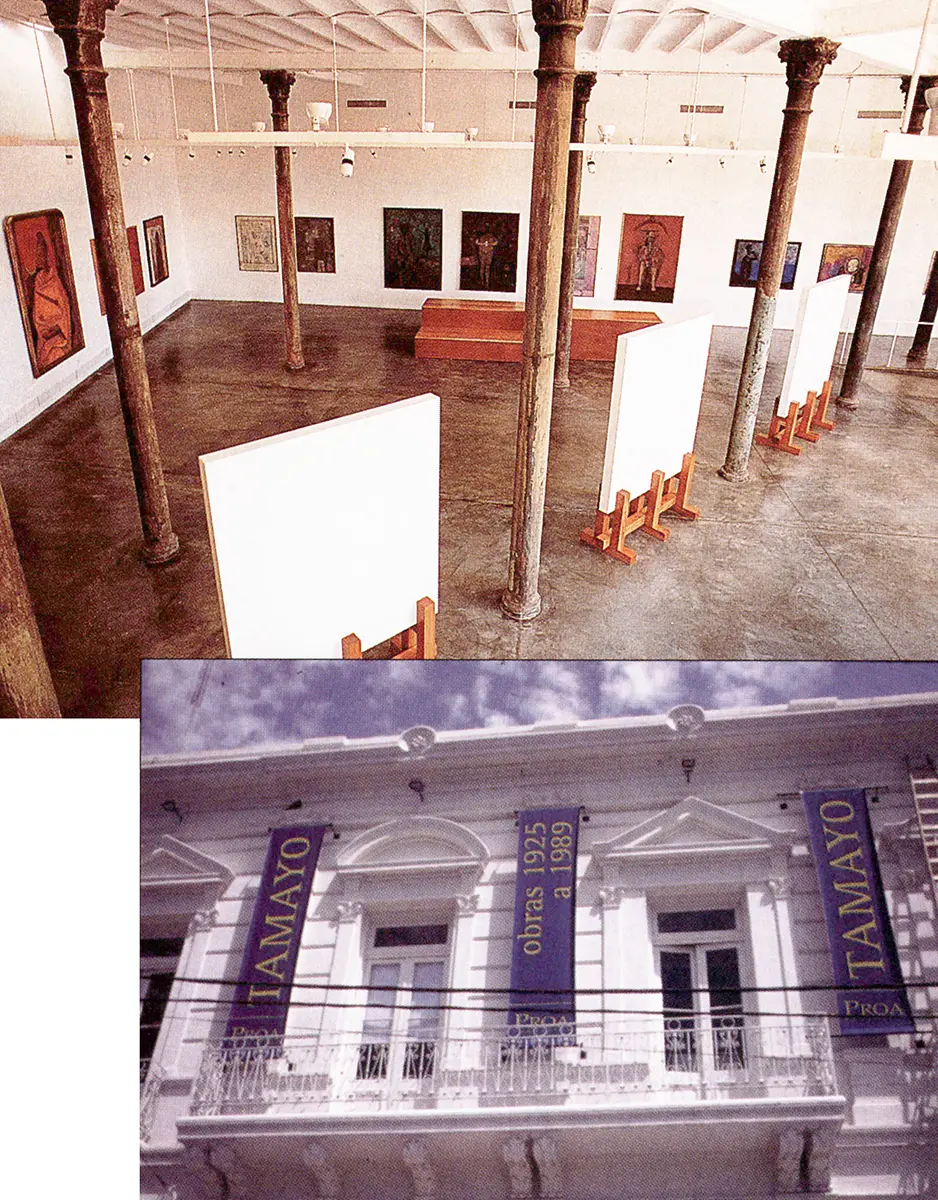
As with Rio’s Centro de Arte Hélio Oiticica, the officials in charge of the project chose an old building (dating from 1895) which they renovated and made into a center for the promotion of contemporary art. It is interesting to note that the architect, instead of ripping out the interior and retaining only the external facade, as is now often current practice, has managed to retain the quality of the earlier spaces, and in particular the restored patio. He did this by redefining them according to a plan which combines the need for communication with the architectural preservation of the place. In contrast to the Brazilian project, PROA is located away from the cultural activities of the city center. However, the wager seems to bode well, given the quality of the artistic project as there is a complete fusion between the architectural and museographical components. Furthermore —and this is of crucial importance in a place for contemporary artistic creation— the objective of dissemination is coupled with an ambitious pedagogical program (research with publications and archives, grants for training under the direction of Guillermo Kuitca for the first year, workshops, courses, seminars, databases, etc.). The students and creative artists are also involved since they have a readily available (as does the public) place for research that provides computer and video equipment as well as CD-Rom facilities, books, and journals.
Financed with private funds (the Argentinean enterprise Siderca belongs to the Rocca family), this space in Buenos Aires is one of the best-equipped sites for exhibiting contemporary art and is fully able to meet state of the art requirement in museography (humidification system, lighting, flooring, hanging systems). During the inauguration, the two floors were given over to an exhibition of work by Rufino Tamayo, remarkable for its selection of canvases and the balance between the various periods in the career of the Mexican artist. Admittedly, this first exhibition was intended above all to project a certain image of prestige at the cultural and political levels, leaving the creative adventure until later (the show was inaugurated by the President of Mexico). However, PROA officials have their ambitions set on contemporary creation. The objectives of the Foundation (described in its information brochure) are part of the Argentinean tradition of private patronage and are presented as those of an institution immersed in the most contemporary forms of communication networks with a view to facilitating and communicating information, a key factor in the development of our society.
What is surprising in these three places, which are very different from one another in their design and objectives, is that they may seem—with all allowances made—to be isolated political projects rather than promising signs of an overall cultural project. They may also be viewed as rather anachronistic achievements within a cultural landscape that is difficult to nurture in times of economic crisis—as elitist rather than clearly democratic enterprises. Have the questions concerning the kind of public and their motivations (quantitative and qualitative reception) been addressed in these projects with all the attention they deserve? Have the design and location (social and cultural environment) as well as the choices of conservation/exhibition criteria been given priority? In France, research on the subject of the art public and the reception of art is still a rare and recent phenomenon and focuses above all on the quantity rather than the quality of the reception. It shows however that access to places that show contemporary art—or simply, access to contemporary art—is still very marginal and confined to an elite, despite the multiplication, over the last fifteen years.
Many of these places are now threatened with closure by the Government throughout the country.
Despite the criticisms and omissions to which I have drawn attention, one can only welcome such initiatives in Brazil and Argentina. Latin American art is no longer stuck between the periphery and the center. Such criteria are now no longer valid to the art of this continent. Latin American art exists, with its differences and its characteristics linked to the history of its artists and places, and it has taken flight with its own wings. This coming of age of the art of the different Latin Americas within the framework of international art is also one of the major shifts these new structures highlight. One can also assume that young people, who make up so much of current Latin American society and are tomorrow’s potential public, will generate new ways of looking based on the openness of criteria and a rejection of restrictive cultural and artistic prejudices. Account must also be taken of the flexibility of this society, and its willingness to adapt to modernity. The old continent, a little too bent on its own cultural and historic heritage, immobile and inward-looking towards its old values, is having difficulty accepting a change in the way it looks at the art of Latin America thus delaying the process of its acceptance of an inevitable and necessary transition.
CHRISTINE FRÉROT
Historian, art critic, curator, and member of the AICA. Researcher at the EHESS and encharged of courses at the University of Paris. Specialist in the Latin American Art.