
The set of works presented recently by Matilde Marín at the Centro Cultural Borges comprised a veritable installation that extended an invitation of aesthetic enjoyment and reflection to the spectator. The title of these works, The Promised Land, evoked a wide range of suggestions relating to the myths and beliefs of ancient cultures or utopic visions of the present, as well as a third variant which would include both, with man as the protagonist searching for the meaning of his existence. In short, a journey in time in which the human element, as an expression of man's existentialist awareness, is a permanent feature. The exhibition revealed other facets of Marin’s creative activity in combining conceptually different artistic languages and techniques so that these works need to be seen in the context of her extensive production.
It is worth recalling the artist's well-deserved reputation as a printmaker. She has developed a technique not only in its traditional or academic sense but by transgressing established conventions and proposing technical innovations, as well as through the use of unconventional foundations. The doors opened up by these innovations have led her towards a three-dimensional expression that combines other techniques. In the objects which she produces, space and volume acquire their own meaning in the instrumentation of her artistic language, which goes well beyond any merely formal game. She thus uses paper and different printing methods, metal, wood, marble, and ceramics.
The harmonious relationship between form and content reflects the maturity that Matilde Marín has achieved, a maturity reflected in the world of forms that covered the walls and floor of the exhibition space. The main surface of these works was paper, a medium with a fragile existence, and on which the action of the flame has left its mark, coupled in some cases with photo-printing, which establishes a counterpoint between the natural and the elaborate. This relationship also extends to another kind of counterpoint- between the rational and the subjective, a feature which emerges in all her work.
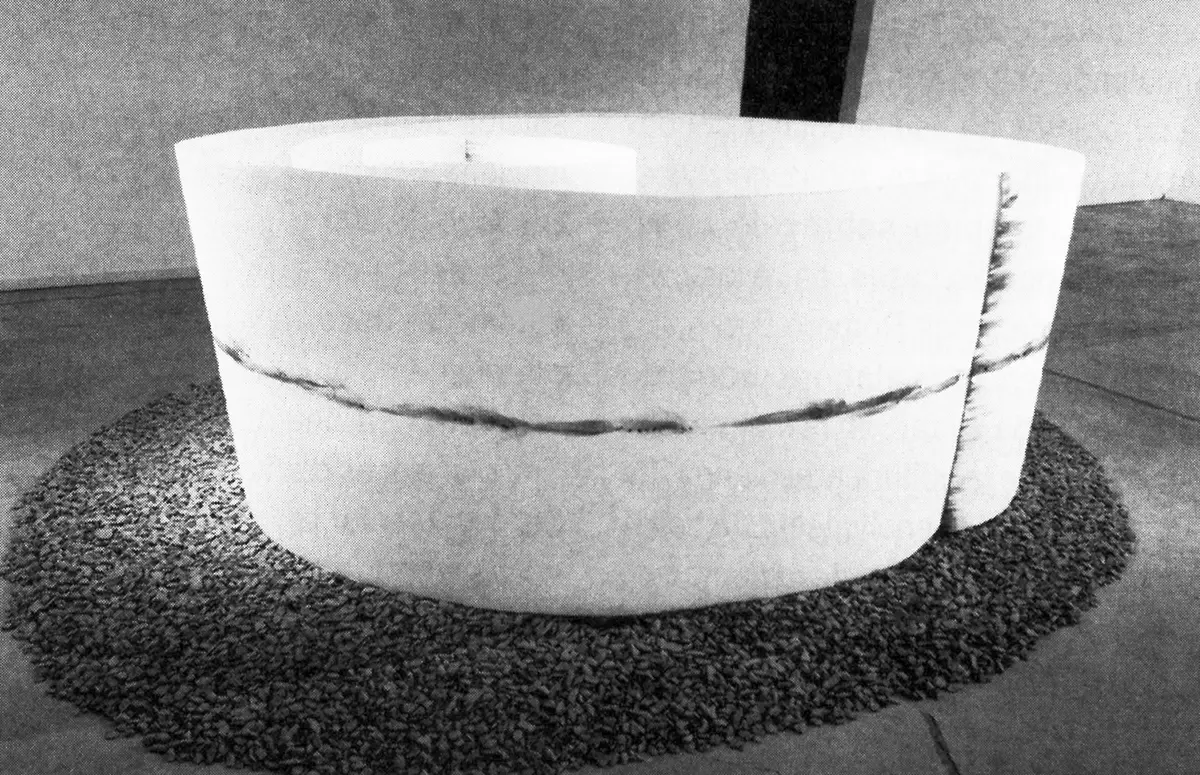
The group of rolls of burnt paper on the floor created a spatial presence that was related to the human scale, emphasized by the warmth of the materials. The traces of fire, as in Signs, suggest The Paths which lead us to The Promised Land. A protagonist is a man and the artist’s goal is an attempt to encourage us to embark on the path of reflection.
The works, which fit together like a checkerboard, emphasize the interplay between the print and the matrix, creating a permanent dialogue between what is given and done and in which the image becomes the protagonist of existence fully conscious of its own ambiguity and contradiction.
ALBERTO COLLAZO