
Red and black—the colors of Exu, the ambient colors of the darkrooms of black and white photography—define the atmosphere of Miguel Rio Branco’s images in NAKTA, the Brazilian photographer's one-person exhibition at D'Amelio Terras Gallery. Color, to make a linguistic analogy, is not simply an adjective in these photographs; it is not just an attribute of things. Red and black operate here also as powerful substantives, as things in themselves, as visual sensations—not just “red blood" but also “the red of blood.” There are certainly additional color hues in Miguel Rio Branco’s work, but they seem to vanish from memory as one recalls these images, submitted as they are to the play of red and black.
If the operation of giving autonomy to color might represent a reduction in the direction of abstraction, its effect by no means extends to the overall reception of the photographs. These images possess no evidence of aesthetic sublimation; no matter how dazzlingly and turbulent is their emphasis on color as color—red as red—no matter how much the gallery installation adds to the disorienting effects of the images, there remain always unavoidable clues to the world outside the frame. The way Rio Branco manages to make pure color co-exist paradoxically with referential color does not point up toward sublimation, but rather down to debasement. At the same time that the color red adds drama to red in its iconographic function (as blood, for instance), it also overwrites it by operating at a level below that of knowledge—the level of immediate sensual perception. Before being perceived as blood, red is red—but not just that either.
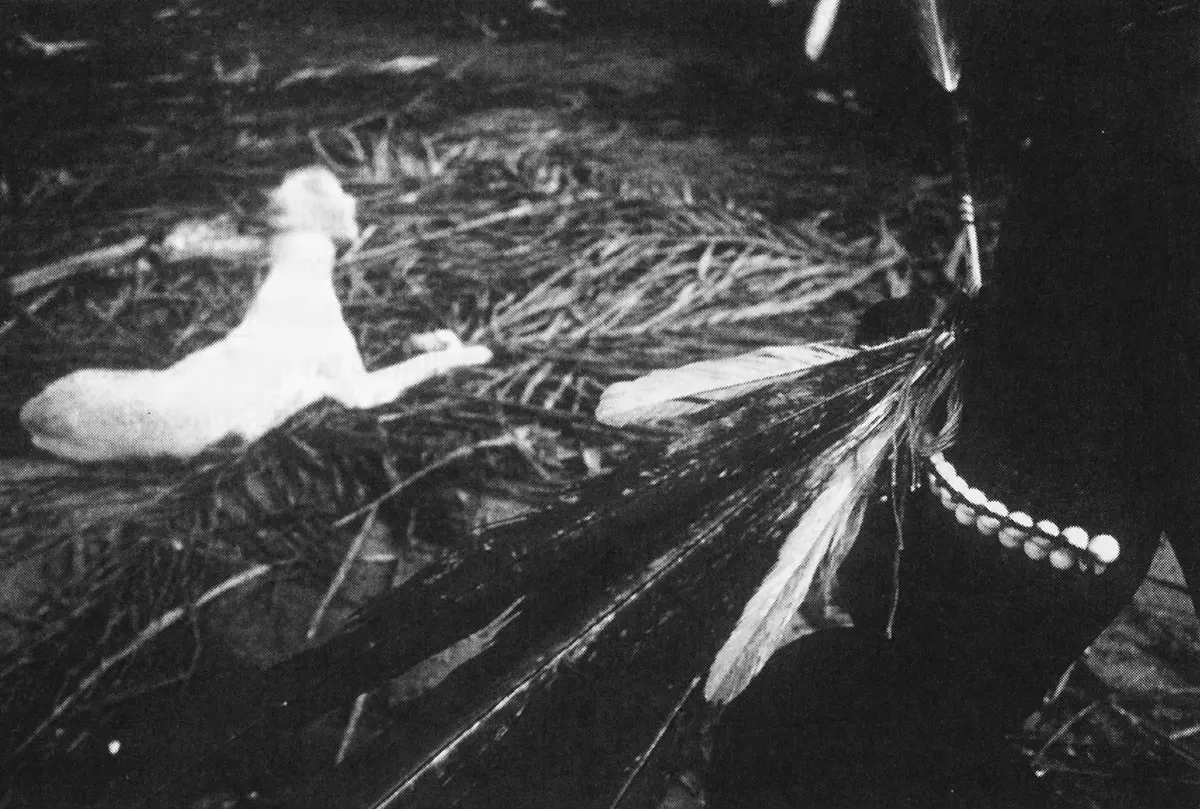
The disorientation resulting from this break in the hierarchy between cognition and perception is reiterated by other photographic strategies. Slow shutter speed blurs the limits between things and their environment. Unusual cropping severs and redefines units of meaning. Camera angles point almost invariably down to the ground, often focusing on fragments of legs, feet, and toes. But, most of all, following right behind color, the representation of texture comes as a decisive device for the production of meaning in these pictures. In Pelourinho (1979), for example, a photograph in which the rotten texture of a dying dog’s skin is made equivalent to the mineral texture of the sidewalk on which it lies, Rio Branco seems to illustrate Freud’s assertion that "the final goal of all organic striving (...) is to become inorganic again, that the aim of all life is death." Human flesh, meat, fur, dirt, rotten sheep heads, mirrors, grease, knife, blades, bread, glass, blood, plastic, and rocks, become all the same—entropically homogenized as photographic textures. The hierarchy between mineral, vegetable, and animal, between life and death, between attraction and repulsion, bear no predictable correspondence to values of glossiness or matte in Rio Branco's work.
Two extraordinary photographs are particularly worthy of mention. Both address the pervasive subject of the slaughterhouse. The first, Copacabana (1974), is more likely to be a picture of a run-down butcher's shop than that of a slaughterhouse. The image is divided in half: on the right, we see through a cracked glass into a refrigerator where a piece of raw red meat hangs from a metal hook. On the left, a heart-shaped mirror hangs among electric wires on a tiled wall. Within its shiny metal frame, the mirror reflects the image of the chunk of raw meat hanging in the refrigerator. Heart as the symbol of love is made to coincide with the de-sublimated idea of the heart as meat—the symbolic is destabilized, lowered, by its juxtaposition with the rawness of the real. The operation of debasement is here performed basically through the act of framing—an exception to the dominance of color.
The second image, Junco, 1992, is even more disruptive. It is overall immersed in red—not bright saturated red but a brownish red and a yellowish-pink red. The image is divided where these two larger surfaces meet, and we perceive a much smaller, also formless blot of flat, dense black. The texture then intervenes. The pinkish area shines as if wet or greasy. Through its highlights we start to discern the volume of a body that it seems to cloak, to protect underneath its now visible folds. The patterns of unpolished parquetry begin to emerge through the brownish-red surface revealing itself as the dirty, stained, wooden floor of a dimly lit room. The formless black spot slowly begins to connect to the cloaked body, transforming itself into the head of a dead cow—the scene of slaughter is completed. From then on, a series of dazzling disjunctions and reversals unfolds paradigmatically. The protecting cloak is the skin partially peeled off from the body of a cow, but not from the head to which it is still attached. The yellowish-pink hue is recognized now as the blending of fat, meat, and blood. We can fairly easily cope with meat hanging in a butcher's shop surrounded by the clean surfaces of stainless steel, glass, white tile, and the graphics of price tags. But meat, fat, skin, and blood on a dirty parquet floor become murder. We can even confront, with a certain amount of pleasure the outer skin of a cow—on the live animal, like a rug, as leather—but seeing inner and outer skin at the same time is rather disconcerting.
Formlessness, debasement, entropy, decay, and blood, are all terms that lead us inevitably to the surrealist renegade writer George Bataille. In 1929, as the editor of Documents, he even commissioned photographs of Parisian slaughterhouses from Éli Lotar. But it is not to Bataille that I want to turn in conclusion, but to Exu, the trickster. Exu is the entity in Candomblé (the Brazilian version of Yoruba religion) who takes offers in the form of sacrificed animals, blood, alcohol, cigars, etc., from people interested in establishing contact with the Orixas, the superior deities. Like the cow’s skin in Miguel Rio Branco’s photograph, separating and joining the body's interior and exterior, Exu stands at the crossroads, the liminal space between worldly and otherworldly realms in order to perform his tasks. As a transitional figure, he encompasses not only transmission but also noise. Exu means seduction. Exu is active ambiguity and indeterminacy. As for color in Rio Branco's works—both abstract and referential—Exu is not one or the other, but one and the other.
Exu and Bataille are in synch. If I focus on the former, it is in order to evoke its ‘‘protection’’ against the threat haunting Rio Branco’s work in his vulnerable position as a Brazilian photographer, namely, the risk of being pushed away from Bataille's radical critical project into the sterility of the exotic (which has such a currency in the art market).
Two questions remain—Is it really possible for a photographer in this “pluralist" moment at the end of the century to engage in seventy-year-old strategies and retain their critical edge? is it possible to be radical and exotic at one time?
In the evidence of NAKTA, I dare to answer yes.
Against the exotic, Miguel Rio Branco brings the structural exotic.
FERNANDO ACEVEDO