Despite the constant challenges experienced over more than 15 years and its relative geographical isolation, the Ruta Correa Gallery continues to present work by a selection of high-quality Latin American artists that is characterized by a healthy, dynamic, and non-conformist sense of individual eclecticism. The recent exhibition by the Chilean painter Vivian Scheihing, who has lived in Paris for the last 15 years (this was her solo show at the gallery) followed on from her solo show at the last Frankfurt fair in May 1997.
In this show of 25 large and small format canvases and works on paper from 1996 to 1997, Scheihing once again revealed her capacity for renewing her concept of space. A painter marked by the abstract expressionism from which she managed to distance herself thanks to her strong artistic personality, Vivian Scheihing handles the form/space relationship on the basis of a conceptual schema that reflects both the objectification of space and the spatialization of the object. For Scheihing, conceptualizing does not involve abandoning form but rather reinventing its permanence. Nor does it mean relinquishing the pictorial incentive, but rather it means making color into an expressive counterpoint to form. To conceptualize is to be unafraid of creating an identifiable and personal iconographic vocabulary that allows the artist to structure both the construction of space and the intellectual and plastic meaning of the work.
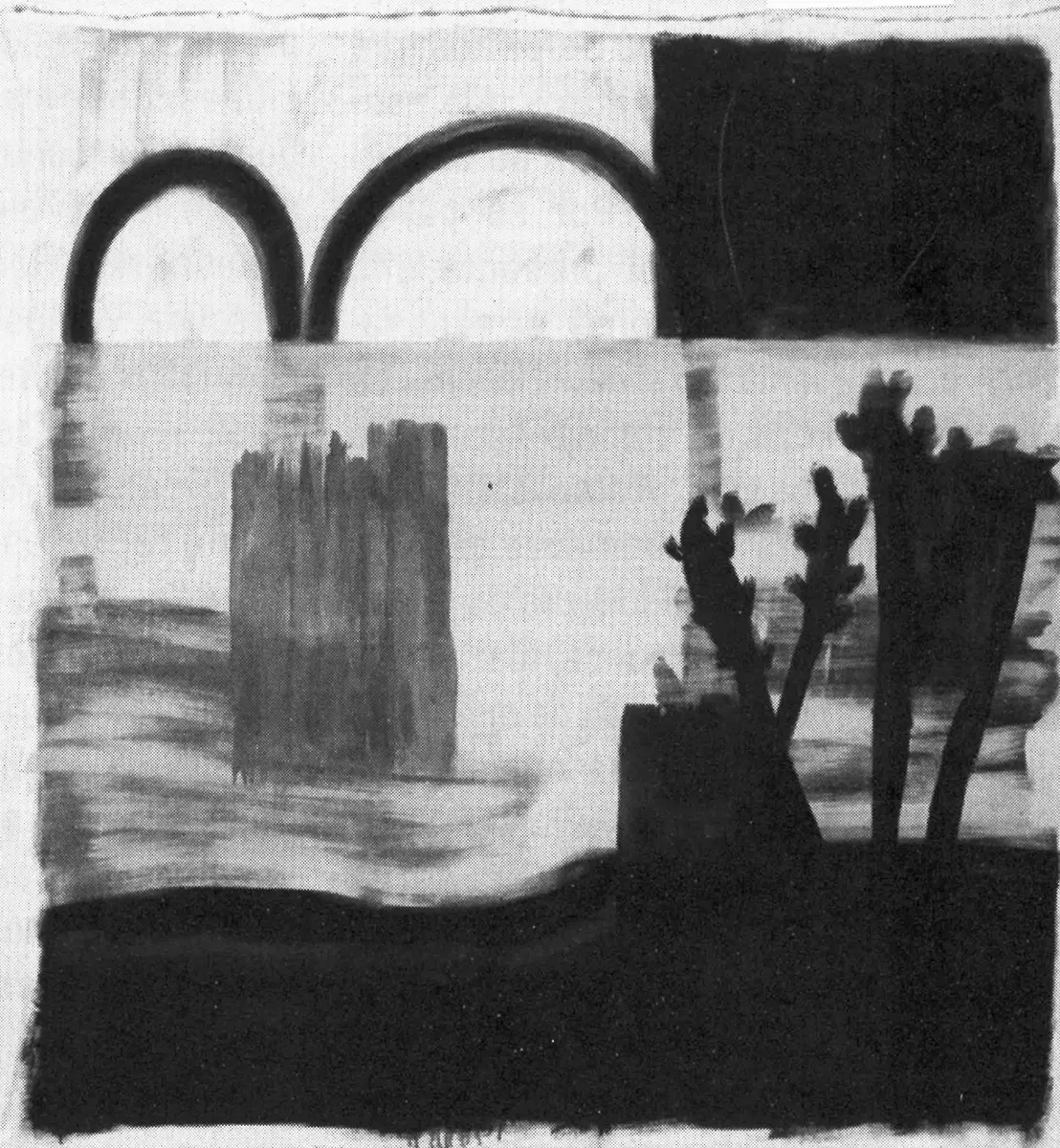
In general, her pictures are constructed vertically. However, she emphasizes the sense of rupture. Often a symbolic arch, lintel, or large door will break this vertically and open up successive surfaces (readings) that are the keys to entering the materialization of space-a materialization which is thus effected through a void. There is also a de-materialization in the metaphysical dimension where the essence of the work is at stake. Here, Vivian Scheihing communicates a painful and unutterable discourse: violence vs. tenderness, sorrow vs. happiness, life vs. death. The icons used a ladder, a tree, a mountain, and a plant-do not lead to a monothematic reading. On the contrary, an intellectual and emotional ambivalence is the counterpart to the artistic ambivalence- crosses vs. hearts, for example. Her canvases are always the setting of combat that ends up being that of good and evil. I do not mean that this is a moral kind of work, but rather it is one that expresses itself through the interplay of plastic elements and individual feeling—expressiveness, and strength accumulated through many years of withdrawal. Her “geometry” might belong to that which the Brazilian critic Roberto Pontual has rightly called “sensitive”, referring to the abstract and geometric artists of the Southern Cone, as compared to the “cold geometry” of the Europeans.
In these recent works, several of the small canvases propose a different division of space. The customary vertical schema is replaced by a horizontal distribution to create a new spatial organization in the form of a register. In this new proposal, the space continues to be the form and the form the space. The elaboration, both intellectual and sensitive, reflects a certain sense of peace, an appearance of serenity. The space of the canvas is nothing more than a battlefield. Its de-complexification reveals a calmly achieved process of maturity in the desire to construct and deconstruct—the backbone of her work, and the reading is once again both plastic as well as pictorial and conceptual. Several of the small canvases are almost monochromatic given their range of reddish hues that challenge the retina: the oranges, reds, and fuchsias create an explosive combination that alternates with the images of the large canvases with their rhythms made up of symbol-signs—like pictograms full of sensations and ideas.
The work is in a certain sense "calligraphic" if the term is understood as a way of conjuring up the human dimension elliptically without ever (or almost never) citing it or giving it a human form. Vivian Scheihing’s work, in its constant process of interrogation—the investigation of the language of the work—has been able to transcend the vicissitudes stemming from the (virtual) disappearance of painting over the last 15 years. Her ability to continue working on painting itself, on codes of expression and seductive surfaces has enabled her work to remain living and dynamic, a source of renewal within its own permanence.
CHRISTINE FRÉROT