
In this her first exhibition in Madrid, Adriana Verajão revealed the extraordinary complexity of her pictorial proposal, the recent developments of which include more disturbing and renovative elements that take her work closer to an objectual dimension, as well as an installation based on pictorial resources that require a sense of experience from the spectator.
Adriana Verajão’s painting offers an acute and accurate interpretation of the essential problems of culture, life, and art in her country, Brazil, using history as fiction and at the same time as material or tools.
At the same time, the use of painting allows her to engage in a radical and profound analysis of the role played by painting in contemporary art, revealing the aporias, contradictions between surface and depth, which in a sense are analogous to those which exist between the outside and inside, skin and flesh, of the body. Through her fables and poetry, she transforms painting into a body.
From painting, and above all painting based on figuration enriched with the heritage of tradition, she takes up —with courage and topicality— the legacy of the long and rich tradition of Brazilian modernity, constantly in touch with its cultural and popular roots. From her personal experience of painting, there seems to be something more than just suggestive contents, fortunate metaphors, or impressive formal resolutions: in a sense, she has managed to transfer to the pictorial field and express through pure and hard painting the poetic, analytical, conceptual and above all terribly vital spirit of the projects and aesthetic adventures of artists like Lygia Clark or Hélio Oiticica. With account being taken of all the differences which obviously separate them in terms of historical reference and formal intention, Adriana Verajão shares with them the sure manner in which she forges her own language (in this case painting), to that the works themselves speak to society of the most elemental things.
In the present situation of rampant academicism, formalism, and aestheticism, with their inevitable tendency towards decorative elements and the permanent search for viable and suitable formulas for a not very problematic consensus, the idea of introducing into the very heart of painting a sense of disquiet and perturbation, of raising the most unanswerable questions about the nature and meaning of painting and above all the contradictions of the history of culture, is naturally not a very easy, or certainly a very common pursuit.
Adriana Verajão’s artistic search has been constructed and progressively made more complex through the integration of thematic contents: anthropology, cultural identity, torn apart traditions, and formal problems, to which she has tried to give formal solutions.
The painting thus becomes a territory of metaphors that constantly refer to the body, the body of painting, its entrails and innermost parts, and our bodies with which we confront the painting itself.
Painting is not simply a language, but becomes an idea, a concept for reflection; yet it is also a condition of experiences that go well beyond the visual. In this respect, Lozangos (1997), the most impressive and soul-stirring piece of the show, and which is related to such earlier works as Língua (1995), raises the question of the corporal nature of the body. The carnal nature of the painting becomes our own what the painting, a surface skin of colored tiles, is ripped open to reveal the dense and obstinate flesh of the reddish oil on which this decorative and colonial panel is set. Heads and tails, the splendor and misery of history, of the Conquest and art.
Out of this bloody, oily flesh emerge the internal ruptures that lie behind the finished work.
Anthropophagy, as a theme, is treated as an excuse or point of departure which facilitates her (eminently symbolic) reflection on the history of Brazil.
Thus this path opens up clear and fascinating visual insights into the formation of the Brazilian character, which essayists of the standing of Buarque de Holanda or Darcy Ribeiro have seen as a combination of humor, magic, and delirium. Verajão imagines and constructs in her canvases the magnificent hyperbole of grandiose pieces of tilework in which the blue on white, in the best and most refined Portuguese tradition, depict scenes that retell the drama of the Conquest of the New World.
These are narratives that invert the official history, but not in order to make claims or attempt to re-establish the tale of our neighbor. Neither is there a search for lost identities (the identity which asserts itself is that of contradiction, that of total cross-breeding), but rather a plunging deeper into the reality in which we live. The historical inversion is used to introduce an almost narrative fiction like those of Borges, in which the possibilities which never happened are the best explanation of the present in all its contradictions: the language of the Portuguese conqueror (the tile) tells of the triumph of the Amerindian autochthonous tradition which through ritual anthropophagy explains the intensely devouring and digestive fusion of cultures which make up a specifically Brazilian culture. In Figura de convite (1997), the image of ornamented white and blue tiles shows a splendidly baroque female nude with tattooed skin and floral motifs, like some allegorical or mythological figure facing an exquisitely ornamented balustrade, with in the background a crowd of naked men, women, and children, like in the Garden of Eden, plunged in a cannibalistic orgiastic frenzy.
But there is in these works no essentialist or nationalist kind of vision and the metaphor of anthropophagy is a means of rethinking the contemporary world from the standpoint of Brazil, from the angle of its own complex history and contradictions.
Anthropophagy also provides another link with the Brazilian avant-garde movement of the 1920s, connecting back with the spirit of Oswald de Andrade’s Anthropophagical Manifesto.
The reflections make use of the codes of sensuality, corporeality, and carnality translated into a visual language, but with account always being taken of the importance of touch for the gaze.
Between touch and vision lies the place which her painting develops with the fullness of its power.
In her pictures, the painting perfectly fulfills the role of deceiving touch through vision. But this is no trompe l’oeil which deceives through depth and perspective, making the eye believe that what is painted in two dimensions is a three-dimensional object, but rather a simulation for the glance of surfaces which like the skin of a body length to be touched, caressed or which simply invite us to run our hands over them.
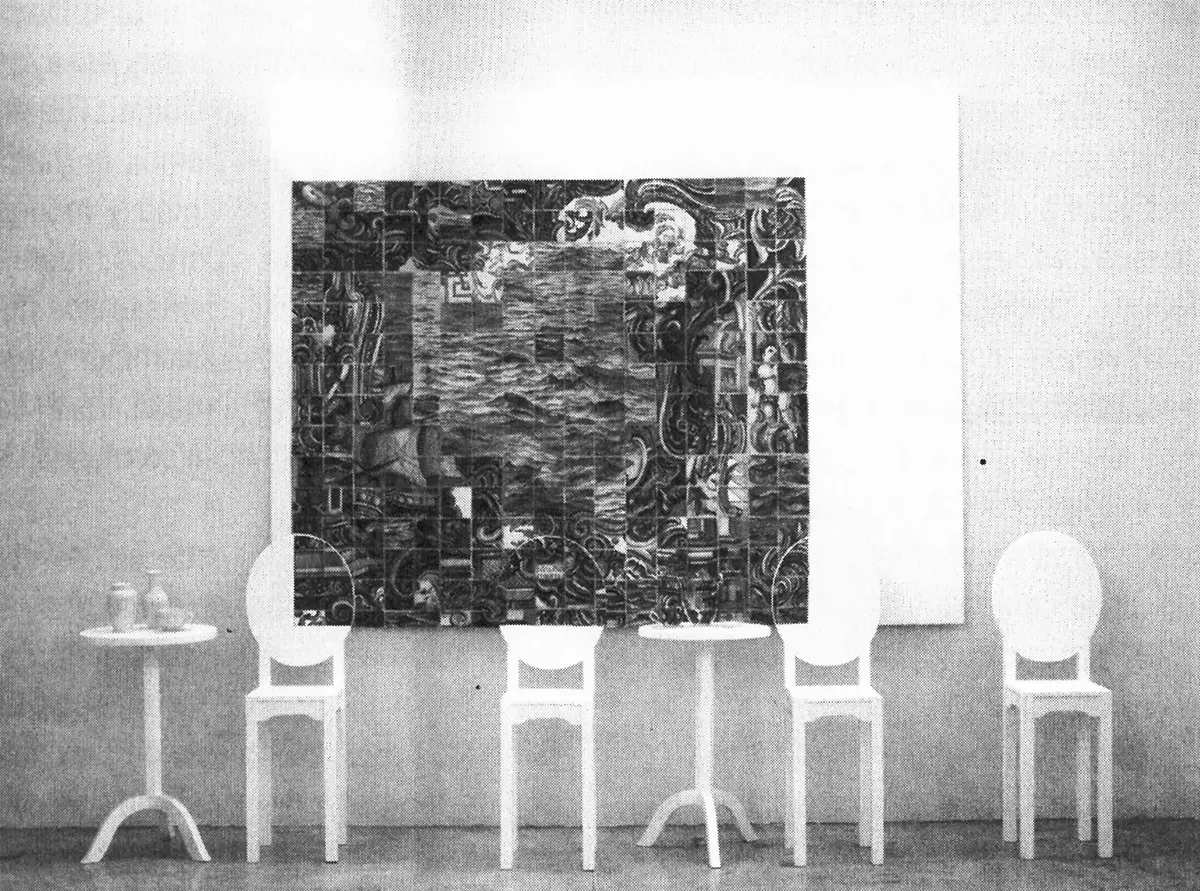
The scenes constructed in her feigned tiles make up a pictorial fiction, imaginative, dense, and suggestive like a novel: smooth surfaces that the eye makes brilliant because it is accustomed to seeing in the patios and churches these tiles glistening in the sun...Surface and objectuality combine in Tea and Tiles II (1997), which functions as an installation of painting, furniture, and objects, while the painted scene of the tiles fixes the baroque disorder of an incoherent, ruinous, or patched up mosaic.
In other works, such as Irezumi con padráo de ceramics, it is the tattoed skin and that of the creature whose body has been snatched away which can be seen hanging on a surface painted with white tiles. The skin is exhibited like a bloody trophy, and we do not know if it is ritual, love, or the fury of war that explains why this skin without a body should in its turn be transformed back into a body.
SANTIAGO OLMO