The Museum of Art of Fort Lauderdale presents Breaking Barriers, a historical exhibition that shows for the first time its permanent collection of contemporary Cuban art. The curator, Jorge H. Santis, organized a collection that represents the broad spectrum of the Cuban visual arts of the most recent decades.
The criteria selection was simple. The exhibition included artists somehow related to the island. Although most artists were born in Cuba and live in exile, some were born in other countries of parents of Cuban descent. As with any general exhibition of this kind, there are some artists missing, whether by omission or by personal decision (some artists did not want to participate). The decision not to include artists living on the island also created a big gap from a historical point of view. Nevertheless, Breaking Barriers puts together the most representative artists of contemporary Cuban art and presents one of the most important collections at the museum level.
The complexity of the historical context in which contemporary Cuban art develops made it difficult to organize the show in a chronological or a stylistic manner. Santis suggested a thematic presentation in the catalog’s essay, but the exhibition, which occupies the whole museum, appears more like a series of galleries in which the works are presented without necessarily sharing any particular characteristics. With the exception of very few galleries where there is a thematic, a technical, or a generation link among the works, the exhibition tends to show Cuban art as a group of multiple individual projects.
The most outstanding work is, without a doubt, the installation by José Bedia, A Violin for the Guardian Angel (1996). The angel's figure is drawn on a white wall and shows marks on his shoulder and on the left side of his chest. A black silhouette, also marked, is decorated with an airplane and a violin on its left shoulder. The violin, which is the focal point of the installation, refers to the musical offer made to the spirit. The work includes a series of metal arches supported by bricks full of wood sticks, and a plaster Indian placed on a plate as an offer to the guardian angel.
The works of María Magdalena Campos-Pons, María Brito, Mario Petrinera, Ernesto Pujol, and Juan Sí stand out among other installations. Campos-Pons’ Footprints of a Journey (1992), is made out of three boxes of Plexiglas filled with African beads, a ceramic vessel, sand, and a glass ball painted with blood. The walls of the boxes are written with texts about her roots, her identity, and her living experience. Brito’s piece, Come Play With Us (1985), is also autobiographical, and most likely one of her best works. A series of eyes posted on a wall, look at the viewer who shares the space with a sort of crib/jail, that contains a mirror with a self-portrait of the artist. The piece suggests Brito’s preoccupation with issues such as vigilance and control and presents many symbols of her personal iconography.
Petrinera's Some Times the Pieces Don’t Fit (1988), is a small suitcase with drawers filled with photographs related to the theme of paternity, inspired by his own experience as father and son. Pujol's installation, Suitcases (1994), refers to the journey and the exile. Three blue suitcases with painted images of underwear, coffee cups, and bassinets symbolize his experience as an immigrant and suggest the idea of the fragmentation of the cultural heritage of the Cuban exile. Juan Sí's installation Rosa Nautica (1994) refers also to exile, more specifically to the rafter. It pays homage to his physical and psychological effort. (The first one is represented by a set of arms and legs forming a cross and the second one by the cold metallic feeling of the piece).
Several generations of sculptors were included in the exhibition. The masters are represented by Agustín Cárdenas’ beautiful horizontal bronze Au revoir la nuit (1993) and by Tomás Oliva’s steel sculpture, Untitled (1992). The next generation is represented by Álvaro García’s Consequence (1993), Tony Labat’s David and Goliath IV (1990), and Zilia Sánchez's Untitled (1985).
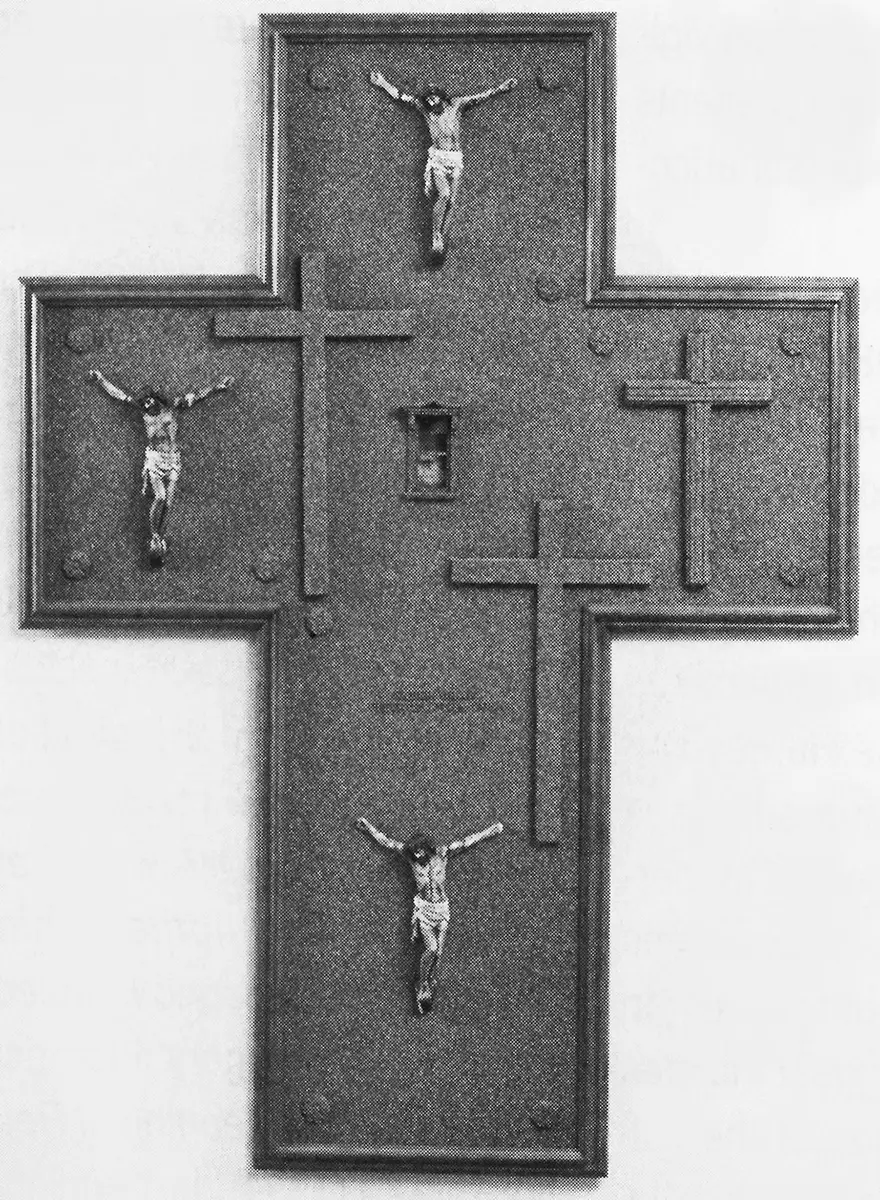
Breaking Barriers also included works by artists of the eighties generation. Ruben Torres Llorca presents To Know How to Pray, to Believe is Another Thing (1993), a cross-shaped wall piece with religious imagery. Florencio Gelabert’s The Meaning of Relationship #1(1994), is a work that combines the aesthetic with the utilitarian, and Ricardo Rodríguez-Brey's Untitled (1996) is a black rubber piece that combines the cold aspect of its materials with the sensuality of its shapes. Another work that stood out is Connie Lloverás' Of Wounds and Armor (1994), a T-shaped work in ceramic with nails and bleeding wounds symbolizing human pain.
Painting occupies, without a doubt, a primordial place in the exhibition. Among the masters the following stand out: Guido Llinás, Black Painting (1992), Hugo Consuegra, Multiculturalism In Midtown Babel (1995), Antonia Eiriz, Between the Lines (1993), Agustín Fernández, Object (1972), Rafael Soriano, Captive Fantasy (1989), and Gladys Triana, The Hidden Link (1995). The presence of works by Llinás, Consuegra, and Eiriz, locates the chronological beginning of the exhibition in the 1950s, when these artists, together with the rest of the members of the group Los Once, developed the first Abstract movement in Cuba. It is also important to point out Eiriz's work in the context of the exhibition. Her painting depicts multiple skulls watching a scared figure. Its expressionistic qualities remind us of her earlier paintings which inspired many artists of later generations.
Among the more traditional artists we can mention Emilio Sánchez, Long Shadow at Sunrise-Courtyard (1992), and Humberto Calzada, Planning the Eclipse (1990), both represented here with architectural works. Figurative painting is represented by Miguel Padura, Recurring Dream (1997), Ramon Carulla’s The Delicate Look of Madness (1992-1993), and Arturo Rodriguez’s Untitled (1990). We can also mention the works by Lydia Rubio, Trie Encounter) 1992), Mario Bencomo, Paradiso Lontano (1986), Rogelio López Marín (Gory), When the Angel Falls (1996), and Eleomar Puente's The Escape (1994). A very important piece by Carlos Alfonso, Untitled (1990), a painting on a wooden folding screen, is located at the entrance of the museum as a symbol of the exhibition. The back of the screen features a grey and blue painting by Baruj Salinas, Untitled (1990).
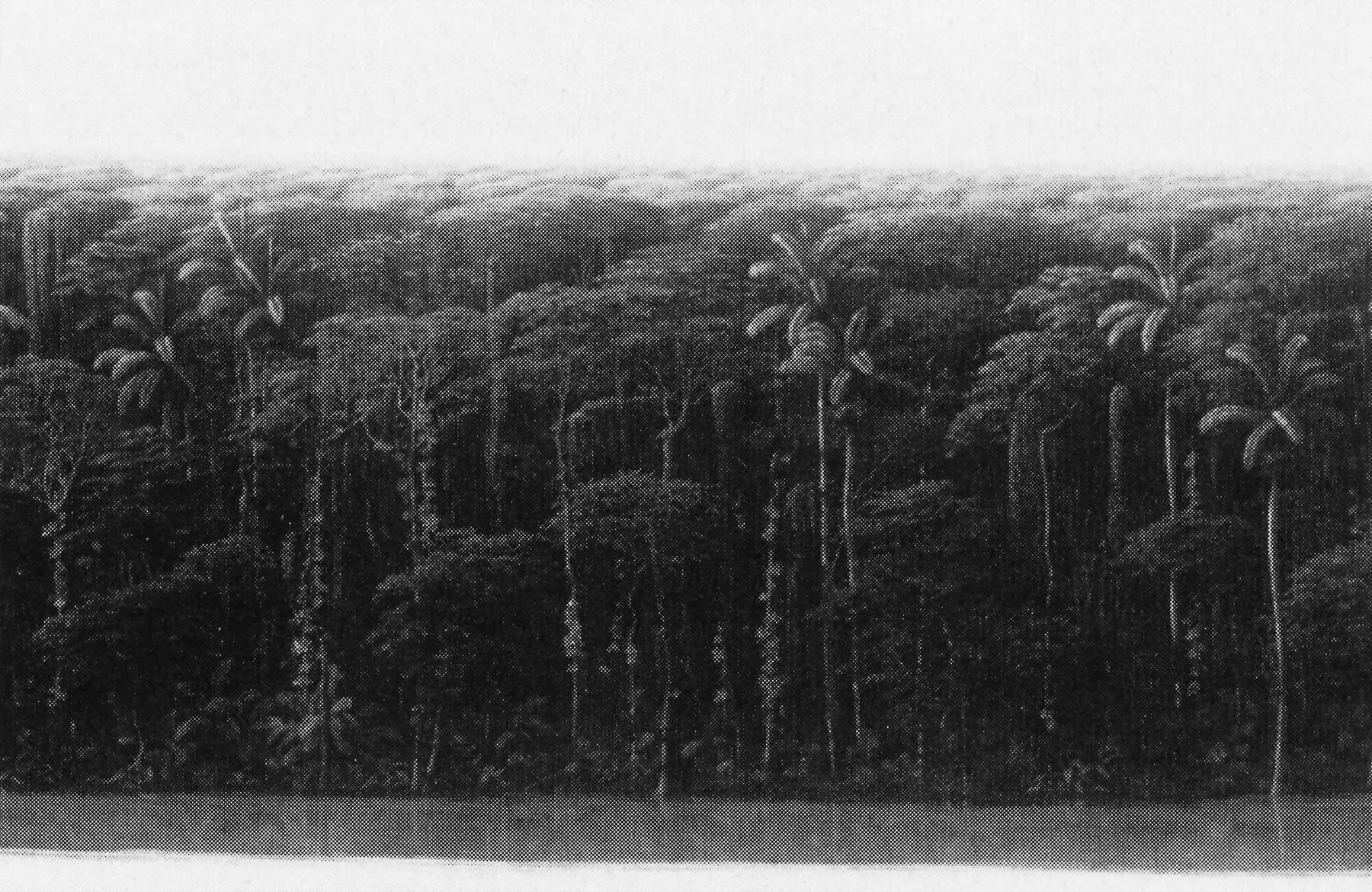
Landscape is represented by Tomas Sanchez’s Riverbank (1995), a work that is almost minimal and depicts two white stripes which frame a color one, representing the river and the jungle. His ecological message contrasts with the strength of the works by artists who deal with social and political issues. Luis Cruz Azaceta’s Dead Rafter II (1994), suggests the issue of the Cuban rafter, with the artist’s self-portrait on a raft hanging in the air.
Carlos Cárdenas also refers to the rafters in Untitled (1992), a big blue triptych in which two boats are depicted, one with a skeleton and another with three men protected by the Virgin of the Caridad del Cobre. Among the works of the artists of the eighties, generation is Ana Albertina Delgado's The Apple (1989), Adriano Buergo’s The Wait in the Bedroom (1991), Tomás Esson’s In the Attic (1992), and Julio Antonio’s The Represor (1993). All of these artists are engaged in denouncing political and/or social realities. Juan Abreu can also be included in this group although the work included in the exhibition Objects of Desire (1993), precedes his stronger works.
The youngest generation is represented by Williams Carmona’s Untitled (1993), Gustavo Acosta's Watching Death and Killing (1994), and Gustavo Ojeda’s Untitled (Subway Station) (1984-85), and a work by Heriberto Mora, New Down (1993). The bones and the obscure tonality of Mora’s work make it seem a continuation of Eiriz painting). Some impressive drawings by Jorge Pantoja, Continuity of the fragments (1995), and works by Ciro Quintana, The Marvels of Cuban Art (n.d). Glexis Novoa’s You Left (1994-95), a drawing on canvas that depicts two groups of buildings and writings, is probably one of his best works are also included. Another important work is Cesar Trasovares’ Sera bos arte, a mixed-media wooden piece that is an example of his most recent work.
Breaking Barriers presents an important photography collection, which includes Ana Mendieta’s Silhoutte series (1980s) and a famous piece by Arturo Cuenca, Science and Ideology (Che)(1988-93). The exhibition also includes photographs by Mario Algaze, Eduardo Aparicio, José Azel, Juan Pablo Ballester, Consuelo Castaneda and Quisqueya Henríquez, Eduardo del Valle and Mirta Gómez, Gory, Silvia Lizama, Tomás López, Luis Mallo, Maria Martinez Canas, Luis Medina, Tony Mendoza, Eduardo Morell, Eduardo Munoz Ordoqui and Andrés Serrano. The collection also includes videos by Raúl Ferrera-Balanquet, Ebbo for Elegua (1992), Coco Fusco and Paula Heredia, The Couple in the Cage: A Guatinaui Odyssey (1993), Ela Troyano, Carmelita Tropicana (1993), and Ricardo Zulueta's Untitled (1995).
A full-color catalog with an essay by Carol Damian accompanies the exhibition, which will be traveling to the Tampa Art Museum, Florida, the SNITE Museum of Notre Dame University, Indiana, and the Latin American Art Museum of Long Beach, California.
FRANCINE BIRBRAGHER