
The Argentinean artist Fernando Canovas (b. 1960) left his country at the age of 20 to settle in Paris. His artistic career has thus been pursued almost entirely in Europe—although it has extended to New York over the last two years—and he has presented his work individually only four times in galleries in Buenos Aires so his work is unknown to many people in his native city. The exhibition at the Museo Nacional de Bellas Artes last December, featuring works from the period 1984-1997, served then as a kind of —official presentation— of the artist, especially since the exhibition was sponsored by the General Council of Museum Consortia of the Valencian Community and was accompanied by an excellent 200-page catalog.
Apart from the changes which occurred during the 13 years covered by the exhibition, Cánovas' painting appears firm in particular aspects. First of all, it is constant in its attempt to depict the vulnerability of things through the passage of time. The artist's way of drawing close to objects, a tendency so well utilized in the 1980s by Kiefer and his followers, to refer to history through the use of surfaces that are worn, bituminous, oxidized, or decaying, are seen in what might be described as the central feature of his work—his "style" in accordance with Barthes' definition of the latter as a “blind” and “secret force” which the artist cannot forsake. In this sense, it is interesting to note how in some abstract works derived from the minimalist current, such as Quatre Étages or L'Étagère (both from I990), the most marked imprint by the artist is to be found in the greyish patina that envelops the works, giving them a clearly narrative component, a formal characteristic that the artist rejected initially.
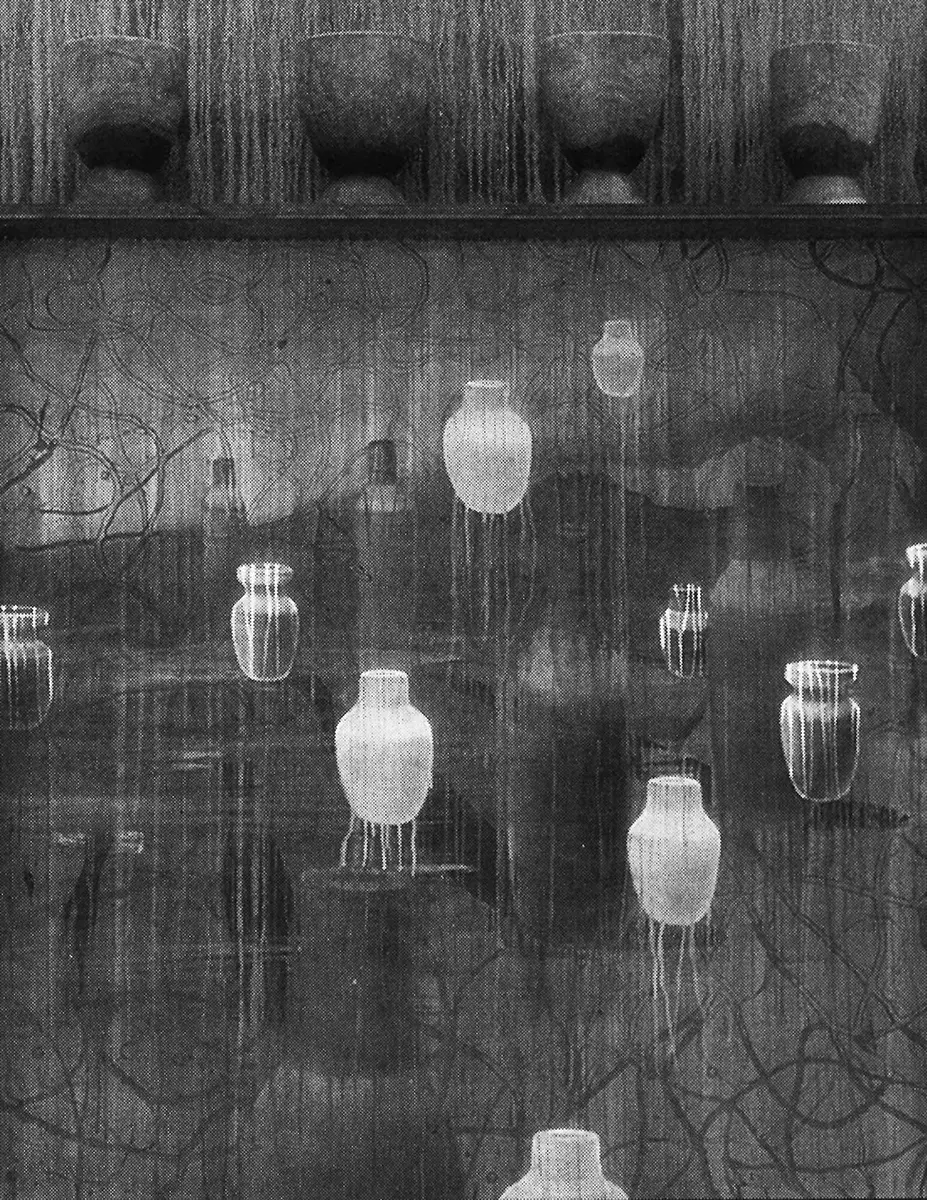
Everything in Cánovas has been eroded by the intense passage of time. His figures— whether a series of beams or geometrical structures or the image of receptacles or bottles suspended in space without gravity—are imbued with the drastic evidence of their decrepitude. There is also a permanent struggle between flatness and volume, a tension that is almost programmatic in his production. His obsessive interest to go beyond two dimensions operates at two distinct levels: on the one hand, from his early pictures of 1984 that depict cell-like constructions to his recent works that juxtapose geometric structures and figures of receptacles, perspective is fundamental. Space is always a kind of flight towards a distant horizon. The artist places the spectator's gaze above things, which unfold and float in a kind of empty and apocalyptic space. On the other hand, this desire by the artist to suggest an illusion of depth is repeated and enhanced by the operations undertaken outside the picture. These consist of a series of dialogic games (which sometimes include installations) between the painted image and something outside it: stretchers resting on stretchers, pieces of wood leaning against the canvas, shelves resting on the canvas, frames and metal extensions— all of which extend the picture into space. However, as noted above, Canova's "style" is to be found in the painting. In his interventions outside the canvas, the artist is less subtle and with a few exceptions, the associative interplay established between the strictly pictorial element and its physical derivations is limited to a simple volumetric translation of his repertoire of figures.
The most noteworthy works in the exhibition were those in which the artist limited his spatial aspirations to perspective and concentrated on painting. In the period up to approximately 1993, Cánovas produced a series of pictures, including his blue series and some exceptionally colored works, in which stains gained ground over his constructivist and conceptual intentions. In these works, the figure of the receptacle—which had appeared in 1991, after having been suggested with circles and indentations in his pictures from the 1980s— monopolizes the image as an emblem of multiple meanings: it is a symbol of domesticity, decoration, funerary rites. It is in some of these works—in which the repetition and superimposing of the figure of the vessel reach their peak and where the linework, color, and stains become more pronounced, to the point of transforming the image —that Cánovas seems to take flight and become more suggestive.
INES KATZENSTEIN