German Londoño's work reflects the best achievements of the so-called transvanguardia over the academy of modern art: humor, the use of caricature, the immediate reaction of gesture vis-a-vis the irrationalities of establishment rules, the recuperation of narrative elements that painting enjoyed in the Gothic and pre-Raphaelite periods. The telling of anecdotes that reveal the presence of another metaphysics- that of triviality and the silence of everyday hazards. Where have we seen these women who are bored, these men who bury their heads like ostriches, these strange rivers, these salons? The analogy is a method that allows these scenarios to emerge and which the unconscious recognizes as its own since Londoño knows well and develops with sensitivity the mnemonic possibilities of the imagination. Nineteenth-century prints were able to develop these possibilities of the image through the heightening of different kinds of sentiment-which is what Londoño finally achieves: solitude, tedium, metaphysical helplessness, and laughter.
Perhaps this is the true metaphysics: where else but here can find the absurd, and beyond the latter, the farce of everyday life? But this sense of the absurd is not that of Kafka, which is the result of the strangeness of the world and a much-named reality, but something which comes from the falta morgana of days of dejection, from the bitter paradoxes of looking for ways out without finding them, of the bitterness which comes from the realization that reality itself provides the evidence within which there is no room for the perplexity of existential helplessness.
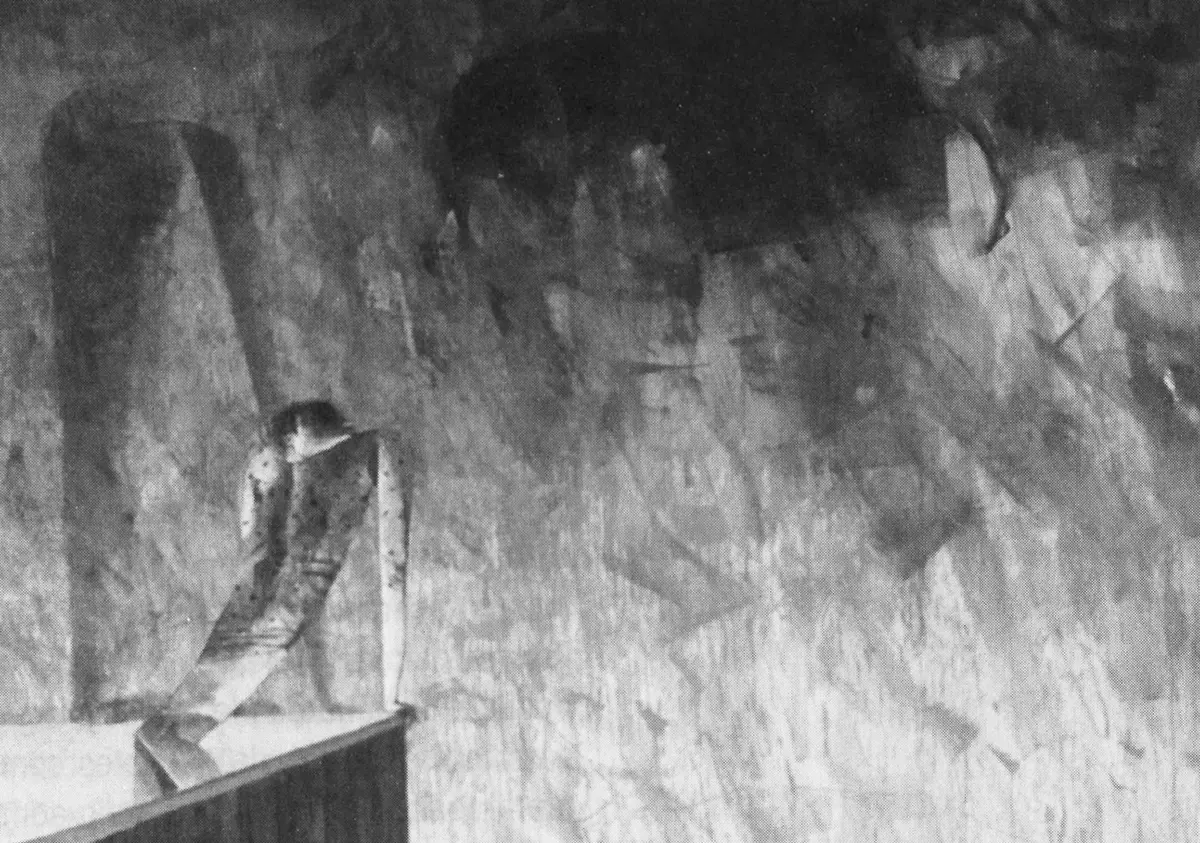
Beckett’s homunculus is still a bellowing human being, a nervous tic that reveals the condemnation of a body heading for insignificance, but has not managed to escape the condition of having a fixed origin. In Londoño's figures, lucidity has shed a painful light on life. The protagonists Lam, Obregón, and Bedia live in the magma of the telluric. They have not even reacted to the nonsense of history, the nonsense of the so-called history of art when, as today, the latter seems about to fall into the final abyss of insignificance. In Londoño, on the other hand, the protagonists are involved in living history, i.e., those major events that the powers program in the abstract and which human beings suffer in practice.
Like Francis Bacon, Londoño extends the possibilities of painting to the point of virtuosismo—that is, by working against the expressionism that rips the brushstroke and the figure, the transvanguardia which unpaints. Here the brushstroke and impasto are of a classical kind, giving power to the contrasts and rendering the history of a figure and a setting even more caustic.
In this way, the sculpture-as in Baselitz emerges as the logical consequence of a dialectical process, rather than as something added on. The sculptural element, already proposed in the canvas, acquires body and expands something which Londoño handles with consummate mastery: the mise en scène. His characters are always irremediably linked to the spaces, colors, and decors in which these secret horrors unfold, spaces taken from art and which return to art itself. Can we imagine a universe more closed?
In a short period of time, and from his first exhibition, Londoño has gone beyond all the premises of the transvanguardia, openly establishing his own style and shunning pre-determined formulas, to create his own universe. In this exhibition at the Museo de Antioquia, that universe emerged as the triumph of a young and talented artist who has been able to propose a number of artistic premises and use them to carefully craft his own language.
It is language as an aesthetic proposal, challenging the déjà vu, the conformity of the new "avant-garde" movements, startling us with the metaphors of an absurd reality in which untold physical violence and, the irrationality of unnamed powers have abolished the art scene, the steps from the historical sites and the meaning of encounter-leaving only these images, which we are unable to place, and our ignorance of how these images in turn place ourselves.
DARÍO RUIZ GÓMEZ