
There is a lot to be said for returning to and revisiting things we have done in the past and which have remained quiet in some corners. A clear example of this is the work of the Colombian painter Gustavo Zalamea, some of which were on display in the Diners Gallery during February and March. Zalamea is known both in Colombia and outside the country for the richness of its plastic production.
I return to my point of departure because I believe that it is precisely here that Zalamea's painting achieves its maximum effect and richness. Zalamea scrutinizes very carefully his earlier work, those things he has already created. He makes use of them over and over again, studying the different aspects which have made up his pictures. But the same things always communicate something different, just as in the cinema or in literature, a film or a book will always take on different connotations each time we return to them. The effect depends on our state of mind, among other things.
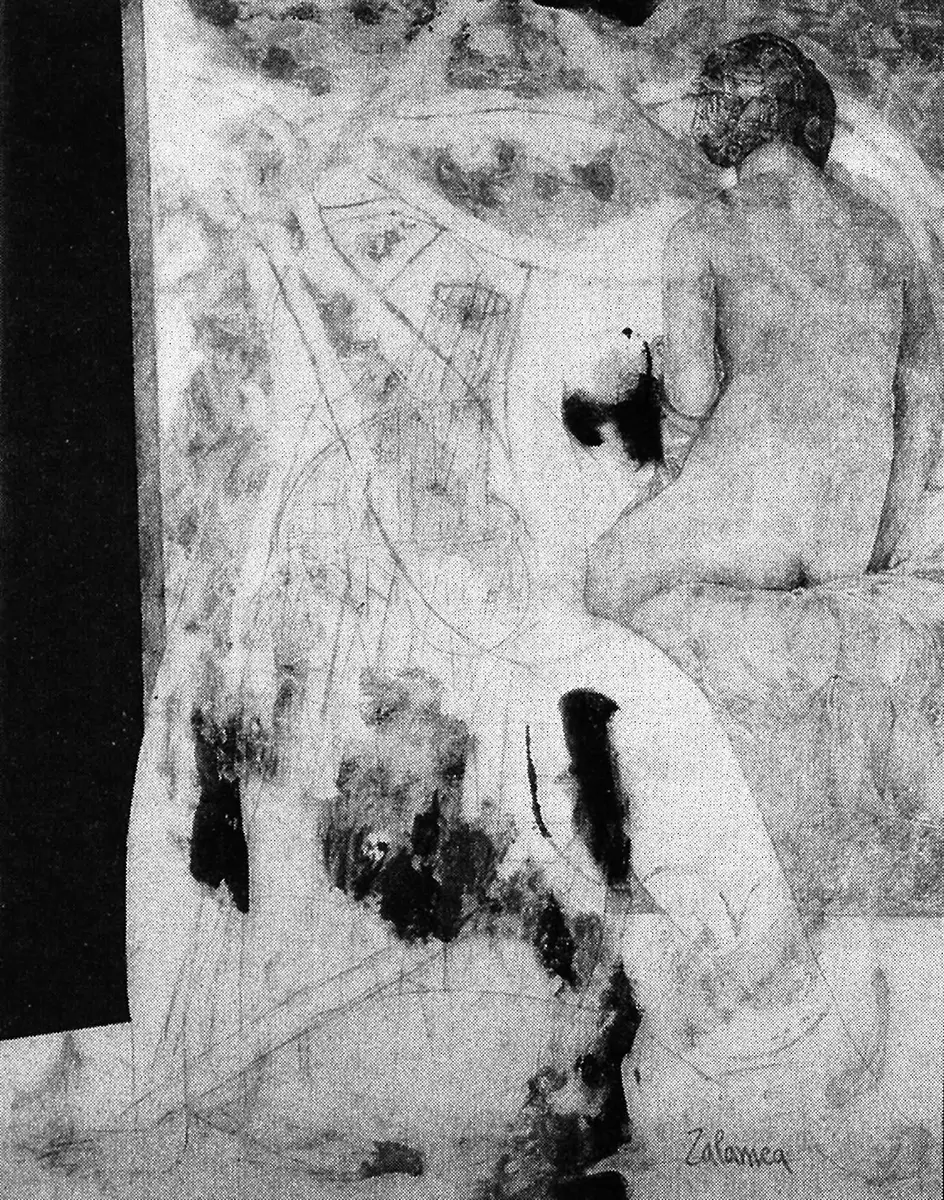
Perhaps for this reason Zalamea’s pictures never reach a final point, they never become finished and therefore always say something different. They never become monotonous. The changes from one exhibition to another may be almost imperceptible; everything might appear to be the same but there are slight modifications that can only be noticed through careful observation. Our appreciation of his work depends to a large extent on the sensibility and disposition of the spectator, who in the end is responsible for “finishing” the work, as it were. The communication between the work and the spectator is the finishing touch to each brushstroke, the extra layer of paint which seems to be missing, masking areas without touching the canvas, imprinting a concept onto the picture. Zalamea’s work is an enriching dialogue, the final and rounded result of a process of reworking and transforming what he has already done, a constant metamorphosis and process of looking back at itself. It is a serious and profound kind of decantation, a process of constant return in which the artist never loses his way, but, on the contrary, becomes more sure of himself.
Time, therefore, plays a fundamental role here, as well as conversation with others. This is what allows him to abandon work, to leave it for a while until things change around and inside us. And it is time that in the end allows work to become something else, later on, making it necessary to add a bit of color or a few more brush strokes, because, in the final analysis, nothing can truly remain unchanged.
But this constant revision does not refer just to itself, but to the history of figurative art. Representative figures and forms appear (or disappear) that have, in one way or another influenced the creative process— Matisse, Caravaggio, or Tallin, for example. The dialogue also continues through the appropriation of work by other artists from different periods. It is like copying from nature or going to a museum to reproduce pictures. But the result never becomes rigid since the formal treatment given by Zalamea is fluid and rich in expression. The painting and drawing fuse and combine with pigments as they emerge from the tube, without further mixing, and are therefore clean, bringing a breath of fresh air and calmness to contemporary painting. The lines drawn with graphite sometimes complete an unfinished detail in the painting, but the opposite may also be the case.
Zalamea cannot be pigeon-holed into any specific movement since he moves from one to the other with complete naturalness. He is constantly contradicting himself, finding pleasure and importance in the meaning of something which many others might criticize irresponsibly without understanding what it is really all about. Zalamea’s painting is both contemporary and individual. It clearly reflects his intense exploration of himself and the world around him.
The use of the same format—generally large—functions as a kind of puzzle in which each piece exists side by side with the rest, to be assembled and form part of a whole, rather than to continue in isolation. The artist also takes into account the size of the gallery. There is movement in the installation process since some pictures might be hung traditionally on the wall, whereas others simply lean against the wall, breaking the horizontal line in the gallery which can sometimes become rigid, especially when all of the works are of the same size. Gustavo Zalamea continues to be interested in installation work. Indeed, the unusual way in which his pictures are presented allows us to see the work as a whole as a kind of installation made up of a series of drawings and pictures communicating with each other and with the spectator. We come out of the exhibition feeling that we have seen some good contemporary paintings.
MARCELA MEDINA