The Emma Molina Gallery, in Monterrey, presented as its inaugural exhibition works on paper by Humberto Spíndola (Mexico City, 1950). Spíndola presented four series making up a total of 65 works. The first series consisted of figurines in confetti paper and paper māché —compositions with a strong sense of popular Mexican traditions. Second, placed on a pedestal under glass domes, were a number of little sculptures in caskets, the content and format of which evoked the oriental cultures based on the rites of contemplation. The third group was made up of the artist's most recent work, reflecting a contemporary and universal language and an economy of elements, in which the paper plays the role of the protagonist. The last group consisted of works made in collaboration with Antonieta Figueroa, of a geometrical kind, and unfinished figures done on metallic paper.
Paper-making, an ancient tradition in various cultures, is used in various ways in these works in which the bases were provided by wooden boxes, with the papers co-existing alongside certain ornamental elements like as gold leaf, oxidized metals, handmade paper, papier de Chine, and metallic paper, used to create figures ranging from kitchen utensils to a human form without any face and folded clothes.
Spíndola also presented two large-format pictures (1.74 x 2.30 meters), with equine figures —horses with Etruscan decoration in gold leaf on paper of ochre and earth tones from India. In these works, the Mexican tradition of brightly colored confetti paper gave way to an Asian sensibility, with its use of grays, whites, and ochres.
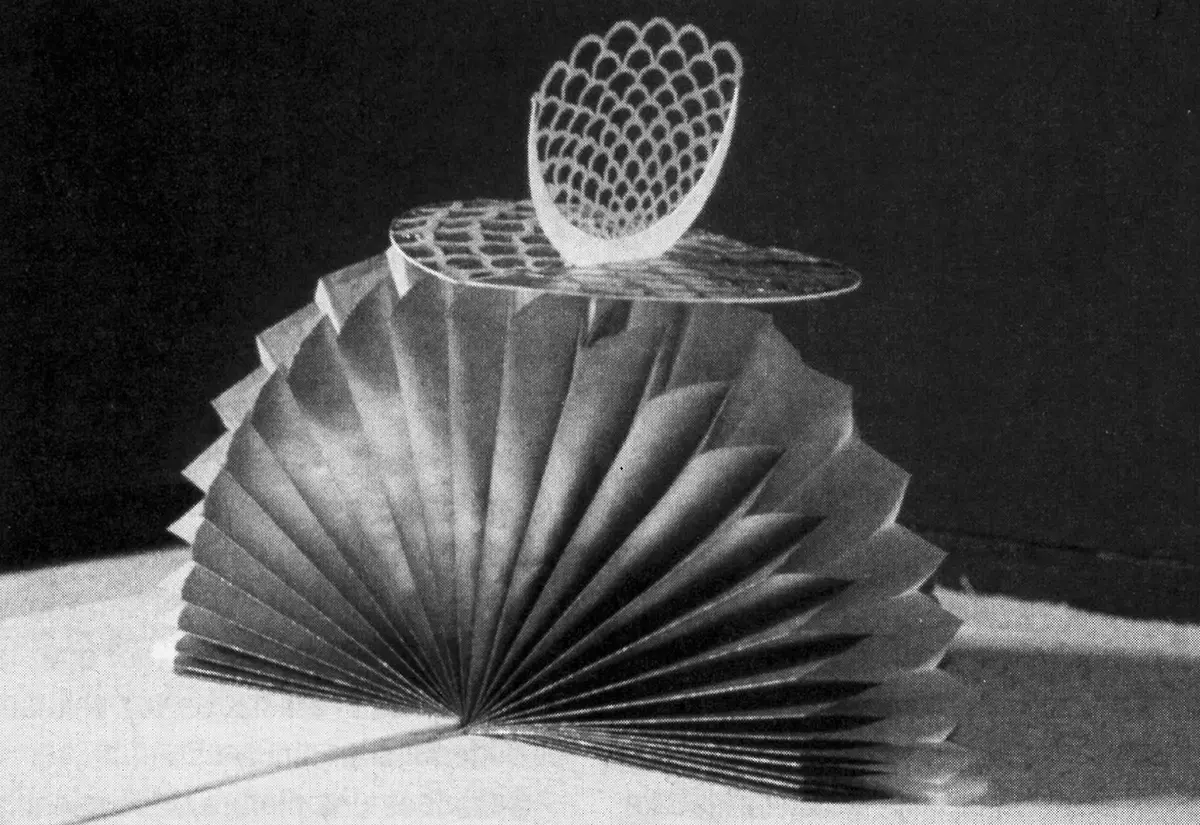
In these pictures, which do not usually exceed 50 x 30 or 40cm in size, Spíndola also makes use of Japanese papers painted with natural pigments. These books, as he calls them, or portable sculptures were presented in small cases (50 x 30 cm), which when opened, allowed delicate papers with miniature cut-outs to rise up, as if from some work of engineering, and to form elaborate and richly textured lacework, sometimes encrusted in 24-carat gold leaf, silver leaf, and natural pigment ochre shading.
In another part of the exhibition, there were seven pictures done in collaboration with Antonieta Figueroa. These pieces rework typical Mexican motifs, with bright colors, papier de Chine, and metallic papers, to form unfinished geometric figures of a silver-plated goblet, flowers, and other elements such as thorns—all evoking the idea of consecration.
The works included in this exhibition by Spíndola, who has carefully studied the popular traditions and folklore of Mexico, revealed a marked sense of evolution. The artists go through a stage clearly inspired by the Mexican traditions of colored papers, bright tones, and figures taken from the popular imagination. Later his work undergoes a transition with the horse's theme, we can see a transition toward the Asian cultures. These works incorporate fewer elements and use gold and more somber adornments. The portable sculptures also reflect a number of typically Asian characteristics.
Finally, there are his latest works, where the purification of elements almost results in the elimination of complicated adornments, and where the language becomes very contemporary, with the paper playing the main role. In these works dating from 1997, the paper, with its natural textures and reflections, creates an abstract plastic discourse.
NORMA GARZA