
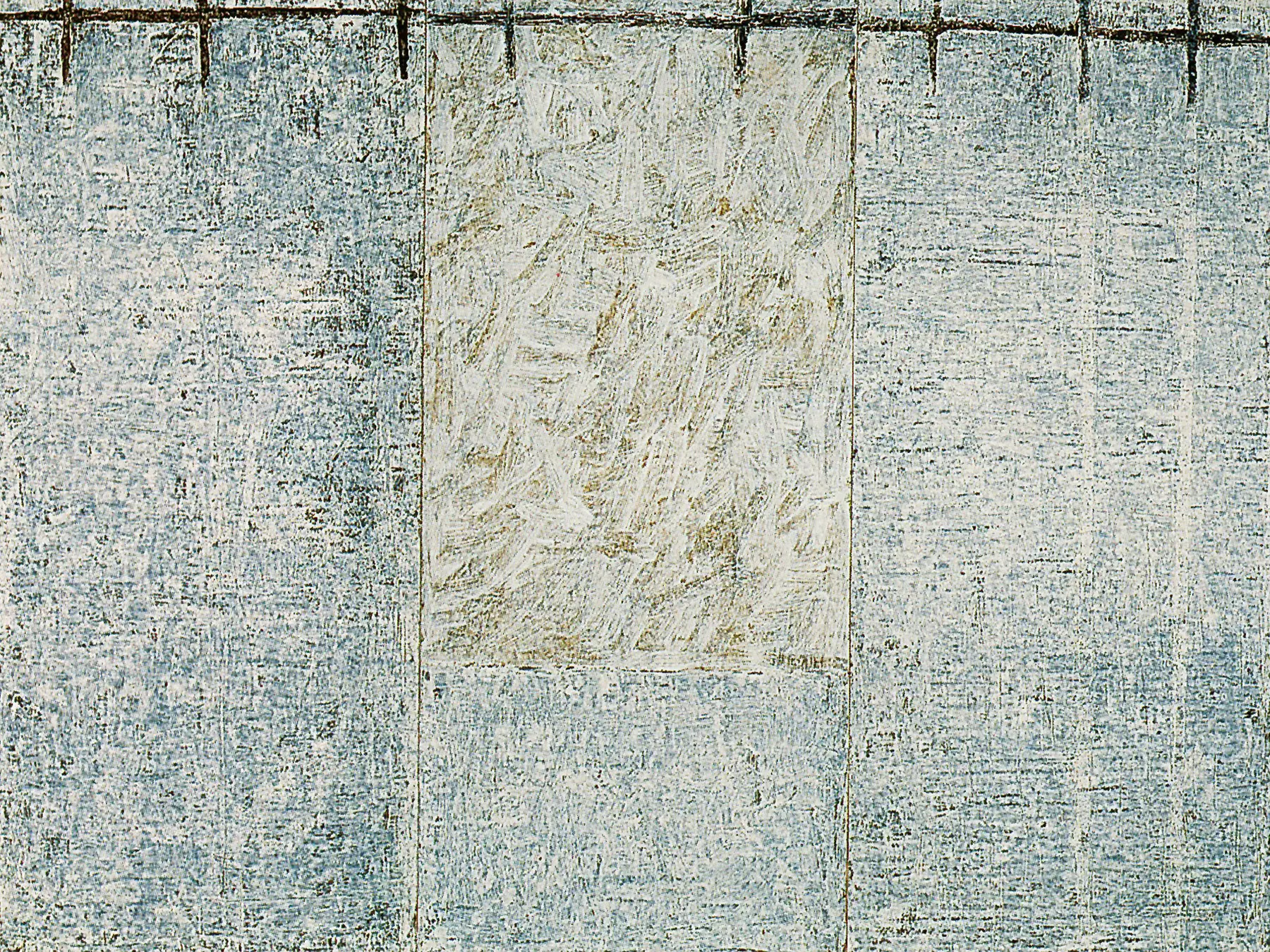
As Leo Steinberg said so beautifully, all art has to do with its past, all good art, above all, has recognizable antecedents. The painting of Jaime Franco (Cali, 1963) is a good example of this observation. Upon reviewing his canvasses, important works are recalled and these antecedents have already been noted by various writers on art.1 What is perhaps most interesting to consider now is why the artist has studied certain works and not others. To what extent does his own painting reveal its influences and, at the same time, demonstrate special creativity that stems from those sources? All that can be said in this regard is that the painter demonstrated quite early on —in his education, his temperament, and his personal tastes— an inclination toward abstract art. Given the options of his time (the eighties and nineties,) his preferences have been equally for a painting that mixes and balances the rational and the emotional as for an essentially pictorial work—work related to that which for a long time has been considered the true nature of painting. Franco commented in 1994 that "few artists are interested nowadays in true painting. Most use painting to convey intellectual concerns but that isn't painting to me. I recognize my place in the great tradition of painting, a tradition that began in the fifteenth century and which I believe has not yet died."2
It must be noted here, that the painter not only works within the tradition of modem painting begun in the Renaissance (oil on canvas) but also in the tradition of painting of the twentieth century, which, according to Alfred Barr, "breaks definitively with the transmission of real and natural appearance, which is nothing but a copy or a mere retelling of one aspect. It turns all information into an invention. The integration of spaces, colors, and forms becomes a pictorial surface, controlled and plastic."3 But the point is, if Franco's work is painting, it is beyond question that his paintings are not simply that many empty surfaces but rather, that they possess a certain density. As such, it must be understood that his paintings contain are rich in content that could have a literary, historical, or even, to a certain extent, scientific character. The allusion, of course, is to the series of his works bearing titles related to Dante's Divine Comedy, to his oils in which he alludes to Paolo Uccello's obsession of attempting to transmute all lines into one single, ideal quality,4 and to his unflagging interest in the representation of space and the latent structures of the universe according to the concepts of contemporary theoreticians. We shall return to these points later.
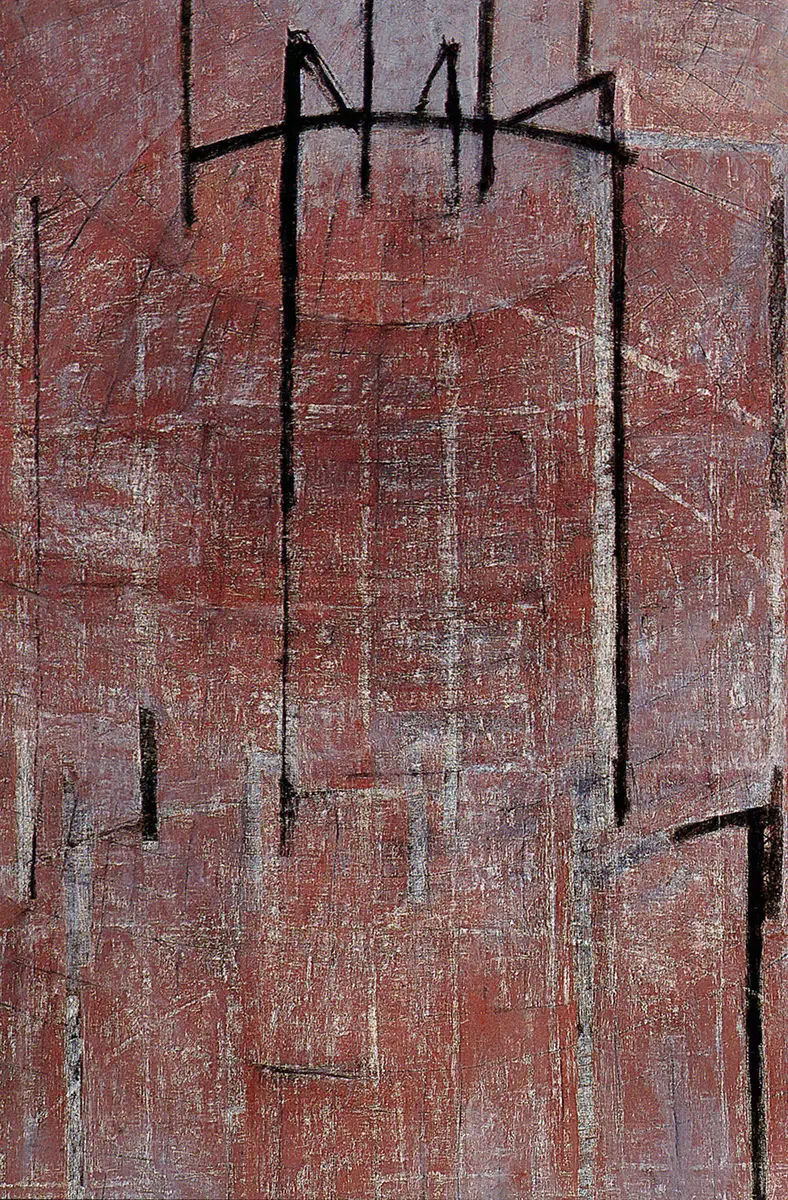
Franco says that his paintings can be seen as the remains left under the open field after the heat of a battle. The metaphor is beautiful and clear. It indicates, of course, the arduous process of work involved in each of his paintings, in which layers of paint are applied one on top of another, and thus, with each surface of color, something is drawn, is configured, is scratched, is erased, is covered over, and is begun again. This manner of creating his works is not new. It starts practically at the beginning of his career. In 1990, the Venezuelan critic Mariana Figarella, in analyzing his paintings of that moment, wrote: "The surface of the canvas... is richly worked, layer upon layer, such that it lets through or forms textures on which the entire process of creating the work is made manifest: structures, scrawlings, remains of ancient constructions, plans that startle the existence of nearly extinct colors and refer to an active interior life of the work."5
Over the course of the current decade, Franco's production has undergone a great evolution. However, upon close examination, said transformation proves to be quite coherent. To confirm this, one need only recall that the artist has in mind the lucid description by Mariana Figarella when he now speaks of his work, most likely in a subconscious form. By the end of 1997, Jose Ignacio Roca wrote: "Franco finds the 'min' to be a fortunate metaphor in understanding his own work: in a constant process of painting, erasing, revealing, and hiding, what subsists, in the end, are those elements that are the most firm. The pictorial process, like the gale winds of time, undertakes to select that which is essential."6
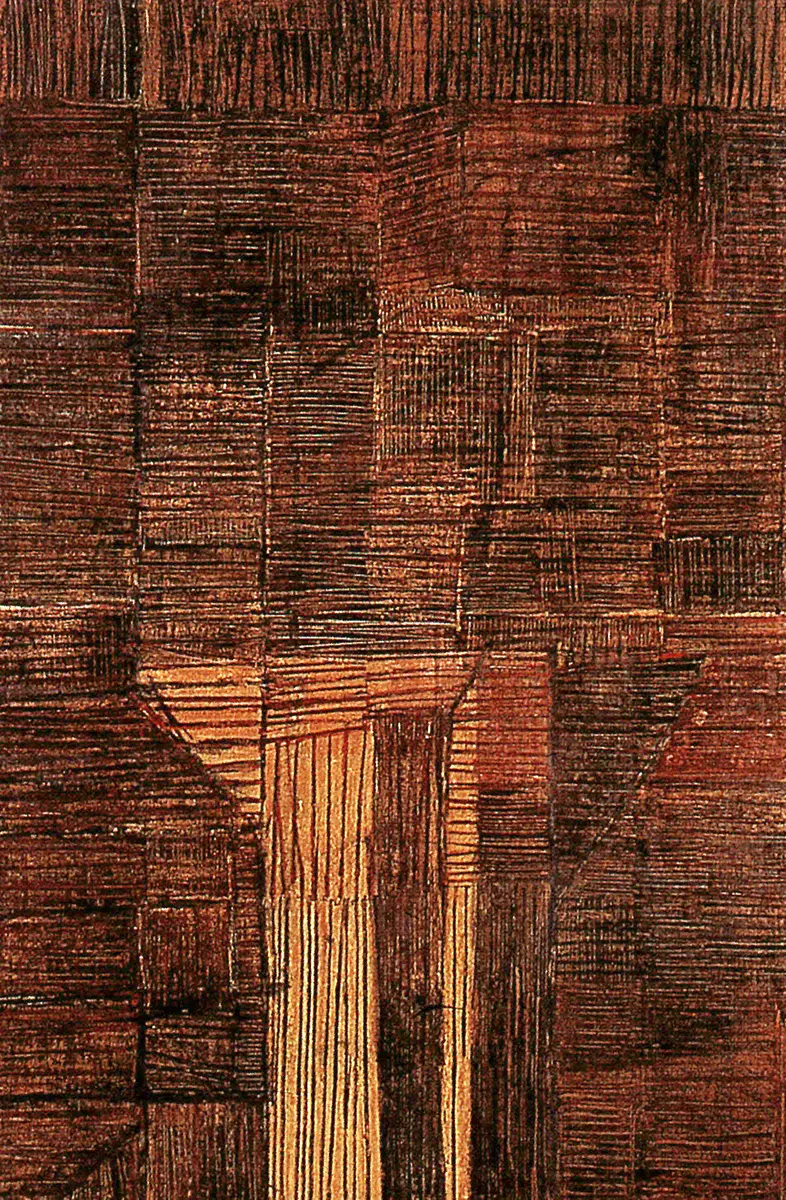
Franco's artistic career spans only ten years. It is a truly short amount of time in which the painter has produced numerous canvasses, some of them in large format. He began to draw and paint in Paris —where he lived for several years— without any formal studies in painting. He studied a bit of sculpture and some of that patient work of pulling something out of a block or molding or slowly making a form can be related to his painting: covering the canvases with one layer on top of another, as of molding something and then erasing what has been made, as if pulling something out, carving something from a mass. His first drawings were figurative: self-portraits, hands, roofs. On a trip to Colombia, he tried to draw while looking at the Pacific Ocean, and from that moment on, everything changed. His works produced nothing but horizontal lines, colors turning ash-gray. His first paintings, many of them on cardboard, were simple, made with few colors —ochres, blacks, grays— and few formal elements —squares, rectangles, crosses, and circles.
Several of these paintings come from his very small drawings done in ink, which tried to retain in instant such varied events as movement, climate, his state of mind, etc. The artist still keeps a selection of those works he considers the most significant of the ones he made in Paris. He returned to Colombia in 1987.
Very quickly, Franco began to distinguish himself by the quality of his paintings. In a short time, he advanced an oeuvre characterized by its restraint, and by constant elements such as lightly smudged surfaces, textures visible though delicate, and gray and ochre tones at times with beautiful shadings. Also notable was the evident presence of a grid that could create compositions in the fashion of walls or become so subtle as to be like the threads of a fabric, to just insinuate themselves in dots or just attain visibility at the four edges of the painting. Elegant, refined paintings —words employed here with admiration— recall the best of the informalist style, never approaching the irrational but rather, always permeated equally by an evident sense of order as of the desire to eliminate the superfluous. Oils, at times on paper, had something of an Oriental quality, that is, with a certain distance, reservation, and a lot of simplicity and meditation. These were the first years of frequent exhibitions in the Yoshii Gallery in New York, Paris, and Tokyo.
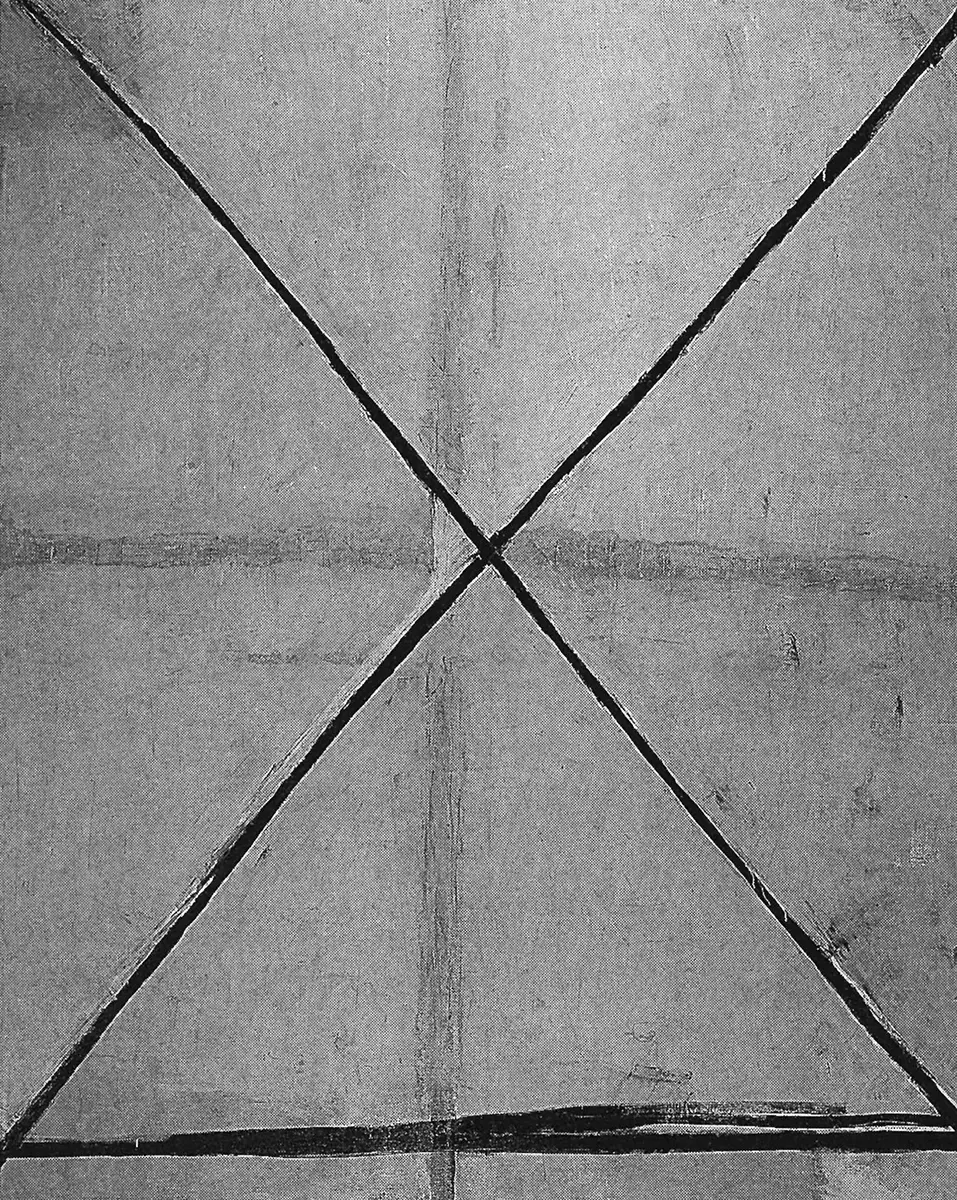
His first paintings relating to the Divine Comedy by Dante Alighieri date from 1992. These paintings distinguish themselves by the presence of curved lines, which sometimes completely obscure the grids (and other times don't), and of spirals. Franco told Charles Riley: "I feel close to Dante in the way he observed nature. He was able to see the tragedy of life but always maintained a calm attitude and never grew pessimistic. All the pathos is in his work but it is never really evident. The big questions of life are not obvious but remain hidden beneath numerous surfaces. The inferno and purgatory are both spirals. One descends, the other is a mountain and I find that in any motion and growth of the natural system one finds the spiral—from molecules to galaxies, passing through plants, animals, and humans. The curved elements of my paintings are certainly related to the forms Dante describes in his journey and my interest in color is close to the "chromatic impression " I had upon reading his complete works."7
In the Divine Comedy, Dante himself and Virgil descend through a deep hole into hell and cross the River Acheron. They then enter the infernal mansion, passing through various concentric circles in the shape of a funnel. When they arrive at the center of the earth, Satan's home, they climb over his gigantic body in the opposite direction and ascend first to purgatory, then to paradise, and finally to the empyrean. But the curves and spirals of these paintings don't only obey the travel description of the Italian poet but also relate to Franco's desire to transcend the essentially Cartesian attitude of his production at the time and to try to make a work in which the irrational is also present. We cannot forget an important aspect of the paintings related to the Divine Comedy. It is that which, according to Riley, has to do with the blurred and imprecise treatments of the lines in several of these oils, which alludes to the smoke in numerous passages by Dante.
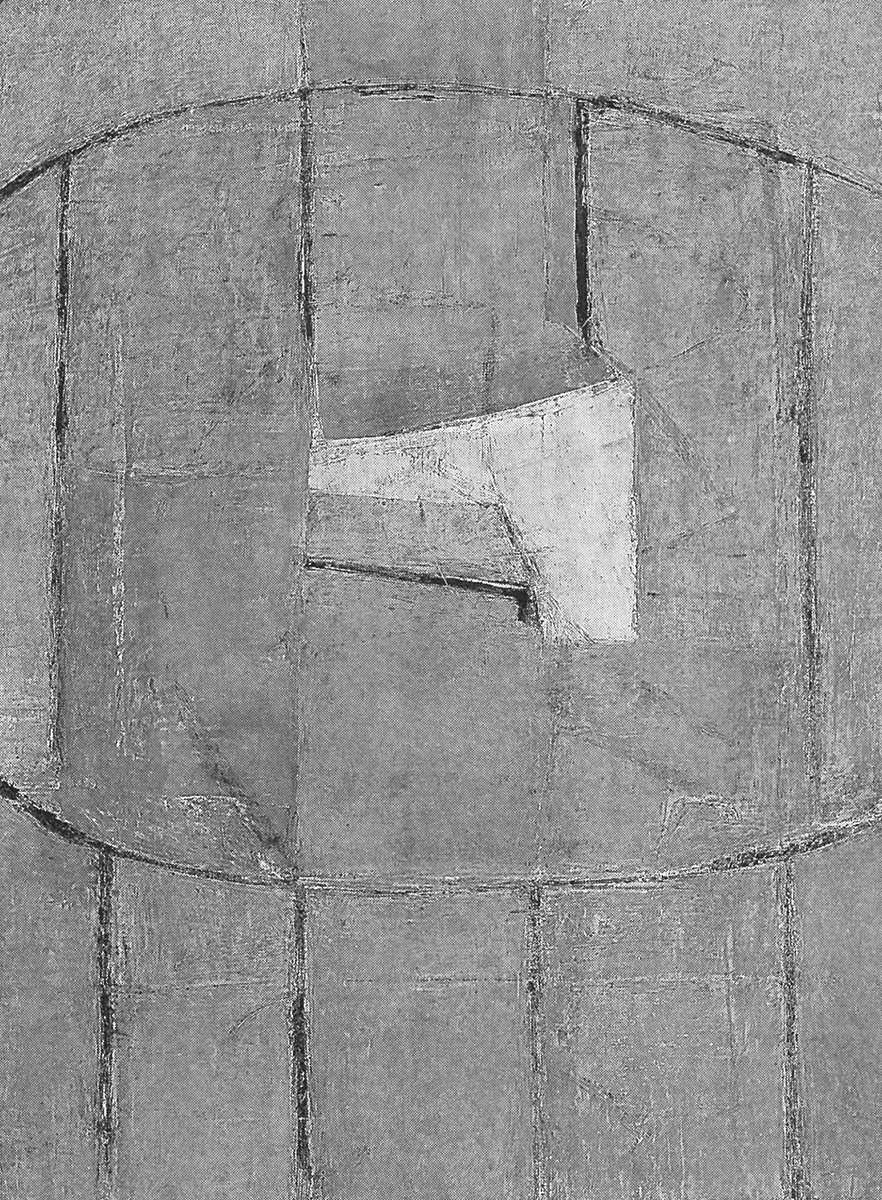
The exhibition at the beginning of 1994 at the Yoshii in New York had few paintings but large ones, indeed. In Sueño de Dante (Dante's Dream) and in Matrix (Matrix), the spirals and curves are still present. Not so in the rest: Ascension (Ascension), Sangre (Blood), and Ratio are beautiful paintings that insisted on the impeccable elaboration of monochromatic and muted surfaces covered over with fine screens and evident rubbings. Having arrived at this point of great mastery, Franco decided to change direction. He didn't know what path to follow but was aware that he needed to change. According to the artist, he personally experienced a beautiful passage from Alice in Wonderland by Lewis Carroll, where Alice asks the Cheshire Cat, " 'Could you show me where I should go from here?' 'That depends on where you wish to go,' the Cat answered. Tin not so much concerned about where... In that case, it doesn't matter which way you go, the Cat interrupted. 'As long as I get somewhere,' Alice concluded by way of explanation. 'Oh, you will always get somewhere,' said the Cat, 'if you walk long enough.' "8 And Franco began to walk along new paths without ceasing to be himself. In 1995, 1996, and 1997, the artist had solo exhibitions in Bogotá. In 1995, he exhibited in the gallery of the Museum of Modem Art and later in the El Museo Gallery.
His first show initially had small-format oils painted in blacks, ochres, yellows, grays, and pinks. These paintings revealed two important changes: they were not really abstract and several of them showed various kinds of cylindrical drawings or with some object reference the designs were deliberately childlike and almost all were surrounded by other designs that had apparently been covered over or erased. They were enchanting pieces, well resolved in his games with planes of macerated colors and hesitant lines that alluded to virtual volumes though well placed within the two-dimensionality of the canvasses. The first exhibition in the El Museo Gallery was titled Crisol (Crucible) and in the explanatory sheet, there appeared a selection from a text by Marcel Schwob, taken from his Vidas imaginarias. Franco remembers with pleasure the happy moment when he discovered in a book from the past century an account of Paolo Uccello, the great Renaissance artist, with whose obsessive work he identified. The Colombian has also been passionate about studying the infinite lines of all living beings, still or in motion, and of all things made by man, beginning with architecture and, like Uccello, who worked in the manner of the alchemists, has, according to Schwob, "poured all the forms into the crucible of forms ... to fuse them and recast them ... in order to transmute all lines into one single ideal quality... and to conceive of the universe created as it was reflected in God's eye, which sees all shapes springing from a complex center..."9 Theoilsin this exhibit included planes and lines with a few figurative and spatial references, from vessels to bells, labyrinths, domes, and arches. All of these are barely insinuated and well-arranged on the textured surfaces are now characteristic of Franco's work. The artist's final exhibit took place in the second half of 1997. There, he showed a good number of oils, some in large formats, such as Fuego (Fire), from 1996, measuring two meters high by four wide, although there were also others of smaller sizes. On this occasion, Franco's painting stemmed from a variety of realities, if we observe the titles of the paintings which always gave a precise indication. The artist is currently exhibiting numerous figures that quite surely have come from the information he has regarding the knowledge currently available of the physical world, yet he doesn't cease to state that in the end, everything comes from his imagination and certainly, from his great creative ability.
In recent years, Jaime Franco has demonstrated sufficient proof of his talent. He knows, nevertheless, that in order to move forward, one must be convinced that the world of fine arts is still richer and that to achieve a work of greater transcendence, one must work with discipline, with modesty, and without any inclination toward snobbery.
NOTES
1. Miguel González mentions Malevich, Reinhardt, and Motherwell. Charles Riley cites Matisse, Johns, Tobey, Twonbly, Marden, A. Martin, and Diebenkorn, particularly in speaking of color.
2. Charles Riley, Element of Shadows: Jaime Franco's new paintings, Yoshii Gallery, New York, 1994.
3. Alfred Barr, Jr. La definicidn del arte moderno, Alianza Forma, Madrid, 1989.
4. Marcel Schwob. "Vidas imaginarias". Revista Número, No. 15. Bogota, 1997.
5. Mariana Figarella, "Joven arte colombiano." El Nacional. Caracas, June 3.1990.
6. Josd Ignacio Roca, Jaime Franco. El Museo Gallery, Bogotá, 1997.
7. Charles Riley, Color Codes; Modern Theories of Color in Philosophy, Painting, and Architecture.
8. Lewis Carroll, Alicia en el pais de las maravillas. Editorial Alianza, Madrid. 1981.
9. Op. cit., Schwob.
GERMÁN RUBIANO CABALLERO
Associatte professor at the Instituto de Investigaciones Esteticas de la Universidad Nacional de Colombia. Founder and member of the Editorial Council of ArtNexus.