
While the painting of Lasar Segall is not always fascinating, the case of Lasar Segall is. Born (as Chaim Soutine) at the end of the last century in Lithuania, he grew up in a Jewish ghetto. Initially a painter of the typical scenes of his ghetto, at the beginning of the second decade of the century he began to participate in the Dresden Secession, and thus became an expressionist painter. He was not necessarily a major expressionist artist, but there is, as far as one can see, an unusual feature in his paintings from this period. Whereas the figures in Dresden expressionism seem to be drawn along by the dynamic currents of the world as if electrified, Segall’s perfectly cadaverous figures (yellow skin, purplish lips, and sunken eye- sockets) appear simply never to have found a way of resting in the place where they find themselves. There is a kind of cultivation of tiny, minute instability in these pictures, which is perfectly in keeping with their overriding theme: errant humanity. Errant, not passing or traveling.
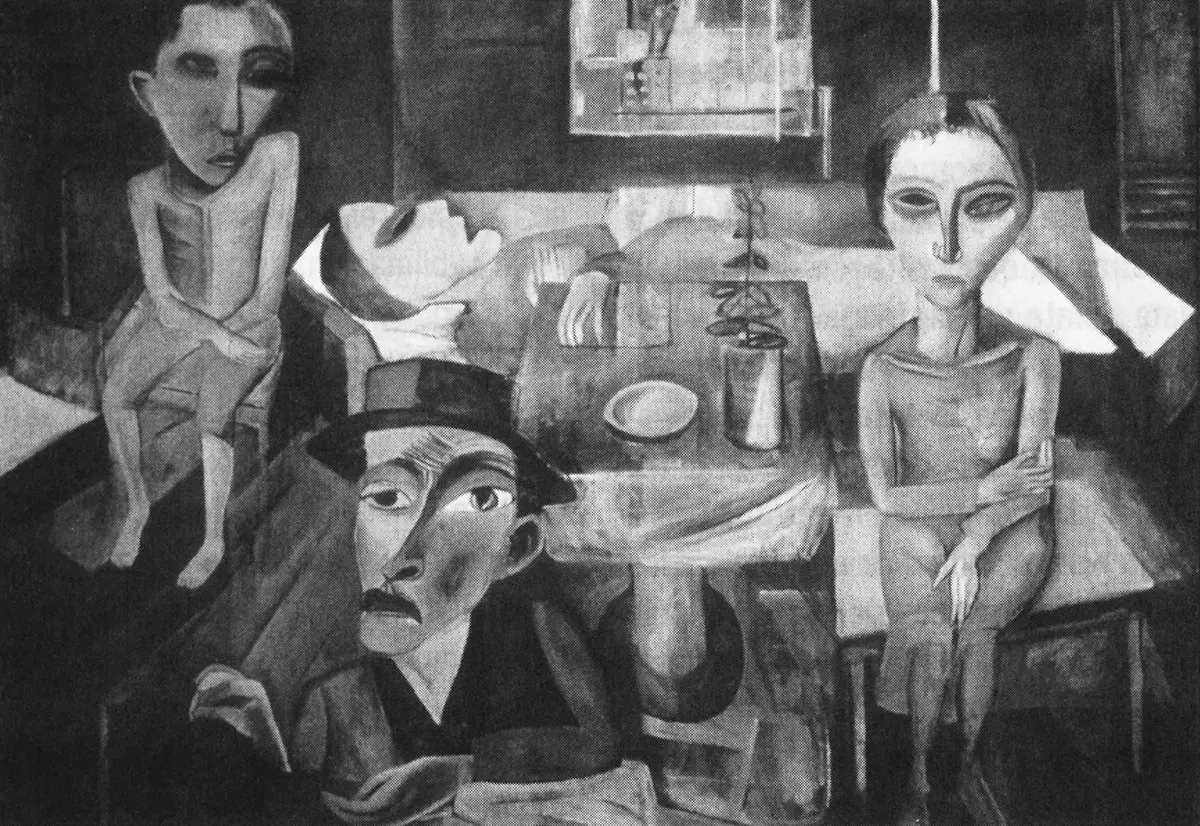
The same was true of Lasar Segall himself during these years. In 1913, he traveled for the first time to Brazil, where some of his relatives lived in São Paulo. There followed a series of trips back and forth between Germany and Brazil, until he finally decided to settle in São Paulo at the beginning of the 1920s. Segall had close links with the avant-garde movement in São Paulo, with Oswald de Andrade, Mario de Andrade and Tarsila do Amaral. His first Brazilian paintings were clearly inferior to his last European works, representations of black dancers, black Madonnas with their children, and blackheads between palm trees. They have something of the work of Tarsila, but are infinitely less unusual in their primitivism, than her pictures. But should not a Lithuanian artist trained in German expression make use of such stereotypes in his endeavor to paint something like the great unity between a richly fertile land and its primitive humanity? These pictures were indeed stereotypes.
Segall himself must have realized that, and shortly afterward he discovered a subject much more in keeping with his talents: low-life genre scenes, and more particularly, scenes from a neighborhood in Rio de Janeiro, Mangue. This is the heart of Segall's work and the achievement for which he has been generally remembered. The paintings in question are not equal, as scenes of popular life, to the best of what was being produced at the time in the continent (mainly the work of Antonio Berni), but they do have a rare and unusual power. The figures (prostitutes, gamblers, passers-by) appear, in streets with crumbling houses, as if they want to remain anonymous, appearing between window blinds or slipping away behind a door. There is an aloof and clandestine air about these scenes, a suggestive power that became lost to the artist after his first expressionist works, and which he was soon to lose again. After the Mangue pictures, Segall’s production once again became rather vague (and sometimes even melodramatic).
This exhibition at the Jewish Museum was probably the first opportunity to see a large selection of Segall's works in New York. As such, it offered the chance to experience a really valuable vision. The presentation of the work emphasized the degree to which the artist's career reflected the avatars of the Jewish communities during this century. The selection of pictures may have been hampered by the circumstances. There was, surprisingly, almost nothing from the artist's best work, the Mangue period (only a few drawings and small paintings). This absence was perhaps compensated by the inclusion of work, both Lithuanian and German, that is rarely reproduced. It was difficult not to come out of the exhibition without having even greater curiosity about the Lithuanian and Brazilian artists.
REINALDO LADDAGA