With Marta María Pérez Bravo's increased exposure in the United States, one finds her work frequently being compared to that of Cindy Sherman. Despite the fact that both women make photographs within which they are present (albeit transformed), this is in many ways a limited and not entirely appropriate comparison. A somewhat more analogous body of work would be Ana Mendieta's Silhouettes, such as her Tree of Life series. While Mendieta used the photograph in a more straightforward, documentary manner, both she and Pérez Bravo have engaged in the art that employs their bodies as the mediums by which to embody or communicate various principles of Santer'a.
Pérez Bravo's latest exhibition was entitled Echú, which invokes the Santer’a deity that corresponds to Destiny, As Destiny is manifest in many guises and qualities, so is Pérez Bravo in these photographs. Many of these pictures have a monumental quality to them despite their often intimate scale and soft quality. Using an almost grainy, low-contrast aesthetic, Perez Bravo evokes dream-like forms that appear as if they will dissipate at any moment. The figure is always present in the center of the picture field, and like a cubist painting or early photographic portrait, the image fades to nothingness around the edges. The lack of any concrete setting or temporal referent creates a timeless and incorporeal quality that befits the deities and abstract personifications she is seeking to conjure.
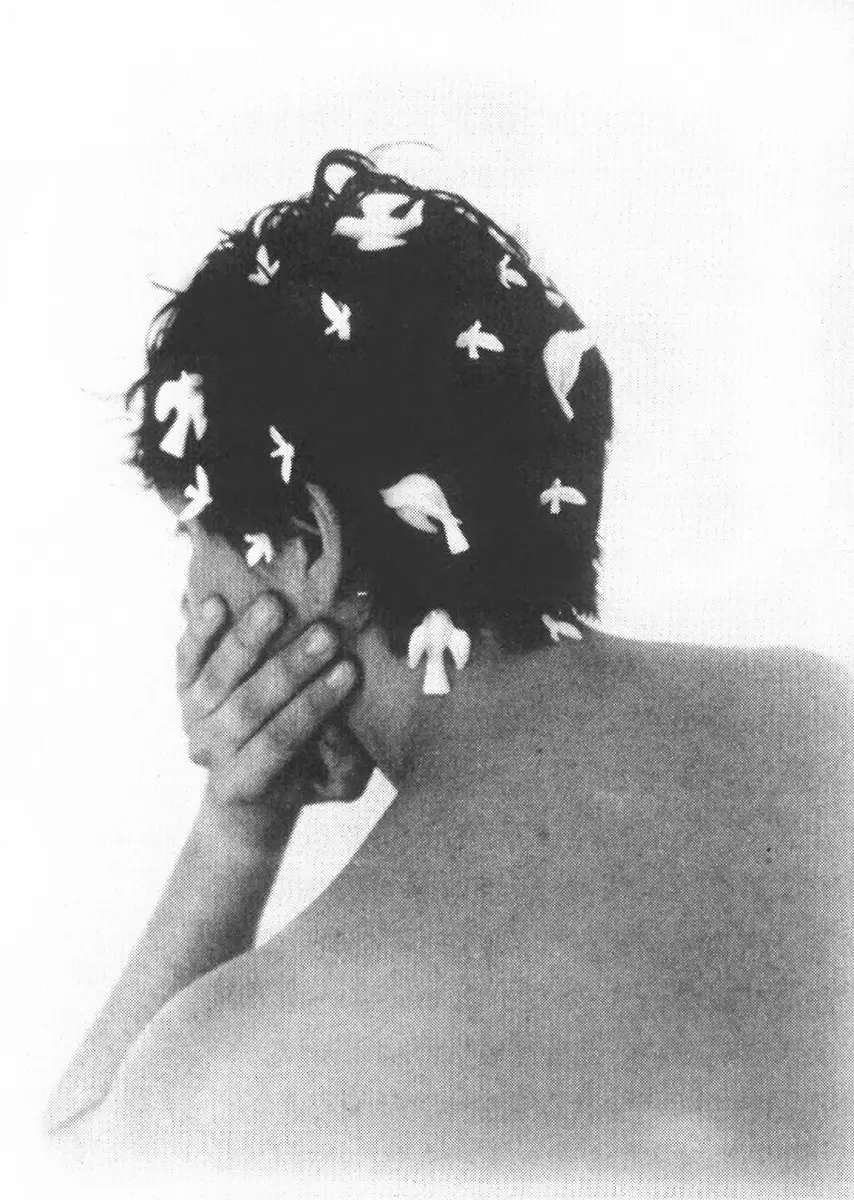
Despite the dematerialization of the forms, however, there is a frank concreteness to these images that helps to ground and actualize them. When Pérez Bravo shows herself with small white doves scattered throughout her hair, the poetic quality of the image is in some way undercut by the inescapable artificiality of the birds. Likewise, the crowns, fetishes, and other altar offerings adorn her body and fill these pictures; they suggest something otherworldly and glorious while remaining hopelessly mundane. This handmade or folkish quality of the objects reminds us that Perez Bravo is invoking a religion of everyday people, and for all their esoteric qualities these photographs retain their earthy roots.
With Echú, Pérez Bravo offers a body of work that has neither the calculated irony of a Cindy Sherman nor the raw confrontationality of an Ana Mendieta. Nevertheless, these works manage to retain much of the strength of her earlier projects, such as her Conceive series. At the same time, it is evident that if she is not careful her art could get lost in the ritual ether that it has brought forth.
JOHN ANGELINE